









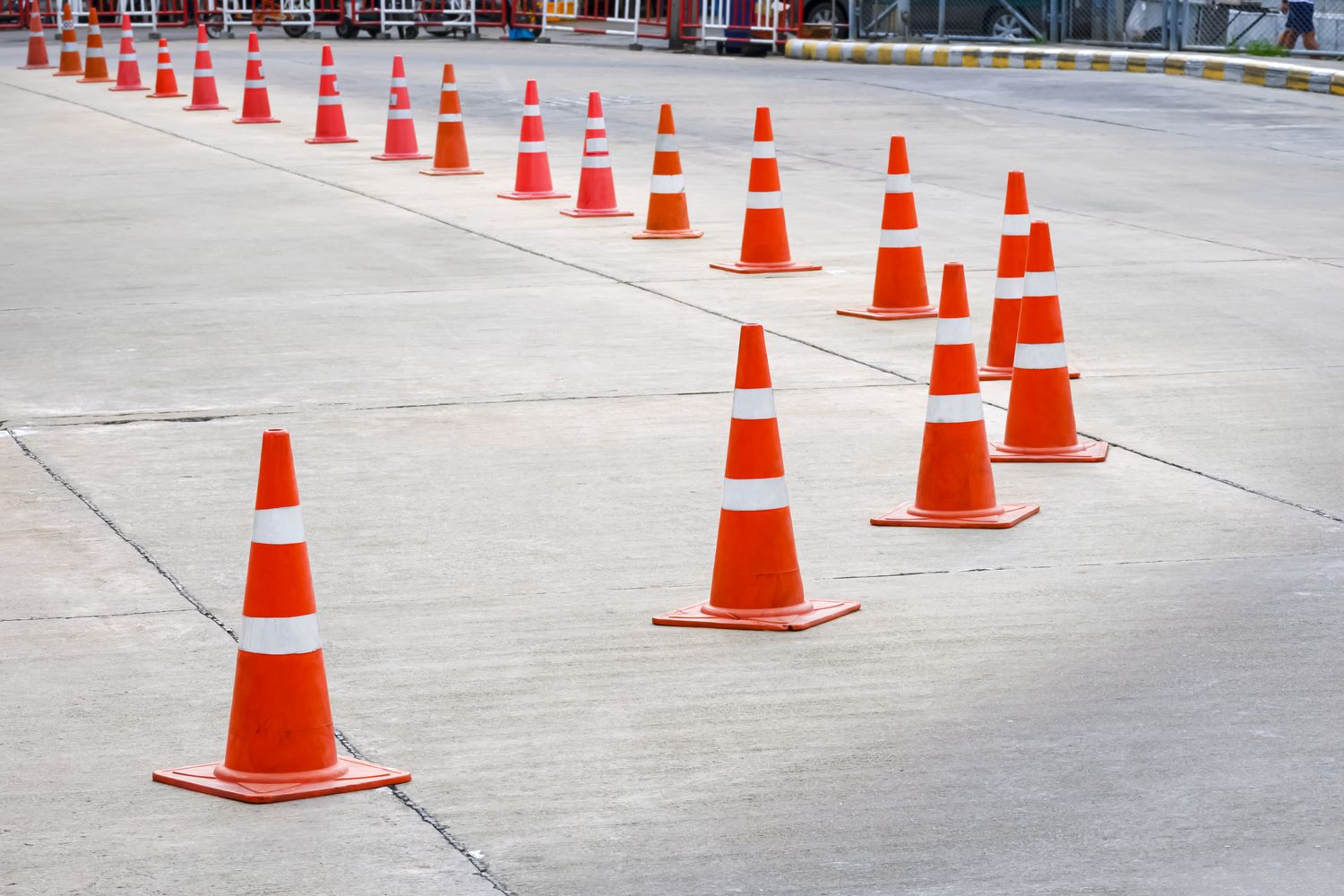
Traffic cones in a logistics center area mark zones that need to be temporarily closed to traffic. They block off a section of the yard for surface repairs, guide trucks along a detour, protect freshly painted lines, and cordon off accident sites. The choice of model depends primarily on where the cone will be placed and how heavy the traffic is in that area.
What are cones used for in the yard and on internal roads?
In the maneuvering yard at a warehouse, it is sometimes necessary to close off part of the area to traffic. Reasons include damaged surfaces, vehicle leaks, parking lot reconstruction, or the renewal of horizontal markings. Cones allow such areas to be cordoned off in a few minutes without the need for tools.
On internal roads, traffic organization is decided by the owner or facility manager. It is good practice to have a set of cones on-site before the first incident occurs.
What cone height is suitable for a logistics area?
The taller the cone, the further away a driver can see it. In parking lots, maneuvering yards, and warehouses, 30 or 50 cm high cones are sufficient. They are lightweight, easy to move to another location, and a wide base keeps them upright. The 30 cm model is suitable for marking parking spaces, cleaning work, and securing freshly painted lines.
In areas with heavy traffic, such as the main access road to a warehouse, it is better to use taller cones with reflective strips. Models with heights of 75 and 100 cm fall into this category.
Weight and base for heavy vehicle traffic
A passing truck creates a gust of wind that can move or tip over a light cone. In an open yard, wind is also a factor. Stability is provided by a wide base.
The differences between models are significant. A 30 cm high cone weighs about 1 kg and has a 24 x 24 cm base. A 50 cm Melba cone weighs 3.6 kg with a 29.5 x 29.5 cm base, and a 75 cm Melba cone weighs 5 kg with a 37.5 x 37.5 cm base.
Will the cone withstand being run over?
A cone placed near the driving path can easily end up under a wheel, for example, when a driver is reversing a trailer to a ramp. Traffic cones made of flexible material deform when run over and return to their original shape. Melba models are made of PVC with the addition of recycled materials, giving them high mechanical resistance.
Visibility of cones after dark
After dark, the visibility of a cone is determined by reflective strips that reflect headlights. Melba cones have white-red reflective strips, while the 50 cm PVC model has white strips applied with abrasion-resistant paint. The material is UV-resistant.
For longer cordoned-off areas, the density of the row also matters. If cones are spaced too far apart, the driver will perceive them as individual obstacles rather than a line to follow.
Cone or permanent protection?
A cone is used for temporary protection. If the same part of the yard needs to be cordoned off every week, a permanent solution may be better. Bollards close off passages and protect pedestrian zones from vehicle entry, while guards protect building corners and columns from impact. Cones are then left for tasks that change from day to day.
Where to buy traffic cones for a logistics company?
A large area requires a set of cones, and damaged or lost items need to be replaced over time. It is more convenient to do this with a single supplier where the same models are available for subsequent orders.
One such place is DROG-ZNAK, a manufacturer of road markings and traffic safety equipment with its own production facility. The znakidrogowe24.pl store offers traffic cones in heights of 30, 50, 75, and 100 cm. In addition to cones, the store also offers bollards, guards, road barriers, and signs, so temporary and permanent site protection can be ordered in one place. In Warsaw, prepaid orders can be picked up in person, and if necessary, the company’s employees can install the signage directly on-site.