









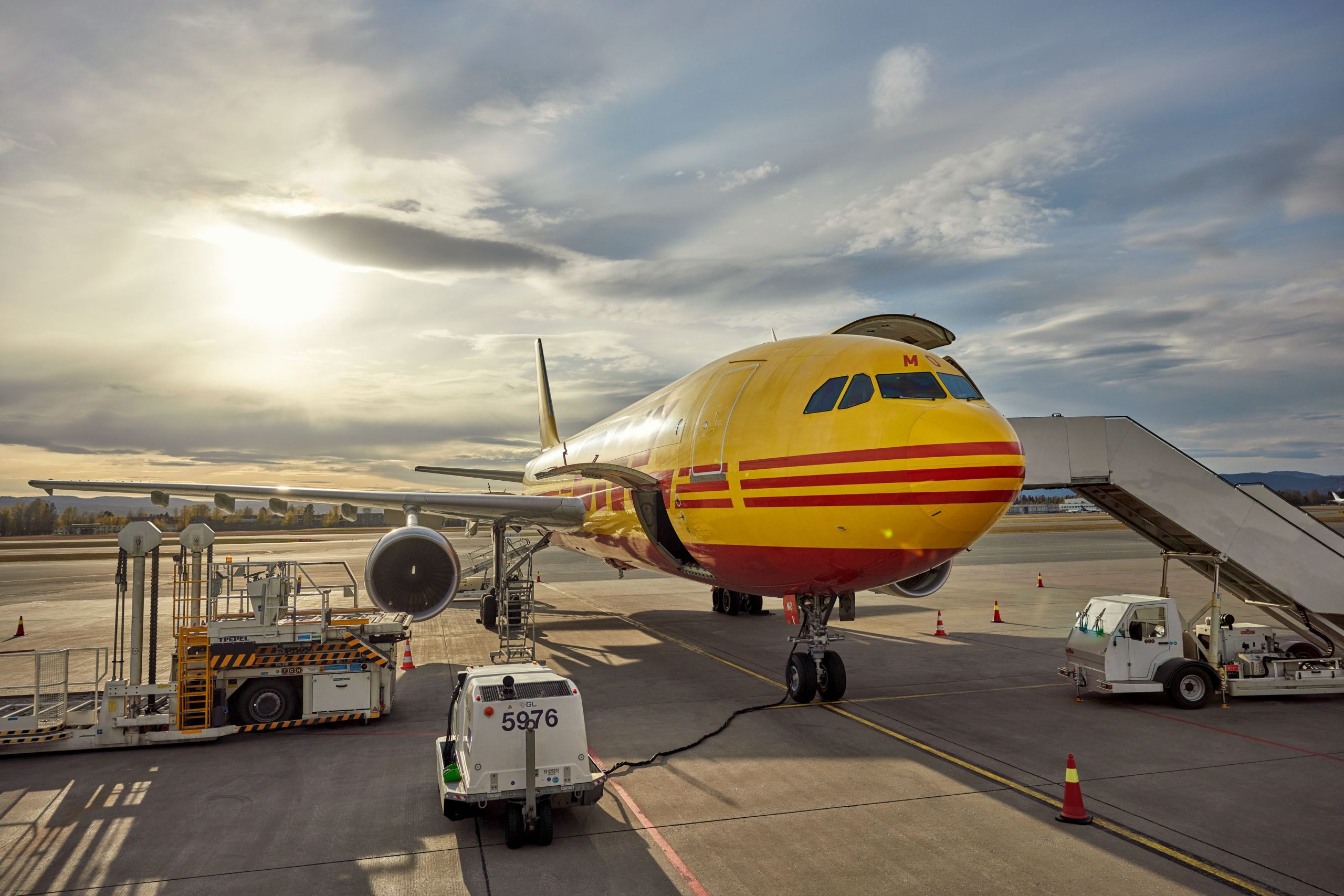
Polish exports are accelerating – companies are competing more actively in foreign markets, and along with them, the logistics that enable fast reach to customers and partners around the world are changing. DHL Express, which has been operating in Poland for 35 years, handled over 10 million export and import shipments in 2025, and between 2019 and 2025, the weight of air shipments handled by the company increased by 42 percent[1]. Today, the company is developing automation, solutions using artificial intelligence, low-emission transport, and further investments in the Polish network.
When DHL Express began operations in Poland in 1991, the value of Polish goods exports was 14.9 billion dollars[2]. In 2025, it was already 414.4 billion dollars – nominally almost 28 times more[3]. And Polish companies are not slowing down: in the first half of 2026, exports grew by another 4.6 percent compared to the previous year[4].
Over 35 years, not only the number of shipments has changed. Three decades ago, selling abroad was a much greater challenge for a small Polish company. Today, a manufacturer, clothing brand, or online store can look for customers in the United States, Great Britain, or Asia without building their own logistics infrastructure in each of these markets. In 2025, 84 percent of the company’s active international customers used DHL Express export services, and the number of export shipments sent from Poland amounted to approximately 5.0 million[5]. This shows how important operations outside of Poland are for the company’s customers today.
However, overcoming distance is only part of the task. Trading outside the European Union means customs clearance, correct commodity codes, documentation, as well as duties and taxes. After Brexit, these obligations also covered trade with Great Britain. DHL Express supports customers with customs formalities and moves some processes to digital tools. In MyGTS, artificial intelligence helps, among other things, to select the product tariff code, and the system allows checking estimated duties and taxes even before sending the shipment.
There are also shipments where time has a completely different meaning. An urgent component for a production plant, a part for an airplane, or biological material cannot simply wait for the next standard delivery. Often in such situations, downtime on the production line means large financial losses for the company. That is why DHL Express is developing solutions for urgent and non-standard transport, including loads weighing up to 3 tons.
More shipments do not have to mean proportionally higher emissions
The development of trade also means greater responsibility for the environmental impact of transport. The change at DHL Express therefore includes not only speed and automation but also the way shipments are transported. The company is electrifying its courier fleet and offers GoGreen Plus – a solution using sustainable aviation fuel (SAF). According to DHL, the use of such fuel can reduce greenhouse gas emissions in the fuel life cycle by approximately 80 percent compared to traditional aviation fuel.
Another change will be visible at Katowice Airport. DHL Express is planning a new operations center with a cargo terminal there, which is scheduled to begin operations in 2029. The investment is being built during a time of rapid growth in freight transport in Pyrzowice – in the first half of 2026, the airport handled over 28,000 tons of cargo, 29 percent more than a year earlier[6]. DHL Express is the longest-operating courier operator at Katowice Airport, and its share of the local cargo market exceeds 30 percent[7].
Technology changes logistics, but its foundation remains people
The change over the last 35 years is most visible in technology. Documents filled out by hand have been replaced by digital systems, a shipment can be tracked at almost every stage of its journey, and artificial intelligence now helps with formalities related to international trade.
But behind each of these processes, there are still people. The Polish DHL Express team includes people who have been associated with the company for many years, including from the very beginning of its existence. Employees take advantage of development programs but also engage socially, including through local volunteer activities.
Over these three decades, almost everything has changed: the scale of Polish exports, technologies, customer expectations, and the pace at which business operates. Once, the challenge was simply sending a shipment abroad; today, a Polish company can win a customer thousands of kilometers from its headquarters and expects logistics to be as simple as domestic sales. Our task is to shorten this distance – through technology, a network of connections, and the knowledge of our employees, because even with increasing automation, it is they who take care of the shipments of thousands of Polish companies every day.
– says Tomasz Buraś, CEO of DHL Express Poland.
For companies operating in international markets, efficient logistics is increasingly becoming part of the product itself – alongside its quality, price, or customer service. It determines whether a Polish manufacturer can reliably promise a delivery date to a recipient abroad, react quickly to an unplanned situation, or enter another market without building its own infrastructure there. Therefore, the next challenge for DHL Express is no longer just shortening the distance between countries, but making it as imperceptible as possible for entrepreneurs and their customers.
[1] DHL Express internal data.
[2] Poland 1989–2014
[3] Statistics Poland / Thematic areas / Prices. Trade / Trade / Border traffic and flows of goods and services at the external border of the European Union in Poland in 2013.
[4] Socio-economic situation of the country – Foreign trade August 25, 2026.
[5] DHL Express internal data.
6] https://www.katowice-airport.com/pl/nasze-lotnisko/aktualnosci/296
[7] https://www.katowice-airport.com/pl/nasze-lotnisko/aktualnosci/288
Source: DHL Express (Poland) Sp. z o.o.