










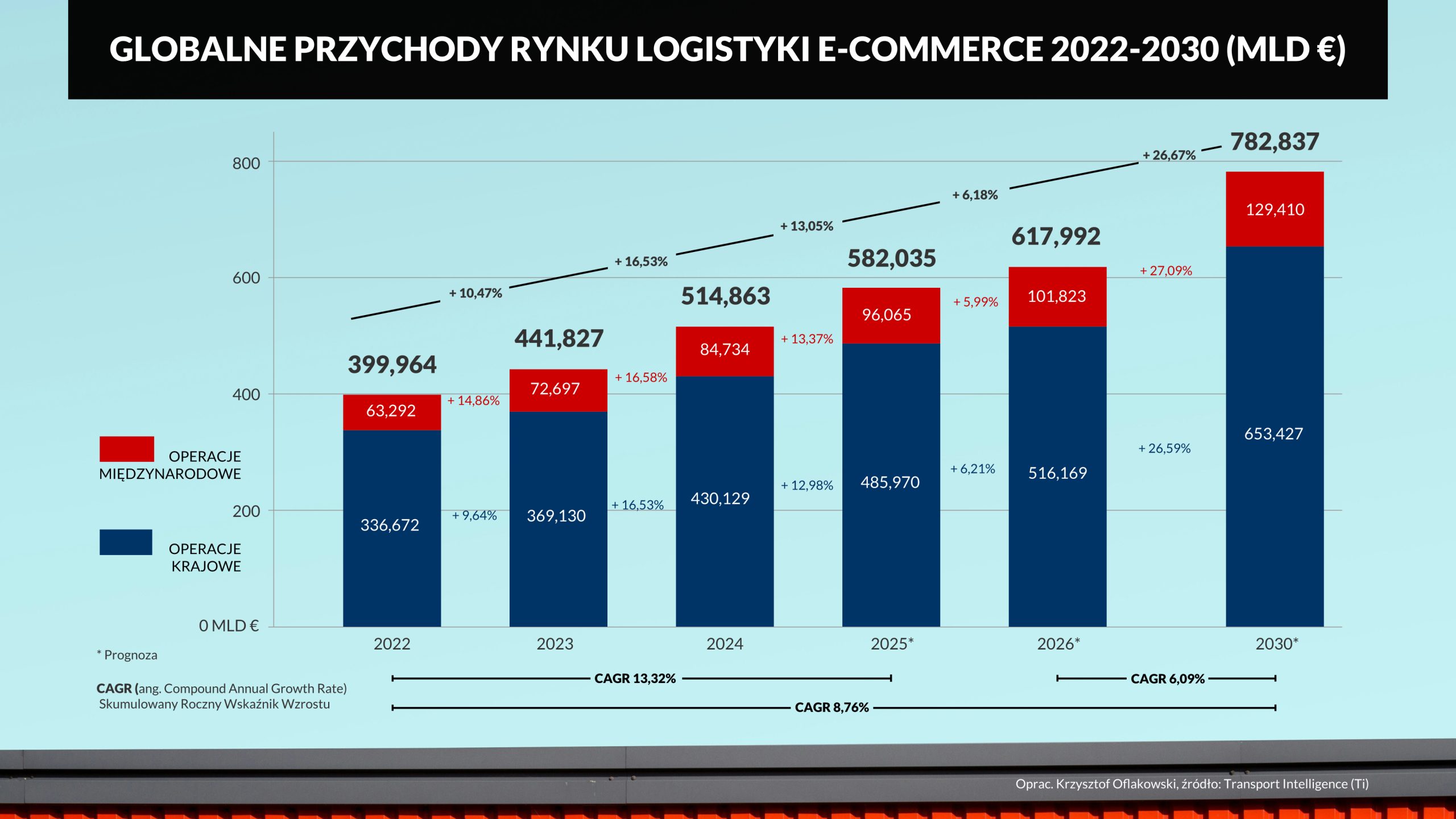
The logistics market serving the e-commerce sector is facing a slowdown in growth, but by 2030, sector revenues will still increase by nearly 27% with a compound annual growth rate (CAGR) of approximately 6.1%. This is lower than in previous years, and the predicted stabilization will be driven primarily by a cooling of momentum in the online retail market, both domestic and international, alongside the global trend of moving away from de minimis exemptions.
The e-commerce logistics market in 2022-2025
In recent years, neither global crises nor geopolitical turmoil have stopped the logistics market serving e-commerce from generating growth reaching double digits annually. The biggest catalyst of the last decade was, of course, the pandemic, but even after it ended, the sector could count on decent momentum in both domestic and international purchase handling. According to this year’s Transport Intelligence report, the global market for domestic e-commerce logistics operations grew from 336.7 billion euros in 2022 to 486 billion in 2025, an increase of over 44.3%, with a CAGR of 13.01%.
It was even better for logistics serving cross-border e-commerce, where revenues increased from 63.3 billion euros to 96.1 billion euros between 2022 and 2025, i.e., by over 51.8% (CAGR 14.92%). Strong growth in both branches of the sector brought the market value to nearly 582.1 billion euros in 2025, which means an increase of just over 13% compared to 2024. In the 582 billion euro threshold crossed last year, domestic services accounted for approximately 83.5% of the market value. The rest was generated by cross-border operations.
Forecasts for e-commerce logistics for 2026
This year, global e-commerce logistics revenues will grow to nearly 618 billion euros, representing an increase of almost 6.2%. Domestic shipment handling will grow by over 6.21% (to 516.17 billion euros), while logistics services in cross-border e-commerce will gain almost 6% and exceed the 101 billion euro mark.
The current year will simultaneously initiate a period of stabilization in which annual momentum will not exceed 10%. According to current estimates, by the end of the decade, e-commerce logistics will increase revenues to over 782.8 billion euros, which means a cumulative average growth of 6.09% in 2026-2030. During this time, the entire sector will grow by 26.67%. For comparison, the CAGR in 2022-2025 was 13.32%, and the market grew by 45.52%.
The beginning of the stabilization trend and de minimis
Already last year, the long-standing and exceptionally good streak of e-commerce logistics began to be affected by a customs revolution limiting the direct import of cheap online purchases to consumers in the USA. Since August 29, 2025, the de minimis exemption for shipments worth no more than $800 no longer applies in that market. This year, the European Union also joined in cutting customs privileges, eliminating a similar exemption on July 1 for shipments worth up to 150 euros.
The introduction of restrictions on e-commerce imports contributes to lowering the growth rate of the logistics sector working for e-retail. However, for the market as a whole, this impact is not overly significant, as according to Ti data, handling cross-border online purchases accounted for only 15-16% of industry revenues in recent years. Nevertheless, the consequences of the changes are noticeable in both current and medium-term forecasts.
It is worth emphasizing that attempts to curb the influx of cheap online purchases, primarily from China, do not only concern the USA and the EU. This phenomenon is global, and various types of de minimis exemptions for e-commerce have been withdrawn in Vietnam, Thailand, and Turkey. Together with the EU and the USA, these are only 5 regulatory jurisdictions, but on the other hand, they represent as many as 31 countries that are attractive sales markets. Furthermore, efforts to reduce cheap e-commerce imports are progressing in countries such as Mexico, Israel, Colombia, New Zealand, the UK, and Japan.
The customs revolution is most felt by cross-border e-commerce logistics
After what happened in the USA, it is clear that the end of de minimis generates immediate consequences primarily for cross-border order fulfillment. This is confirmed by data from the US Customs and Border Protection (CBP). At the end of 2025, the total volume of imported shipments worth up to $800 there fell to 942.5 million from 1.36 billion units in 2024. Their value also decreased from $64.6 billion to $48.1 billion. This was accompanied by a clear slump in the number of bills of lading (BOL) in individual modes of transport. In air freight, there was a decline from 1.1 billion to 794.8 million, and in road transport from 174.2 million to 141.6 million. In rail, the number of bills of lading shrank from 25,000 to 5,000. The only mode of transport that gained from the changes was sea freight, which recorded an increase in bills of lading from 3.7 million to 5.9 million. This is simultaneously a confirmation of the ongoing evolution in the method of delivery and a return to the traditional model of import and distribution from local warehouses.
Similar processes are already taking place in the EU
As in the case of the USA, the first victim of the elimination of de minimis in the EU is air cargo. According to data published in the last days of July by World ACD, after the regulations came into force, there was a sharp decline in air transport from Hong Kong to Europe. Between July 13 and 19, tonnage decreased by 24% year-on-year, marking the fifth consecutive week of declines. An analysis based on over 0.5 million transactions also showed that in weeks 26 to 29, tonnage shrank by an average of 18% year-on-year. In the 29th week, traffic from mainland China also noticeably decreased (by 10% year-on-year), and total transport from Hong Kong and China plummeted by 11% year-on-year over four weeks.
According to World ACD, the declines are a direct result of the elimination of de minimis and affect not only China and Hong Kong but also other countries in the region. In mid-July, tonnage from Vietnam and Thailand decreased year-on-year by 9% and 11% respectively, and from the entire Asia-Pacific region by 13%.
Changes in European logistics have been visible for months
By the end of the year, we will likely observe a decline in the volume of imported e-commerce shipments worth up to 150 euros, but it is too early to assess the scale, as after the initial shock, there may be a partial recovery in demand, especially in the last quarter. This, in turn, will translate into results in the logistics sector serving e-retail. Lower interest in direct cross-border purchases, especially from Asia, was indicated by both our published analyses and what was happening in the logistics market in the few months preceding the change in customs regulations. Research by ID Logistics conducted among consumers using foreign platforms clearly showed that Poles are extremely price-sensitive, and for 90% of buyers, the most important factor is precisely the lower price of products. Far behind it were other parameters, such as available promotions and a wider assortment (41% each). Moreover, as many as 25% of respondents declared that they would order more often from warehouses located in Poland or another EU country in order to avoid additional customs fees, says Marek Kaniera, E-commerce Operations Director at ID Logistics Poland, which provides comprehensive logistics and transport solutions, e-commerce handling, and supply chain management.
It is precisely the consolidation of inventory and local distribution aimed at reducing costs that are key, both for clients, the logistics sector, and the platforms themselves. Sellers from Asia were fully aware of the coming changes and had already begun to modify their existing business model. On one hand, they were building their own logistics capabilities in Europe, which is visible in the warehouse market, and on the other, they were expanding cooperation with operators specialized in handling domestic e-commerce. Cross-border e-commerce from Asia will not disappear, but domestic markets will take over part of the existing cross-border volumes, repeating the scenario we already observed in the USA. Sea container transport will benefit from this, but so will warehouses and contract logistics. Incidentally, this will lead to intensified competition among players with the largest operational and technological background. The rivalry for additional volumes will not only concern distribution capabilities but entire logistics processes, starting from customs agent services to returns handling. Building an advantage at this stage will be extremely important in the medium and long term, especially since, apart from isolated cases, the general momentum in e-commerce is forecast to slow down in Europe in the coming years as well. Taking into account the growth prospects for the logistics market, the slowdown in the online retail sector is a factor requiring much more attention than the mere elimination of de minimis, adds Marek Kaniera from ID Logistics.
Global slowdown in e-commerce
The upcoming slowdown in growth momentum in online retail is indicated by ECDB data, according to which between 2025 and 2030, the cumulative average annual growth in global e-commerce will reach approximately 8%. For comparison, in 2017-2024, the CAGR was 14%. In 2025 alone, the market grew by 9.8% year-on-year, while the current year is expected to bring revenue growth of 8.6%. Although this is the beginning of a global stabilization trend, there is certainly no talk of the sector shrinking. Moreover, in 2026, the market value will exceed the $5.3 trillion barrier to reach $7.14 trillion in 2030. What is important from the point of view of the logistics sector is the fact that large platforms operating in the marketplace model are increasingly strengthening their position in the market. This year, they will account for 87% of revenues generated in the B2C model, which means an increase of 1 percentage point.
Uneven growth in the market
Among the regions with the greatest growth potential in 2026, Latin America comes to the fore, where the expected jump in revenues is to reach 12.4%, while the DACH region (Germany, Austria, and Switzerland) is rated lowest, which will collectively gain only 4.6%, clearly below the global average of 8.6%. North America will grow by 7.4%, EMEA by 6.8%, and Asia-Pacific countries by 9.5%. Among individual countries, Indonesia (22%) and India (17.6%) will achieve impressive results. China is also high in the ranking (8.6%).
ECDB analysts also point to product categories that will generate the highest revenues in 2026. Globally, this will invariably be the fashion sector, which will account for 27.3% of the e-commerce market value, i.e., approximately $1.46 trillion. Electronics will take second place (23.6%), while hobbies and leisure will be third (13.6%).
China invariably dominates in cross-border e-commerce
According to ECDB data, the value of cross-border online trade in 2026 may exceed $1.2 trillion, which means an increase of 6.51% year-on-year. Here, too, a slowdown in momentum is visible, as in 2023-2026 the market developed at an average annual rate of 7.7% (CAGR). Despite the elimination of the de minimis exemption, the United States remains the largest national market for imported e-commerce, where consumers ordered goods worth $65.3 billion in 2025. France ($14.6 billion) and Spain ($13.5 billion) are also high among importers.
On the other side of the scale, i.e., in exports, China reigns supreme, having been the largest supplier of products purchased on online platforms for years. Websites from the Middle Kingdom exported e-commerce items worth an impressive $250.1 billion last year, while Chinese consumers ordered goods from abroad worth $2.4 billion. The United States took second place among exporters, but the gap compared to China is gigantic, as the export value there amounted to $20.3 billion.
What about the e-commerce market in Europe?
The value of the European online retail sector in 2026 is expected to be $895 billion with 8.5% year-on-year growth, but the CAGR in 2026-2029 will reach only 7.7% with revenues at the end of the forecast exceeding $1.1 trillion. This year’s result is close to the global average (8.6%) and beats the calculation developed for the USA (7.4%), however, compared to the largest regional players, i.e., Asia and North America, the European market is characterized by a clearly lower share of e-commerce in total retail trade. This year it will be 18.2%, while in Asia it will be 26.7%, and in North America as much as 30.4%.
Encouraging, however, is the information that Poland is among the TOP 10 markets with the greatest growth potential in 2025-2029, for which the CAGR is forecast at approximately 9%, and revenues in 2029 at $46 billion. It is also worth emphasizing that according to ECDB calculations for 2025, Poland, with an e-commerce sector value of $32 billion, was the fourth market in Central-Western Europe, ahead of, among others, the Netherlands ($24 billion) and Switzerland ($19 billion). The podium was occupied by the United Kingdom, Germany, and France, which accounted for 76% of revenues derived from B2C online trade.