









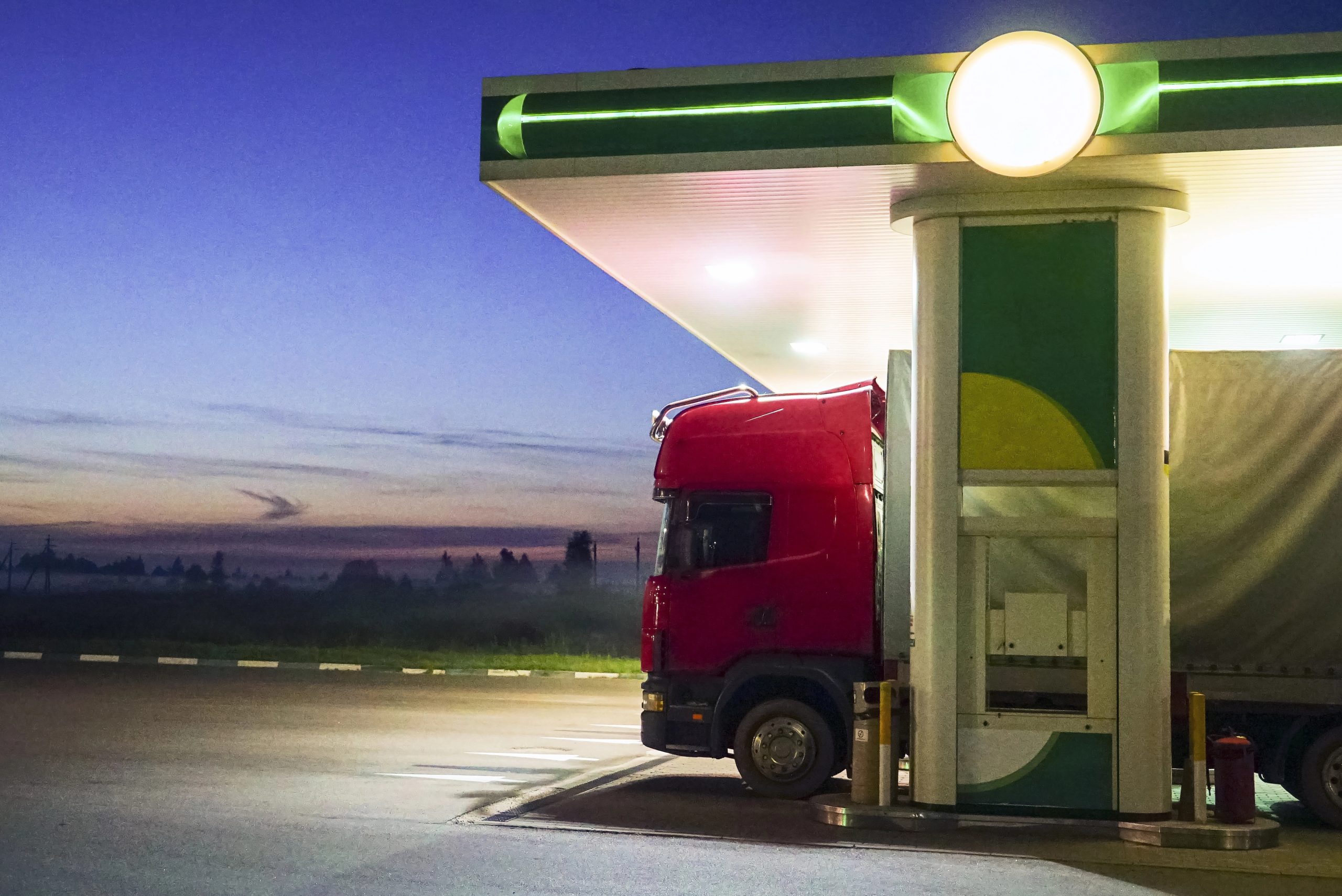
Oil is getting more expensive again: in the past week, the price of Brent exceeded 100 dollars per barrel for the first time since July 2026. For European road hauliers, however, rising oil prices are not the only problem. The tense situation in the diesel market is becoming increasingly important, and the prices of finished fuel have decoupled from Brent quotations. Despite fuel price increases in Poland, the prices of 95-octane petrol and diesel are still approximately 11 percent and 6 percent lower than the EU average, respectively.
The price of 95-octane unleaded petrol in Poland rose by 7 groszy per litre in the past week, while the price of diesel rose by 8 groszy per litre. According to European Commission data, the average retail price in Poland was 1.81 EUR per litre for 95-octane unleaded petrol and 1.98 EUR per litre for diesel. Poland therefore remains below the weighted average for the EU, which was 2.04 EUR/l for 95 petrol and 2.11 EUR/l for diesel, respectively.
Fuel industry representatives sound the alarm
A Brent price above 100 dollars attracts attention, but for European road transport, this may not be the most important event of the week. If the conflict calms down, some of the geopolitical price premium may disappear from oil prices relatively quickly. However, restoring disrupted refining capacity to operation and rebuilding stocks takes more time.
Fuel industry representatives at the APPEC conference in Singapore point out that tensions in the diesel market may not have reached their peak yet. The reason is simple: the mere availability of sufficient crude oil is not enough. It is estimated that about 10 million barrels of oil per day currently pass through the Strait of Hormuz. Refined petroleum products account for only about 1 million barrels of this amount. Most of the current flow is crude oil, which still needs to be processed, while spare refinery capacity is limited.
Some refining capacity in the Middle East has been disrupted as a result of the conflict. Russian refineries have been repeatedly attacked by Ukrainian drones, and Russia has introduced a ban on diesel exports in effect at least until the end of September. Elsewhere, refineries operated at very high capacity utilization levels over the summer, and some postponed scheduled maintenance work. If further capacity is taken offline, replacing lost production by increasing output elsewhere will not be easy.
The global fuel market is described as tight and lacking flexibility. Refineries are still not processing enough oil to prevent a decline in stocks. Kuwait Petroleum Corporation has issued an even stronger warning: maintaining the current high level of refinery operations until the end of the year would already be a major achievement. North-West Europe may therefore face a particularly difficult situation in winter.
For hauliers, the most important thing is that crude oil and diesel prices are not the same. Even if the Brent price stabilizes after the recent rise or begins to fall, the price of diesel does not have to follow it at the same pace. Diesel prices are also influenced by stock levels, refining margins, available production capacity, and transport costs.
What might happen next?
Price forecasts for the end of this year increasingly take into account a scenario in which production in the Persian Gulf region remains about 4 million barrels per day lower than before the war. In such a case, prices could reach levels above 120 dollars per barrel of Brent. On the other hand, a rapid recovery in production could bring Brent back to around 60 dollars in 2027.
As a result, diesel may continue to remain under price pressure even when the situation in the oil market begins to improve. From the perspective of transport companies, this means that when planning costs, it is not enough to watch Brent alone. The availability of finished diesel and the pace of stock replenishment will also be key.
Source: Malcom Finance in Poland