









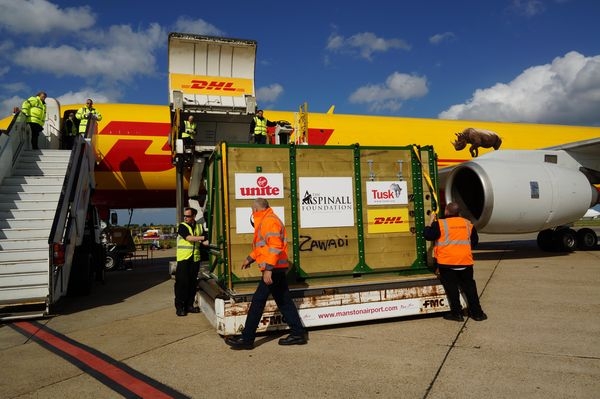
Supporting the Aspinall Foundation project, DHL transported three black rhinos from Manston Airport (Kent) in the UK to Kilimanjaro National Park in Tanzania.
The transport of three black rhinos, which were born in captivity at Port Lympne Wild Animal Park, run by the Aspinall Foundation, is part of an initiative aimed at restoring the population of endangered black rhinos in the Mkomazi Reserve in Tanzania. The campaign is actively supported by the Tusk Trust organization. The number of black rhinos has been significantly reduced due to large-scale poaching.
During the special DHL transport, a male named Monduli and two females, Grumeti and Zawadi, were moved and are now living in the wild for the first time. The rhinos were transported by a Boeing 757, specially modified to ensure their high comfort during the flight and safety on board. The aircraft was equipped with advanced safety features – life-saving equipment and temperature control during the flight. Furthermore, space was prepared for two flight engineers, two rhino keepers from Port Lympne, two people responsible for loading and unloading, and a specialist veterinarian. The aircraft had to be adapted not only for the transport of the animals but also for their food and equipment. On board were four bales of Lucerne hay, carrots, apples, crates of bananas, celery, and spinach, as well as water. The flight lasted 10 hours and began at Manston Airport (UK). The plane had a stopover for refueling in Bergamo, Italy. Here, the local zoo was on full alert, prepared in case any additional measures were needed after the first leg of the journey. From Bergamo, the rhinos were transported to Kilimanjaro International Airport in Tanzania, from where they were taken to the National Park.
– Transporting these animals was a very exciting event for us as an international carrier. We are proud to have supported such a valuable animal conservation program in this way. Our highest priority was the safety and well-being of the rhinos. That is why a dedicated team of logistics experts and engineers in both the UK and South Africa worked closely with the Aspinall Foundation and Port Lympne Wild Animal Park to ensure them a safe and comfortable journey. It was a complex, but at the same time, a very valuable logistical task – said Phil Couchman, CEO of DHL Express UK and Ireland.
Following the successful rhino release operation, the Aspinall Foundation is already planning to complete work on another ambitious and large-scale task of placing other endangered animals into their natural habitat.
– With our facilities and knowledge of freight handling, we were the best partner to provide support for the transport of the three rhinos. Although our team is more accustomed to transporting horses, the three rhino crates were expertly loaded, and the DHL team quickly transported them to their natural environment – says Charles Buchanan, CEO of Manston.
The return of the three black rhinos to their natural environment is a turning point for the Aspinall Foundation.
– The animals we place in their natural environment are an impulse for those already living in the wild that are truly threatened with extinction. As part of our flagship campaign in Gabon, our activities include the reintroduction of a family of 11 lowland gorillas. In addition to the rhinos and gorillas, the Aspinall Foundation plans to introduce eight langurs, five gibbons, and two African elephants into their natural habitat in protected areas. This unique and historic event is possible thanks to the success of breeding programs conducted at Howletts and Port Lympne and global wildlife conservation systems – said Damian Aspinall, Chairman of the foundation.
Report on the transport of the black rhinos