








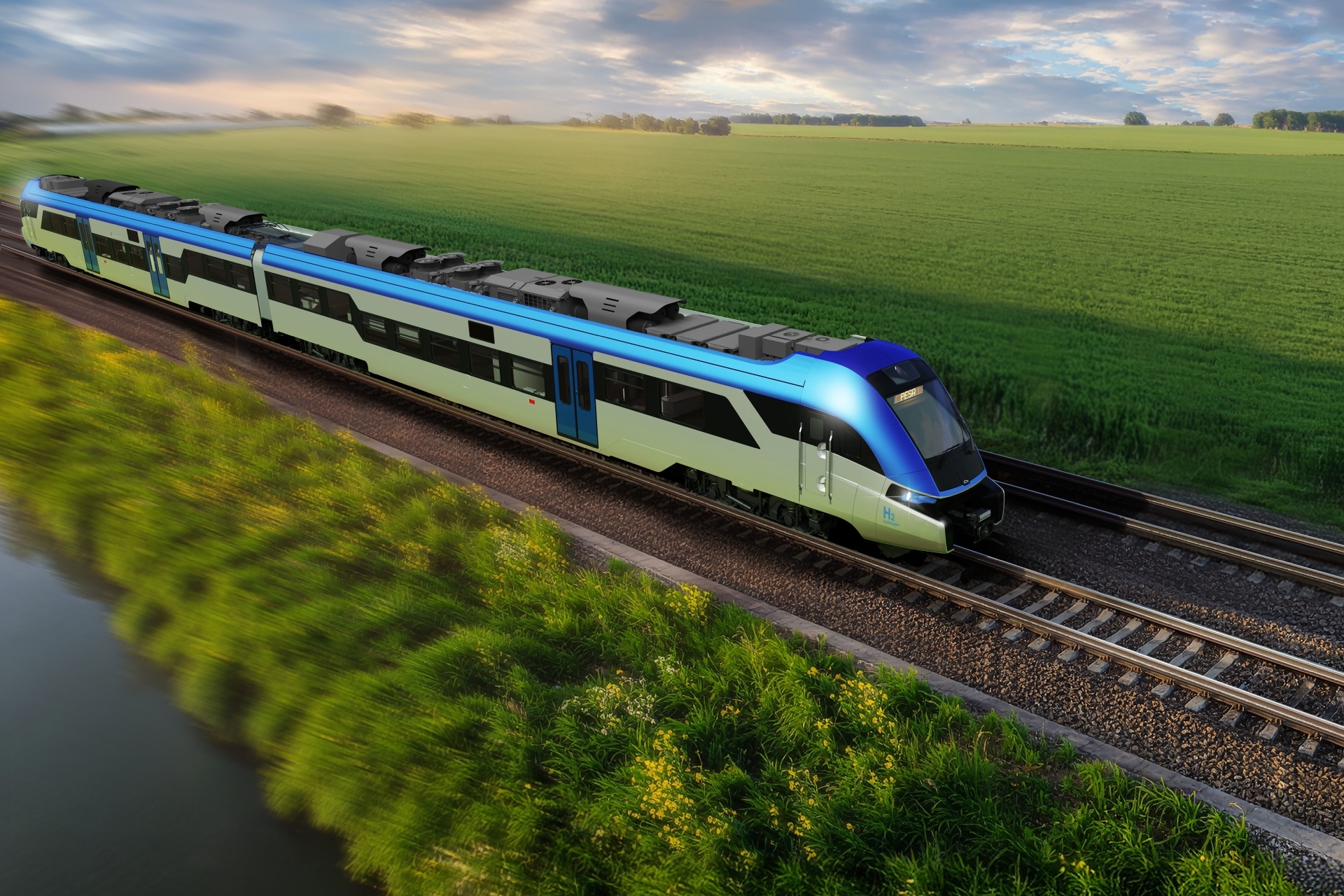
On Friday, February 13, 2026, at the headquarters of the National Fund for Environmental Protection and Water Management (NFOŚiGW) at 97 Pańska Street in Warsaw, a funding agreement was signed for an innovative, environmentally friendly research and development project.
The Polish rolling stock market leader, PESA Bydgoszcz S.A., will receive a grant of PLN 36,157,326 to develop the country’s first hydrogen-powered passenger vehicle with additional overhead line supply capability.
The project, titled “Implementation of an R&D undertaking concerning the development and construction of a demonstrator hydrogen passenger vehicle with additional power supply from the overhead catenary system”, is financed under Poland’s National Recovery Plan (KPO) as part of the “Hydrogen Economy Development” programme.
Today we are taking another step in the development of hydrogen-powered rail transport in Poland. We are allocating more than PLN 36 million for the construction of a prototype of the first Polish hydrogen passenger vehicle – an impressive project with global potential. Poland must reach for the latest clean technologies in renewable energy and transport to build competitive advantages in the energy and climate transition process. The involvement of domestic companies allows us to build our own supply chains and reduce dependence on import markets. We are creating space for our scientists, engineers and company employees so that solutions we will proudly present across Europe and worldwide are developed right here.
– said Paulina Hennig-Kloska, Minister of Climate and Environment.
Breakthrough HEMU Technology: Hydrogen and Electric Traction
The aim of the project is to build a HEMU (Hydrogen Electric Multiple Unit) vehicle. This is a nationwide innovation – the train will feature a triple power source: overhead electric traction (pantograph), hydrogen fuel cells, and batteries.
This configuration will enable:
- Unlimited flexibility: The train will be able to operate on mixed routes (electrified and non-electrified) without the need for transfers.
- Cost optimisation: Thanks to a control system developed by Pesa, the vehicle will automatically select the most efficient energy source, reducing hydrogen consumption on electrified sections.
- Combating transport exclusion: An ideal solution for the 40% of railway lines in Poland that are not electrified, including tourist regions such as Karpacz and the Hel Peninsula.
We support a project that genuinely pushes the technological boundaries of Polish railways. This is the first solution in Poland combining hydrogen propulsion with the possibility of drawing power from the overhead line, making it flexible and ready for deployment under various infrastructure conditions. We are investing not only in a vehicle, but in competencies and technologies that may become a Polish specialisation in zero-emission transport.
– said Dorota Zawadzka-Stępniak, President of the Management Board of NFOŚiGW.
Low-volume but socially important passenger traffic is growing. Today these routes are served by diesel multiple units, but in the future we want to deploy environmentally friendly vehicles on them and secure EU funding for their purchase.
– said Piotr Malepszak, Deputy Minister of Infrastructure.
Pesa as a Leader in Hydrogen Technologies
The Bydgoszcz-based manufacturer not only builds vehicles but promotes entire ecosystems – from renewable-based green hydrogen production to refuelling infrastructure. Experience gained during hydrogen locomotive testing at port terminals in Stockholm, Gothenburg and Malmo, as well as at facilities of SSAB producing “green steel,” will now be used in the construction of the passenger train.
A number of transport companies have already expressed interest in the new vehicle, confirming the project’s strong commercial potential.
Since 2019, we have been consistently building a hydrogen ecosystem. Our hydrogen shunting locomotive has already completed testing and certification, attracting interest in Sweden and from the KGHM Group and Orlen. Now we are taking the next step – the HEMU passenger vehicle. Thanks to funding from NFOŚiGW, we will create a technology that completely eliminates CO₂ emissions on local routes, offering passengers quiet and comfort, and operators efficiency that battery-only solutions cannot provide.
– concluded Robert Tafiłowski, Vice President of the Management Board of PESA Bydgoszcz S.A.