









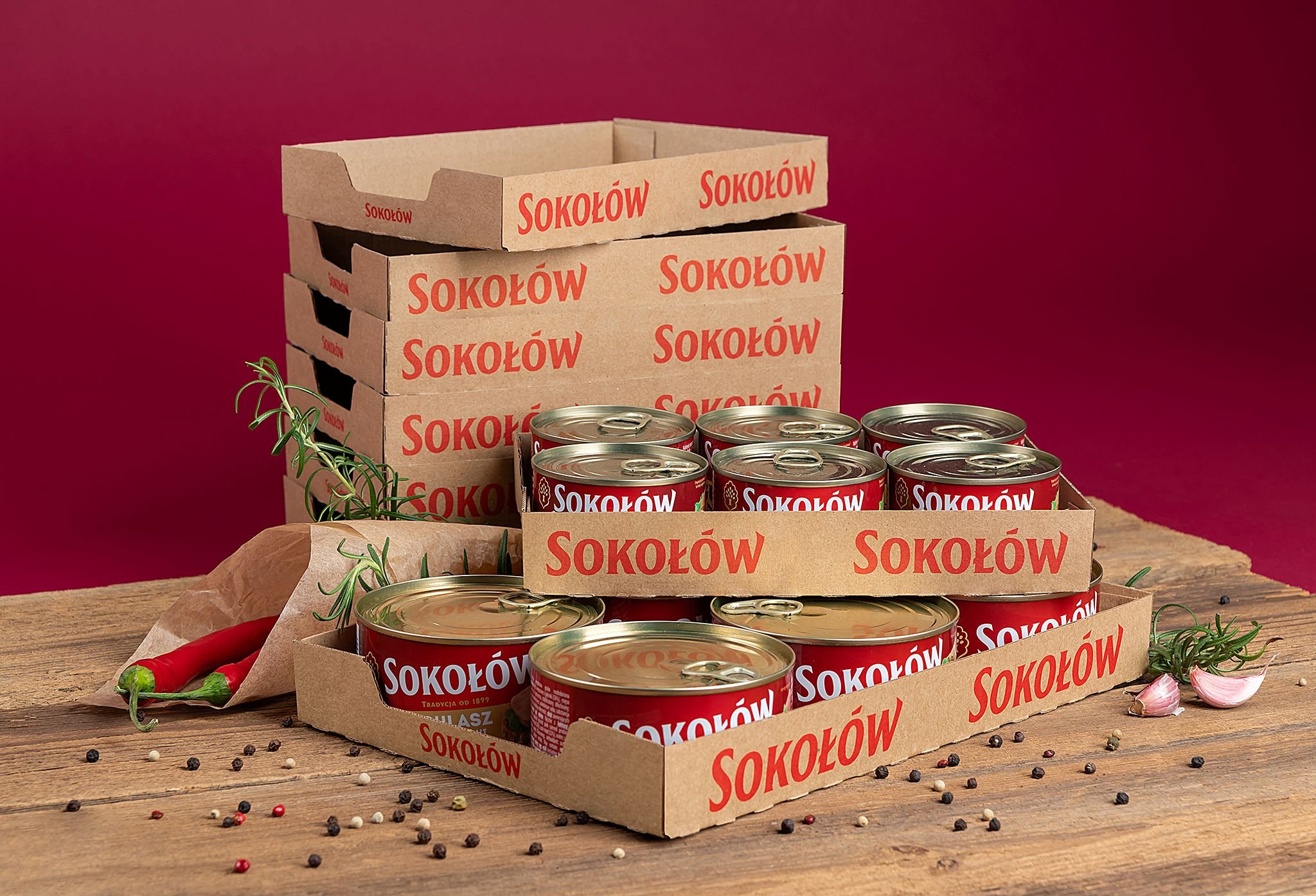
DS Smith, a company belonging to International Paper, a leading global provider of corrugated packaging solutions, has implemented the DS Smith Safe Tray for Sokołów, which has allowed for a 10.8 percent reduction in material usage compared to the previous packaging variant. The new solution improved product stabilization during transport and was implemented without the need to invest in production line modifications.
FMCG manufacturers are increasingly looking for solutions that allow them to reduce the amount of materials used while ensuring adequate product protection. With production scales reaching millions of packages, even a relatively small design change can translate into measurable material, logistical, and environmental effects.
Sokołów faced such a challenge. The trays used previously fulfilled their basic function, but there were occasional problems with product stabilization on the production line and during transport. At the same time, the packaging design did not fully utilize the material and communication potential.
The answer to these needs was the implementation of the DS Smith Safe Tray. Its design is based on modified geometry, including shifting the fold lines and better fitting the packaging to the product. The solution allows for reducing empty space inside the tray, increasing its rigidity, and improving the way loads are transferred.
In the case of large-scale packaging, even a small design change can bring significant results. As part of the project, we implemented new packaging with a tray featuring modified geometry, which improves product stabilization and allows for reduced material consumption. The solution maintains adequate rigidity and protective properties at a lower grammage, and its application did not require any modifications to the client’s production line.
– explains Renata Siudak, Sales, Marketing and Innovation Director at DS Smith.
Less deformation and better product stabilization
The new tray was fully adapted to Sokołów’s existing production line, meaning that the implementation did not require any additional investments in production infrastructure.
The packaging’s graphic design was also updated. The trays are made of double-sided brown cardboard (smart-brown), the use of which limits the scope of material processing. The red Sokołów brand logo was placed on the front and sides of the packaging, thanks to which the tray serves as a brand communication medium and strengthens its recognition on the market.
Reduction in material consumption
An impact assessment of the project was conducted to verify both the business and environmental effects resulting from the changes in the packaging design. The analysis confirmed the possibility of using a lower grammage material without compromising the functionality and visual appeal of the packaging.
According to DS Smith’s calculations, material consumption fell by 10.8 percent compared to the previous tray variant. DS Smith also estimated that the new solution allows for a reduction in annual CO₂ emissions by 7.48 tons, which was estimated based on environmental indicators published by FEFCO (European Federation of Corrugated Board Manufacturers) for 2025*.
Our cooperation with DS Smith was very smooth and based on partnership at every stage of the project. The implementation of the Safe Tray solution confirms that innovations in the packaging area can simultaneously support business efficiency and the achievement of environmental goals. This is an example of a forward-looking approach to packaging design, and its measurable results show how much can be achieved through joint commitment and effective cooperation.
– says Agata Szczotka, Brand Manager at Sokołów S.A.
The Sokołów example shows that reducing material consumption does not always require a complete change of packaging format or a rebuild of the production process. In this case, the key proved to be the optimization of the tray design, which combined a reduction in grammage with improved product stability and transport efficiency.
Methodological note
The reduction in CO₂ emissions was estimated based on environmental indicators published by FEFCO, the European Federation of Corrugated Board Manufacturers, for 2025.
*The comparison was made based on the annual consumption of the previous and new packaging. The cited value results from the reduction in the amount of material used.
Source: DS Smith