









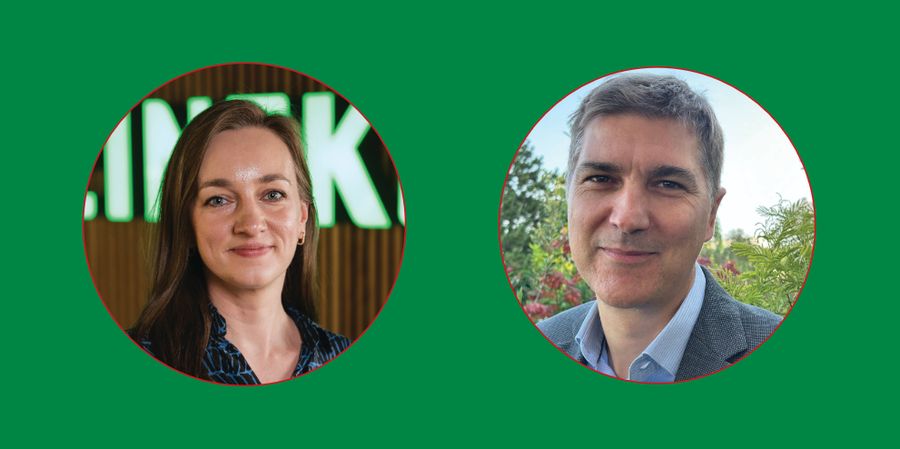
We are talking to Katarzyna Karaś, TM Hub Process Team Leader, and Jean Barbier, Head of European Transport Management Hub at HEINEKEN Kraków.
Michał Koralewski: Could you tell us a bit more about the Supply Chain team in Kraków? What are its main responsibilities?
Jean Barbier: Supply Chain teams perform a wide range of functions from Kraków. The European region is supported in terms of supply planning, material planning, transport planning, and soon also customer order management through three different hubs: the Transport Hub, the S&OP (Sales and Operations Planning) Hub, and the Customer Service Hub. The Global Supply Chain function, which manages our various competencies worldwide, also has positions in Kraków. At the same time, related functions such as Procurement are also present in Kraków. The full scope of the supply chain is supported from Kraków – from start to finish (end-to-end).
M.K.: Is the modern supply chain more than just physically moving products from point A to point B? What specific impact do HEINEKEN Supply Chain teams in Kraków have on market operations?
J.B.: Supply Chain is much more than just delivering products. All activities related to the HEINEKEN supply chain in Europe are supported from Kraków to provide added value to our customers and operating companies. Every brewery in Europe produces our brands according to the supply plan prepared in Kraków. For example, in the case of the S&OP Hub, our planning capabilities covering all European markets allow us to decide which of our beers should be produced, when, where, in what quantities, and for which market. It is similar in the case of transport: we can monitor the availability of transport capacity in markets across Europe and predict periods of peak demand or shortages of available trucks, taking proactive measures to deliver to our customers as agreed.
M.K.: How is the automation of routine tasks changing the daily work of supply chain specialists?
J.B.: We use the approach: eliminate / standardize / simplify / automate. We do not implement any automation before going through the first stages. This allows us to focus our automation efforts where they are needed. If a task cannot be eliminated, we standardize it, simplify it, and then automate it. A significant number of tasks have already been automated: from a simple email reminding a carrier to send a missing proof of delivery to very complex activities within planning processes. All these automations share one approach: they are documented and maintained. Initiatives most often come from members of our teams who deal with individual stages of the process and see the added value that automation can bring to their daily work.
Katarzyna Karaś: We are working on reducing non-value-added activities and automating manual work as much as possible. At the same time, we are aware of the important role of human relationships in the Supply Chain, and our experienced planners and analysts remain a key part of our daily work.
M.K.: Artificial intelligence makes it possible to predict supply chain disruptions before they even occur. However, can it replace human intuition in a crisis situation?
J.B.: Thanks to AI, we can do a lot, and we are already using it to a large extent. However, in the Supply Chain, a dynamic environment cannot be handled solely by AI. It can help to better understand data and speed up analysis, but ultimately we manage operations with the participation of employees and suppliers, acting in the interest of our customers and the organization. The same applies to a crisis situation. AI can be very helpful, but depending on the circumstances, the same conditions can lead to different decisions made by leaders, according to current goals or the reality we have to face.
K.K.: We strive to use AI in our daily work, but not as a tool to replace humans, but as a tool to support decision-making, streamline and organize work, and improve our daily operations.
M.K.: One of the key responsibilities of the team in Kraków is supporting the global transformation of the organization through the standardization of processes, technologies, and systems. How, however, can global standards be reconciled with local needs and specific requirements?
J.B.: We have clearly defined priorities that are the same for the Supply Chain hubs and their teams in Kraków. The first is “Accelerate Growth”, the second is “Step-up Productivity”, and the third is “Focus Future Fit”. This means that we must focus on supporting each market in achieving its growth ambitions while maintaining flexibility in response to local business needs. However, this is only possible with a high level of standardization. We cannot act flexibly if every market has a separate process at every stage. We would not be efficient then and would have difficulty properly supporting the business. Specific requirements are challenged whenever possible. Then, with the right level of standardization, local specifics that bring added value can be supported. Individual markets understand this issue well: if we want to provide proactive support based on knowledge, we must standardize our processes so that our colleagues from Kraków can focus on those areas where the specifics really require an individual approach.
K.K.: We use the opportunities provided by the central position of the hubs – we can share good practices and reuse them, act as experts in a given field, and support markets by providing them with in-depth analyses. We already have a good level of analytics and reporting, but to fully utilize them, we need the right level of standardization. This helps to get a better overview of the situation and identify potential challenges faster. It makes it easier for team leaders and markets to make informed strategic decisions in the long term, and also supports quick decision-making in the dynamic environment of supply chain operations.
M.K.: How is automation changing the skills and competencies required of supply chain specialists? What kind of employees will we be looking for in five years?
J.B.: Many members of our team are digital natives. They move freely in the world of automation, artificial intelligence, process mining, and data. However, we believe that you cannot create value without the right business curiosity, cost awareness, and a pragmatic approach. There is no point in creating an advanced automation tool that only one person uses, which brings little benefit, finds application in only a few activities, and does not generate added value. Even if the tool itself is extremely advanced. In the Transport Management Hub, there is a community called the “Data Champions Community”. Its members voluntarily share ideas regarding automation and the use of artificial intelligence. Each initiative has its own guardian who ensures its compliance with our priorities and assesses what measurable impact it can have on our key performance indicators (KPIs). Based on this, we make a decision to implement the idea or abandon further work. Because the teams understand business needs and priorities well, decisions are usually clear and understandable to everyone.
K.K.: Citizen Development, i.e., the creation of digital solutions by employees who are not professional programmers, is an important direction for the development of future organizations. Combining the specialized knowledge of supply chain experts with their digital competencies creates a unique set of skills for which demand will grow, especially with the development of artificial intelligence and the opportunities it offers.
M.K.: HEINEKEN Kraków is transforming from a traditional service center, focused on operational execution, into a key expert hub that supports and co-creates strategic business decisions across the global organization. How does this evolution affect the position of the Kraków team in the company’s global structure? And what does the transition from mere “process execution” to actively shaping the future of the entire supply chain mean in practice?
J.B.: The scope of our hubs’ activities has evolved from tasks focused on transactional service to a much broader spectrum of responsibilities. Thanks to many years of experience, efforts for continuous improvement, and above all, cooperation with all operating companies in Europe, the hubs have developed new competencies. For example, the Transport Management Hub can monitor the availability of transport capacity on the European transport market and share best practices with individual markets to reduce costs or deal with shortages of available transport. In the area of TM Hub responsibility, we also strive to use standards and solutions that are among the best in the industry. This is the strength of our integrated network. I believe that we can make even better use of the benefits resulting from such a wide scope of activities. As a result, the teams in Kraków play an increasingly important role in the organization. Their scope of responsibility is expanding, and expectations are growing. This means creating new positions involving greater responsibility.
The article comes from Logistyka magazine No. 5/2026.