









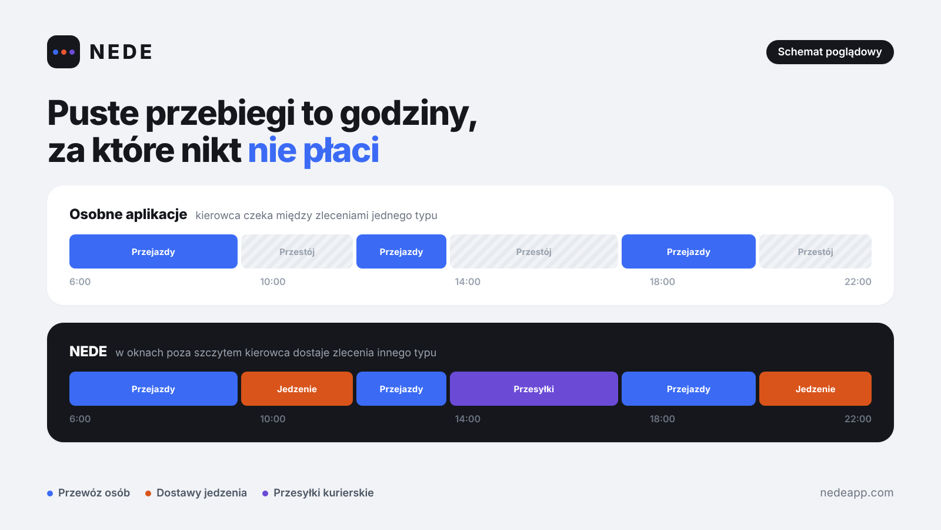
In urban logistics, the most expensive thing is not the trip itself, but the lack of one. A driver ready for work who is waiting for the next order generates costs without revenue. The Białystok-based startup NEDE claims that the problem stems from the market being divided into separate services – and proposes combining them into a single system.
A market divided into three separate worlds
Passenger transport, food delivery, and courier services currently operate largely in parallel. Each of these services has its own applications, its own drivers, and its own peak demand times. Passenger transport peaks in the morning and late afternoon, restaurant orders during lunch and evening hours, and courier shipments are distributed throughout the day differently than either of the others.
From the perspective of an individual driver, this means downtime. From the perspective of a company commissioning transport, it means limited driver availability exactly when they are needed. Empty runs, i.e., trips without cargo or passengers, are a structural phenomenon in this system, not a matter of poor organization by a specific carrier.
The idea: one driver, different types of orders
The NEDE.app platform integrates three types of services into one ecosystem. The same driver can perform passenger transport in the morning, deliver meals at lunchtime, and handle shipments in the afternoon. The system assigns orders automatically, taking into account the vehicle’s current location, the direction the driver is already heading, and their defined preferences.
The algorithmic layer is key here. The platform uses machine learning to plan routes and combine orders that can be handled within a single trip – for example, picking up a shipment on the way to a passenger destination. The fewer kilometers driven without cargo, the lower the fuel costs, the shorter the delivery time, and the lower the emissions.
What this means for the client
- Greater driver availability — orders go into a common pool, not just to drivers of one specialized service.
- No investment in your own fleet — the company uses transport in a service model, without fixed costs.
- Analytical panel — a view of orders, delivery times, and settlements in one place, with data for service quality control.
- Open API — the ability to automatically order transport directly from a store or restaurant system, without manual order entry.
Who is this solution for?
The biggest beneficiaries are entities for whom transport is important but not their core business: catering establishments with delivery, online stores shipping within the city, and smaller courier companies that want to increase capacity without expanding their fleet. Fleet partners also benefit – their vehicles work in a wider time window, rather than just during the peak hours of a single service.
Stage of development
NEDE.app is being created as a development project. After the programming work is completed, the platform is undergoing functional and performance testing, followed by a market rollout. Companies interested in cooperating at the platform’s launch stage can apply now – the team then determines the scope and conditions of the pilot individually.
Want to check if NEDE fits your company? Details and contact: https://nedeapp.com/
The NEDE.app project is co-financed by the European Union under the European Funds for Eastern Poland 2021–2027 program.
