










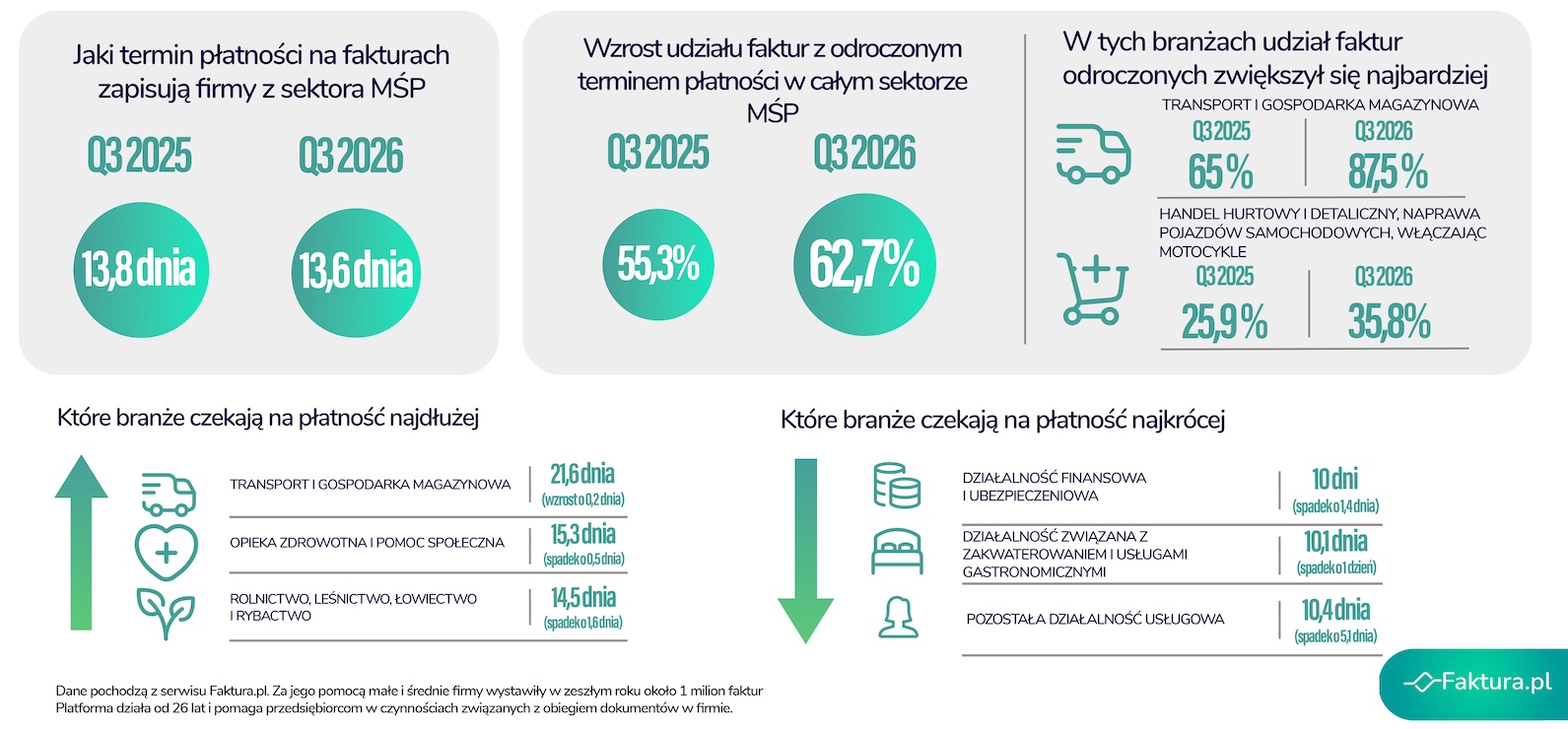
According to data from Faktura.pl, in the third quarter of 2026, 62.7 percent of invoices issued by small and medium-sized enterprises had a deferred payment term. In the same period of 2025, this figure was 55.3 percent. Over the year, the share of such documents increased by 7.4 percentage points. An increasing share of invoices with deferred payment means that waiting for money applies to a larger portion of transactions.
The average payment term stated on the invoice did not extend compared to the same period last year and remained at a similar level (13.6 days versus 13.8 days in the third quarter of 2025). However, a stable time for a transfer does not mean that it is easier for entrepreneurs to maintain liquidity. An increasing portion of invoices provides for payment in the future, and until that moment, the entrepreneur must finance their operations from other funds.
Payment terms must be viewed from two sides: how much time we give the client to pay and how often we agree to a deferred transfer. A two-week payment term for a single order does not necessarily hinder the financing of current operations. However, when this method of settlement covers the majority of sales, it becomes a challenge for the company budget. Besides, nearly two weeks is an average value, so some entities are forced to “credit” their partners for longer. This is usually taken advantage of by larger companies that use their position for a month or even two. The entrepreneur must maintain operations until the money from the issued invoices reaches their account.
– comments Kamil Fac, Vice President of Faktura.pl.
Transport is increasingly financing the economy
The largest increase in the share of invoices with deferred payment occurred in the transport and storage group. In the third quarter of 2025, it was 65.04 percent, and a year later it was 87.46 percent. This is a huge increase of 22.42 percentage points. Currently, payment deferral applies to almost nine out of ten invoices issued by SMEs in this industry.
At the same time, the average payment term has slightly extended – year-on-year from 21.4 to 21.6 days. This is the longest time for a transfer among all NACE groups. Transport therefore stands out both in terms of the frequency of payment deferrals and the length of the trade credit granted to recipients.
Carriers first incur the costs of fuel, wages, road tolls, or vehicle maintenance, and only then receive payment. In this way, they finance not only their own operations but also the flow of goods and the functioning of their principals.
The goods may already be delivered, sold, or used in production, and the carrier is still waiting for the settlement of the route. Transport thus finances subsequent links in the economy. For a small company, this means having to lay out money for subsequent orders before receiving payment for previous ones. With such widespread payment deferral, even a profitable business may have difficulty maintaining liquidity. – says Adrian Banasik, member of the board of Finea, which specializes in financing micro-enterprises.
Trade: shorter term, but deferral increasingly frequent
A clear change also occurred in the wholesale and retail trade; repair of motor vehicles, including motorcycles group. The share of invoices with deferred payment increased from 25.89 percent in the third quarter of 2025 to 35.76 percent in the third quarter of 2026, i.e., by 9.87 percentage points.
The good news is that the average payment term stated on the invoice in this industry shortened from 13.2 to 12.3 days. Recipients therefore receive money slightly faster, but waiting for the transfer covers a larger part of transactions. For a small seller, this may mean a more frequent need to finance the purchase of subsequent goods before receiving payment for earlier deliveries.
This reduces flexibility and competitiveness, as well as the ability to react to the market situation and purchase goods at better prices. This is a worrying signal just before the most important part of the year for trade.
– points out Adrian Banasik from Finea.
Large recipient holds cash, small supplier covers costs
Deferred payment is good for the payer, but not for the invoice issuer, because the recipient uses the goods or service before making the payment. In relations between small suppliers and large companies, the cost of such financing can heavily burden the smaller party, which has weaker bargaining power. A large contractor keeps the cash, while their supplier must cover the costs of the order and settle their own liabilities.
It is difficult for a small supplier to set conditions for a company on which a significant part of their revenue depends. It happens that the ability to win or maintain a contract requires agreeing to finance the client for several weeks. This cost must be included in the price and cash planning. Otherwise, higher sales may mean increasingly greater involvement of one’s own money, instead of new funds available in the account.
– says Adrian Banasik from Finea.
No industry waits less than 10 days
In several industries, the average payment term shortened year-on-year. The largest decrease was recorded in other service activities – from 15.5 to 10.4 days. In agriculture, forestry, hunting, and fishing, it decreased from 16.1 to 14.5 days, and in financial and insurance activities from 11.4 to 10 days. The latter group has the shortest average time for a transfer. In none of the industries is the average payment term less than 10 days.
The Faktura.pl platform checks the basic parameters related to the finances of the small and medium-sized enterprise sector every quarter. The analysis covers nearly 1 million invoices issued annually by SMEs on this platform, including the transfer deadlines recorded on the documents. The entities are divided into 15 main industry groups. Comparing the extension or shortening of the time for a transfer in similar periods allows for an assessment of the condition and trends in individual industries and the entire economy.
Source: Brandscope