









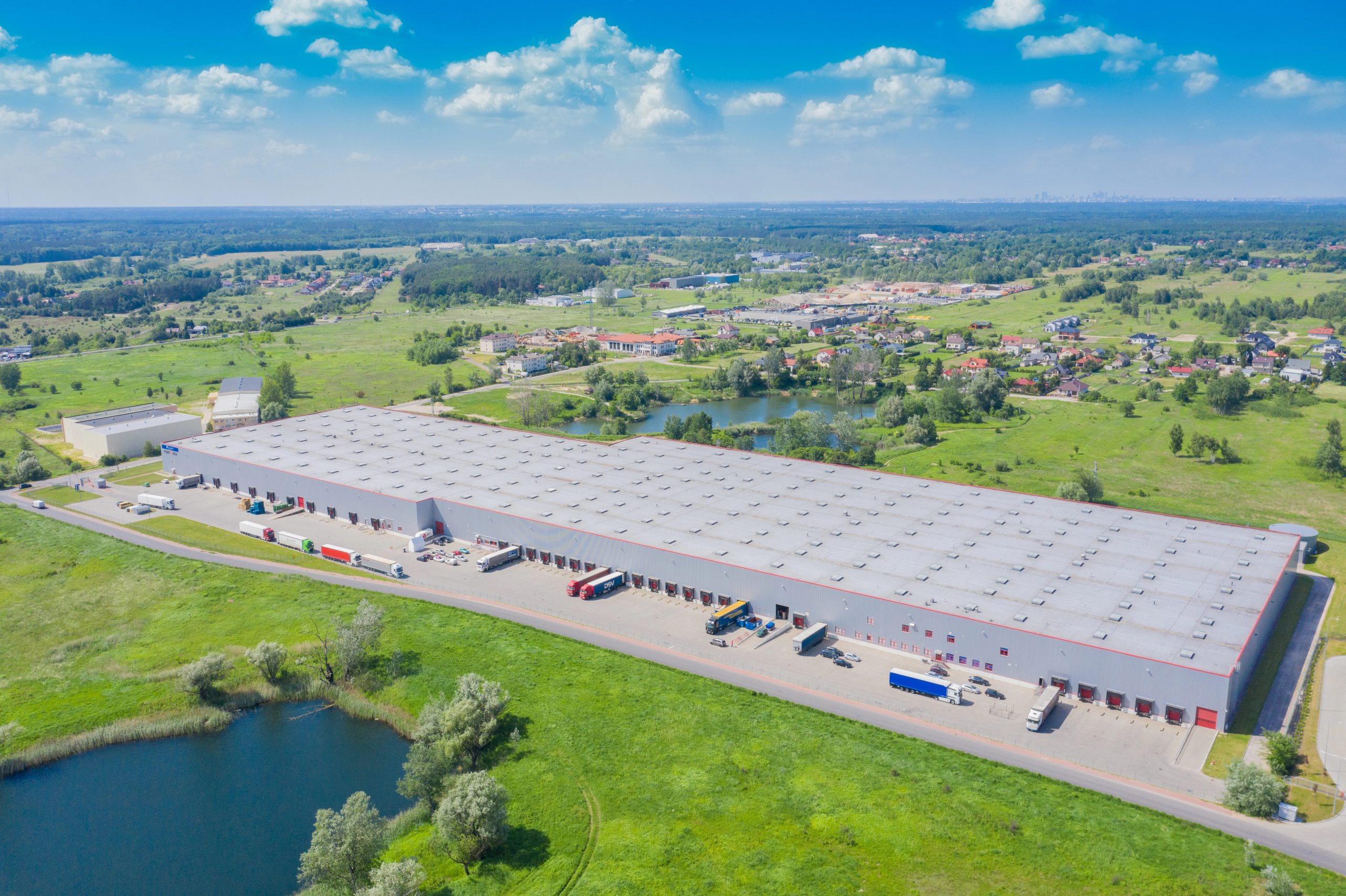
Łódź remains the economic center of Central Poland, but the focus of new investments is increasingly shifting outside the city. Large production and warehouse facilities are growing in Stryków, Zgierz, Piotrków Trybunalski, and Łowicz.
Satellite cities attract developers with the availability of plots and good road infrastructure, and tenants with the ability to scale operations and lower rental and labor costs. The entire region is connected by a network of main routes based on the A1 and A2 motorways and the S8 and S14 expressways. There is already almost 5.2 million sqm of warehouse space in the entire province, and another 160,000+ sqm is under construction. And although one-third of these resources are located in Łódź, the importance of neighboring towns is systematically growing. Leading in terms of the number of warehouse meters are Stryków and Piotrków Trybunalski, while smaller but significant centers in the region include Łowicz, Kutno, Radomsko, Zgierz, and Pabianice.
A common market, different specializations
Central Poland is increasingly developing as a single market in which individual cities have their own roles. – The strengths of Łódź are a large labor market, a strong academic and competence base, and a developed logistics and industrial sector. As a large urban center, it concentrates a significant part of consumer demand, which drives online retail. This translates into a growing demand for last-mile logistics, which will be one of the most important segments of the local market. The warehouse offer itself is also changing. Alongside smaller units, more representative facilities with a larger office section are appearing.
– says Jan Olszewski, Senior Advisor in the Industrial and Warehouse Department at Newmark Polska.
So why are large-scale warehouses being built in Stryków or Piotrków Trybunalski?
Large projects need sufficiently large plots of land, and these are starting to run out in Łódź. Additionally, land prices, as well as property taxes, are higher in the provincial capital than in satellite cities. Furthermore, investors from other market sectors are also interested in attractive land within the city’s administrative boundaries. That is why primarily smaller parks are being built in Łódź, most often with an area of 20,000–50,000 sqm, while large-scale warehouses exceeding 100,000 sqm are developing in satellite cities.
– says Jakub Dudkiewicz, Regional Director at Newmark Polska.
The ecosystem works better than a single city
Marek Sekieta, Chairman of the Board of the LODZistics Cluster, a logistics business network of Central Poland, emphasizes that Łódź is the core of a logistics ecosystem covering a significant part of the province.
The entire market environment determines the advantage, and an increasingly important element of it is the combination of the potential of universities with the needs of the economy – joint research, projects, but also early identification of the competencies that companies will need in a few or a dozen years. Companies are no longer asking how many graduates they can recruit, but what competencies these people will have and whether they will be prepared for the changes taking place in the economy. In addition to logisticians, we need automation engineers, IT specialists, data analysts, AI and cybersecurity experts, as well as management or finance competencies today. That is why the interdisciplinarity of the Łódź academic environment can become our advantage.
– emphasizes the Cluster President.
Stryków: a logistics hub and growing competition for employees
Stryków is one of the strongest examples of a satellite city that has grown into an independent economic center over time. Its location at the A1 and A2 junction has attracted production and logistics companies for years, and the largest developers, such as Hillwood, Logicor, Segro, Prologis, and Panattoni, have developed and continue to develop their projects in the city.
According to Newmark Polska data, the market scale has already exceeded 1 million sqm of warehouse space, which gives Stryków over a 20 percent share in the resources of Central Poland. Almost 38,000 square meters of warehouses in this location are currently under construction.
A high concentration of business has been one of Stryków’s main advantages for years. Today, however, it also means greater competition for employees.
The warehouse market in Stryków began to take shape almost 20 years ago. A good location and a developing transport network attracted subsequent large companies that expanded their operations and created attractive jobs. Today, employees have a wide choice of offers and good employment conditions, which is why it is increasingly difficult for new investors, especially those needing large teams, to compete for staff.
– says Jakub Dudkiewicz.
According to Jan Olszewski, it is precisely the difficulties with access to employees that connect Stryków with Zgierz.
This is a younger market, with almost 270,000 sqm of production and warehouse space, which can take over part of the demand from its more mature neighbor. Thanks to its proximity to Łódź and a developing warehouse base, Zgierz can also be an additional source of employees for companies operating in this entire area. Developers Hillwood and Panattoni already have their warehouses there.
– informs the Newmark Polska advisor.
One of the ways to solve the problem of access to employees is the thoughtful development of transport in the region.
If new jobs are created, but commuting to them without a car is very difficult, we start to lose part of the potential of the entire system. Therefore, public transport, commuter and regional rail, integration of timetables, or park&ride solutions are not just elements of transport policy. They are elements of economic policy and labor market policy.
– emphasizes Marek Sekieta.
For the tenant, the biggest asset is people
The advantages of Stryków were appreciated by Corning, a company specializing in glass materials and optical technologies, by opening a production and technology center there.
The strategic location in the center of Poland and Europe, ensuring access to main transport routes and the markets where our customers operate, was of key importance to us. Equally important was the possibility of further business development and access to qualified engineering staff, supported by the strong academic background of the Łódź province.
– says Łukasz Srogosz, Regional Manufacturing Manager EMEA OCS at Corning.
As he emphasizes, the company’s 25 years of experience in Poland show that the greatest asset of this region is precisely the people.
Their competencies, commitment, and culture of continuous improvement have allowed us not only to develop production but also to create one of Corning’s most important research and development centers in the EMEA region in Stryków.
– assures Srogosz.
Piotrków Trybunalski: the southern gateway to Central Poland
The second important logistics pole of the region is Piotrków Trybunalski, located at the intersection of the A1 and S8. Thanks to this, one can efficiently reach Warsaw, Łódź, Silesia, and Wrocław from the city. The most active developers in Piotrków are: Prologis, Mapletree, P3, and Reino.
Thanks to its location at the intersection of two key transport axes, a warehouse in Piotrków allows our clients to shorten travel times, consolidate goods streams, and increase operational flexibility. The advantage of this location is also the developed logistics and industrial base. Clients today expect the ability to quickly scale operations related to changing volumes or seasonality. Therefore, requirements regarding transshipment, picking, co-packing, and inventory buffering are growing. And Piotrków allows these services to be combined with transport and distribution in one place.
– says Jacek Freund, CEO, xCargoLogistics.
Łowicz: a cheaper alternative to large hubs
One of the younger logistics and industrial markets in the region is Łowicz. The city’s advantage has become its location between Łódź and Warsaw.
Łowicz attracts warehouse tenants primarily due to its proximity to Warsaw and lower labor and rental costs. This combination makes the city increasingly considered by companies from the retail, e-commerce, and logistics sectors looking for savings without giving up access to a large market.
– says Jan Olszewski.
One of the tenants of the Hillwood Łowicz park is SellBEST, an e-commerce company selling home, garden, and physical activity equipment.
With the development of online sales, we needed a location that would allow us to centralize logistics processes – from receiving imported goods to distributing orders throughout Europe. Łowicz responds well to these needs and is an attractive alternative to the largest logistics hubs. It offers all the key advantages of central Poland, while at the same time allowing us to avoid some of the limitations characteristic of the largest agglomerations, such as greater infrastructure congestion or stronger competition for employees.
– says Agnieszka Wereska, CEO of SellBEST.
Less competition, greater specialization. Satellite cities complement Łódź
What will determine the further development of the region? According to Jan Olszewski: the ability of cities to cooperate.
People and their competencies will be of primary importance, but also the ability of companies, local governments, and institutions to work together. The entire province remains very cost-competitive compared to the rest of Poland. An additional impulse for the development of the region will be the ongoing work on the Central Communication Port (CPK). The planned transport hub will influence the increase in demand for modern production and warehouse space. As a result, the region will strengthen its position as a significant economic hub in Europe, which will generate new jobs and the development of local business infrastructure. Today, we have the chance to build the advantage of a region in which individual cities develop their own specializations and at the same time strengthen each other. Such a system will be increasingly attractive for companies looking for a place to develop and the ability to scale their business in the coming years.
– summarizes Olszewski.
Source: Newmark Polska