









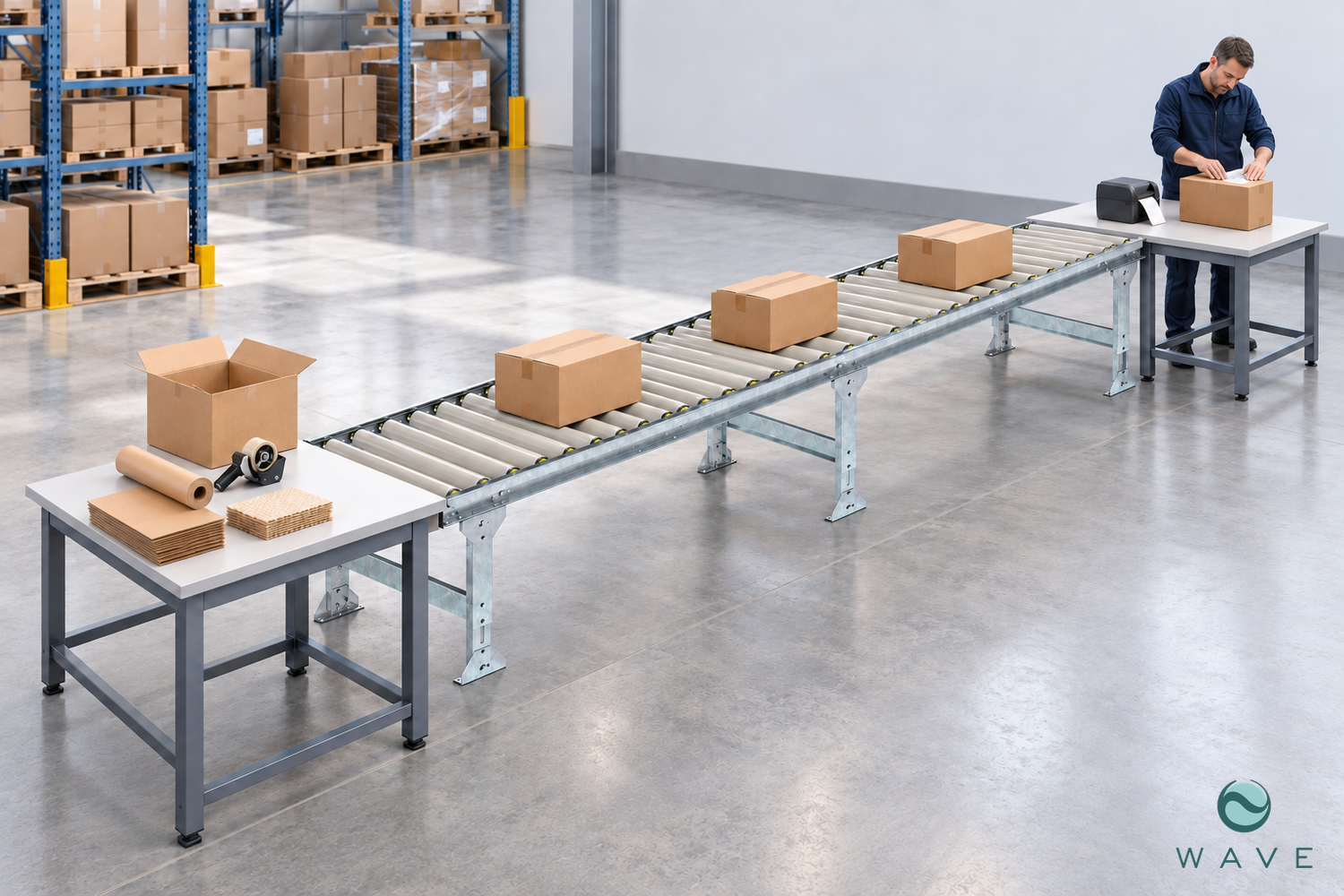
A gravity roller conveyor can reduce the need to carry cartons between tables and designate space for packages waiting for the next stage. It works well for short, repetitive routes where packaging has a stable bottom and the method of moving them suits the work organization. Selection should begin with observing the flow of packages, their dimensions, and weight.
First, determine the route and collection point
Check where the carton is filled, closed, labeled, and collected. Note the sections where an employee lifts a package or places it on the floor. A conveyor makes sense where it can connect consecutive operations without blocking aisles or access to packaging materials.
An example layout might connect a packing table to a labeling station, and then to a shipment collection point. If a queue forms at the labeling station, you must provide a buffer and determine when to stop feeding subsequent cartons. The transport track itself will not increase the efficiency of a slower station.
Manual pushing or gravity transport
In a gravity conveyor, rollers rotate under the moving load. On a horizontal section, the operator moves the package. An incline can allow movement under gravity, but it requires checking the behavior of actual packaging.
A horizontal section is worth considering when the employee needs to decide on the transfer of each package. A layout with a slope can facilitate feeding cartons for collection, but you must plan for their stopping. There is no single incline suitable for all shipments. A test should be conducted with packages of different weights and bottom conditions, also checking the restart after stopping. Too fast an approach to a stop or the previous package risks damaging the packaging.
Match rollers to the smallest carton
The basis is a stable, sufficiently rigid bottom. A collapsed bottom or protruding packaging elements can hinder travel. For soft bags and irregular loads, consider a transport carrier or another technology, such as a belt conveyor.
Roller spacing is defined by the distance between their axes. As a starting point, the load should be supported by at least three rollers in every position. Calculation example: for a carton 300 mm long in the direction of travel, a 100 mm spacing meets this rule on a straight section. This is an initial geometric criterion; weight and bottom flexibility may require denser support. You must also check transitions between modules.
Working width is selected based on the largest carton and its orientation on the route. Check if the packaging passes through without jamming and if the employee can comfortably reach the package. The material of the rollers, their diameter, and bearings should be evaluated together with the load and operating conditions. The WAVE offer includes conveyors for cartons and containers with PVC and steel rollers; the material itself does not determine the permissible package weight.
Check the load capacity of the entire section
The load capacity of a single roller is not the load capacity of the conveyor. The frame, supports, their spacing, and the way the load is distributed are also important. Data must be read for a specific configuration. In the descriptions of conveyors for cartons and containers offered by WAVE, the load capacity is given for a uniformly distributed load, and for selected models, it depends on the leg spacing.
In the buffer, include all packages that may be on the section at the same time. Their total weight and local load under the heaviest carton require verification. Also, agree with the supplier on the selection of the stop and the method of removing packages from the queue.
Combine transport with station organization
Adjust the height of the roller surface to the tables and the method of transferring cartons. Avoid thresholds at connections that require lifting the package. Provide stable support and space for the operator. Select supports, connectors, and stops for the chosen system; check which elements are included in the section price.
A gravity conveyor does not by itself ensure constant speed or automatic separation of packages. When the process requires precise timing, uphill transport, or control of gaps between cartons, a powered solution should be considered.
What to prepare for a selection inquiry
For a selection inquiry, prepare:
- dimensions of the smallest and largest carton;
- weight range of packages;
- photo of the carton bottom;
- sketch of the transport route;
- table heights;
- number of packages per hour;
- maximum number of packages in the buffer;
- environmental conditions;
- method of moving cartons — manual or gravity.
Roller conveyors for cartons and containers can be checked in the WAVE offer. When inquiring about selection, it is worth attaching this data to evaluate the specific layout of stations and the correct conveyor configuration.