









Since July 19, 2026, large companies in the fashion and footwear industry have been subject to, among other things, a ban on the destruction of unsold and returned items, resulting from the EU ESPR regulation. However, the new regulations mean that responsibility for circularity lies not only with manufacturers and retailers. In practice, it also includes logistics operators responsible for managing the supply chain, including returns, the scale of which is systematically growing. As the latest data from ID Logistics shows, in the first half of 2026 alone, the volume of returned clothing handled by the operator increased by approximately 20 percent compared to the same period last year.
The increase in the number of returned shipments in the first half of this year is, among other things, a result of established consumer habits. ID Logistics experts calculate that over the last year, the volume of handled clothing returns has increased by about 20 percent. Considering that the operator’s Polish branch alone currently processes over 100 million returned products annually, the necessity of managing such a huge amount of goods – in the face of the already applicable ban on disposal – is becoming a massive operational challenge for the entire sector in a broader sense as well.
In the clothing industry, returns are a natural, even expected element of the shopping journey for consumers. However, when regulations force the absolute maintenance of these goods in circulation, the burden of managing them increases. Today, it is in the warehouses that operators ensure that clothing safely and quickly returns to the e-shelf in full commercial value.
– comments Marcin Łukasik, Chief Operating Officer for Fashion at ID Logistics.
Value lies in the supply chain
According to market data[1], the cost of handling a single return package for 77 percent of companies ranges from 7 to 30 PLN. This means that an e-shop fulfilling 10,000 orders per month spends up to 90,000 PLN annually on post-sales logistics alone – and that is without including lost margins. Such a huge burden forces the fashion industry, which faces the highest return rates in the e-commerce market, not only to revise purchasing policies (e.g., towards hybrid models) but, above all, to extremely optimize the process of re-stocking clothing.
In the face of new regulations prohibiting the disposal of unsold clothing, footwear, or accessories, minimizing the time it takes for a product to return to the offer after a return becomes crucial. This requires appropriate infrastructure, which is why international brands are increasingly basing their operations on specialized European return centers run by logistics operators.
– adds Marcin Łukasik.
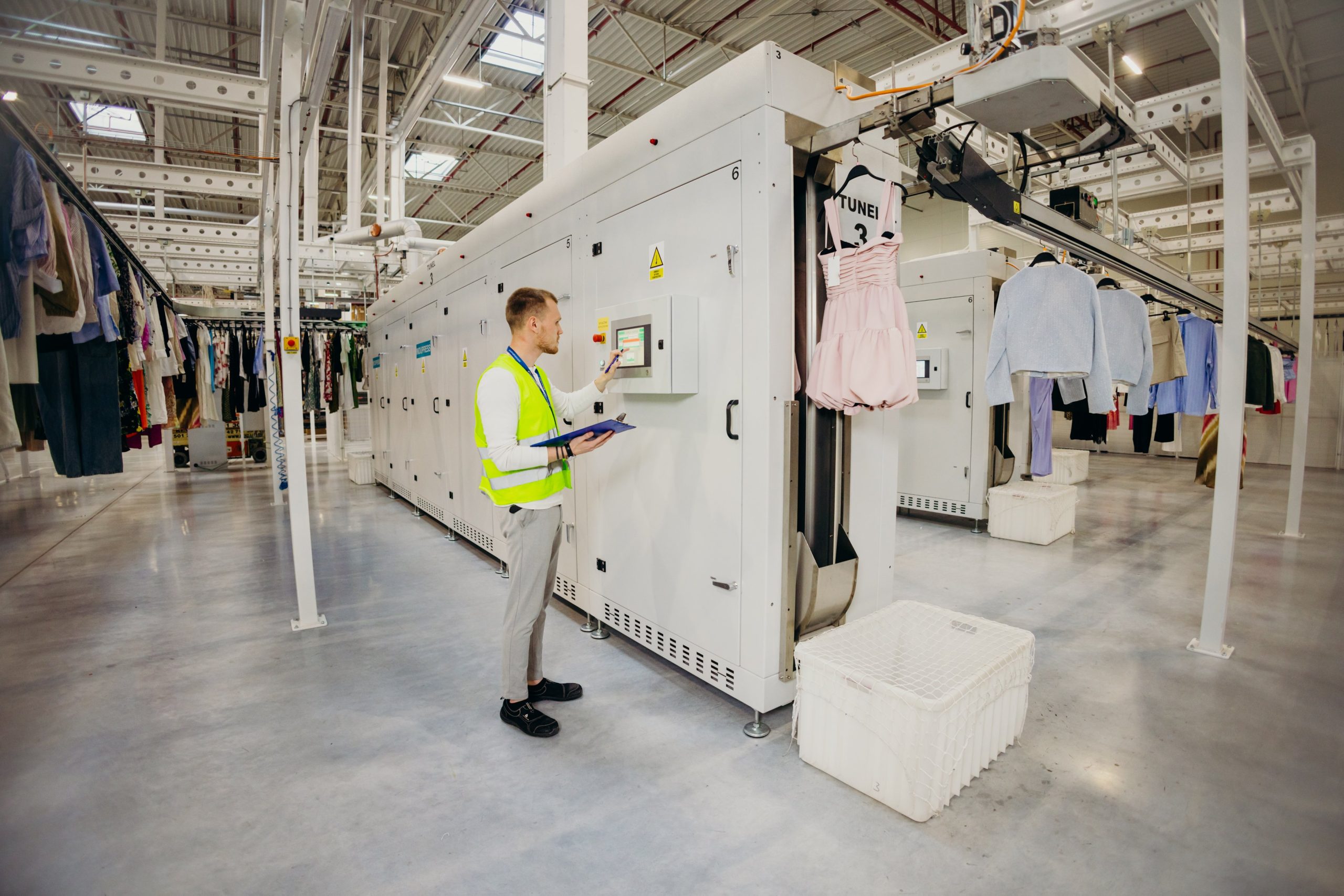
To meet legal requirements and maintain sales liquidity, logistics operators are investing in extensive Value Added Services (VAS) systems, including the use of professional steam tunnels with a capacity of 4,000 pieces per hour, solutions such as steam stain removal, footwear cleaning, and removing creases caused during trying on, or even providing a background of qualified tailoring teams, allowing for the almost complete restoration of the original quality of products.
The new regulations are accelerating changes that part of the logistics industry has been implementing for many years as part of its own responsible business standards. At ID Logistics, processes related to repairing, refreshing, re-preparing products for sale, or reducing waste were in place long before the ESPR regulation came into force.
For us, the circular economy is not a response to new regulations, but an element of a strategy implemented for years. Repairs, refreshing, and restoring products to full commercial value function as a full-fledged part of our operations. Similar to actions to reduce environmental impact in warehouses, including recycling 100% of foil and cardboard waste and sorting other, smaller waste fractions that can be processed, reusing packaging materials, and successively increasing the share of energy from renewable sources, which currently accounts for 88 percent of the energy used in our warehouses. In this way, we help clients not only meet regulatory requirements but also achieve their ESG goals and build more responsible supply chains.
– says Agata Głąbińska, CSR Manager at ID Logistics Poland.
In the new legal reality, where the ban on disposal clashes with the massive scale of e-commerce returns, the logistics operator becomes a fully strategic partner for clothing brands. It should ensure a standard in which resources are effectively managed in a closed loop and the product life cycle is realistically extended. The effectiveness of our refreshing processes means that at ID Logistics, as many as 96 percent of returns regain full commercial value in a few dozen hours. In this way, we show that today, the measure of an operator’s success is not only the number of orders handled, but above all the highest market efficiency in restoring clothing to the closed sales cycle.
– summarizes Łukasik.
[1] Source: Report “Returns in Polish e-commerce 2026”, accessed: August 18, 2026, 10:00 AM, Returns in Polish e-commerce 2026
Source: ID Logistics Group