









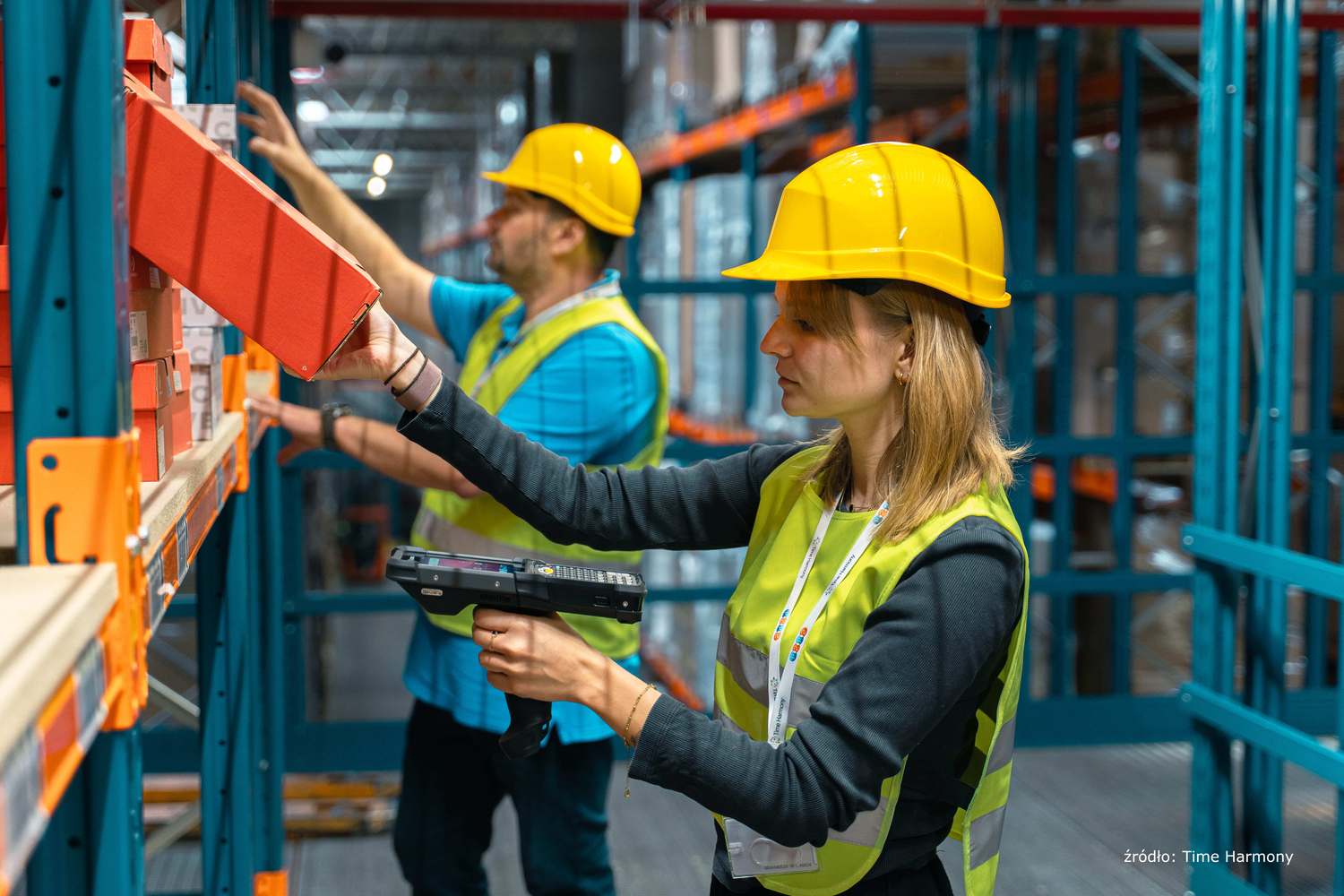
How long does it take to pick a single order in your warehouse? How much time does an employee lose between one task and another? A standard WMS or ERP system does not know this because it records the result of a process (e.g., the number of packed parcels), not its execution. The answer to this gap is activity logging, a tool that calculates the actual time spent working on a task.
What is activity logging and how does it work in practice
Activity logging records exactly what an employee is doing at any given moment: picking, packing, labeling, workstation setup, and how much time they spend on it. In addition, there are non-system activities, i.e., those that have no reflection in WMS or ERP: cleaning, breaks, organizational meetings. Without measuring them, the picture of work efficiency will always be incomplete. The manager can therefore see how much, how long, and where in the process delays occur.
Case study: how Raben Polska calculated the profitability of VAS orders
Raben Polska (one of the largest logistics companies in the country, part of a group operating in 15 European countries) implemented the Activity Logging module with one specific goal: to measure warehouse processes precisely enough to be able to calculate the profitability of VAS orders (value-added services, such as co-packing or labeling).
The system provided more than just a single number. It allowed for comparing real performance and process efficiency with assumptions and standards, forecasting the order completion time at the current work pace, and, thanks to a dedicated real-time dashboard, tracking the team’s work pace, the number of completed tasks, and key KPIs on an ongoing basis. Managers gained the ability to react quickly to deviations from the plan, instead of finding out about a problem after the fact, from a delayed report.
Also important here is the way the data was made available to the team: the dashboard was anonymized, and the data was identifiable only to the employee and their leader, not to the entire warehouse. Such transparency, limited to the appropriate level, motivated rather than caused resistance. The company also noted a decrease in the need for overtime because teams managed their own pace better.
The system met our expectations to a very large extent in terms of obtaining often complex information in our preferred layout, giving the possibility of any data processing – says Damian Dąbrowski, Contract Logistics Manager for the Region at Raben Polska.
Case study: 20% idle time reduced to 2%
The second example shows how large the scale of savings can be. A nationwide logistics operator, managing a network of warehouse centers and employing both full-time and agency staff, implemented activity logging to measure what the WMS does not see: cleaning, breaks, organizational meetings, and so-called idle activities, e.g., the time between arriving at work and starting the first task.
In the first month after implementation, the time spent on unproductive and idle activities reached as much as 20%. A few months later, thanks to objective data and specific actions as part of process optimization, it dropped to about 2%. With employment counted in thousands of people, this difference translates into specific amounts. A seemingly small improvement at the level of one employee, multiplied by the scale of the organization, becomes a real cost advantage.
Data yes, surveillance no
It is worth noting one thing, because the topic of monitoring employees can be sensitive: the goal of activity logging is to improve processes, not to control the individual. Good implementations, as the Raben example shows, limit the visibility of detailed data to the employee and their direct supervisor, and do not make them available to the entire company. Transparency is motivating only when it does not turn into a feeling of surveillance.
Where to start
Implementing activity logging does not have to cover the entire organization at once. The most common path is:
- a pilot in one warehouse or on one process line,
- determining which activities are actually worth measuring (not all make sense),
- building a benchmark: setting a standard,
- scaling to subsequent locations and teams, just as the logistics operator described above did.
Tools such as the Activity Logging module in Time Harmony were created precisely with this path in mind: from a single process, through the entire warehouse, to a network of branches.