









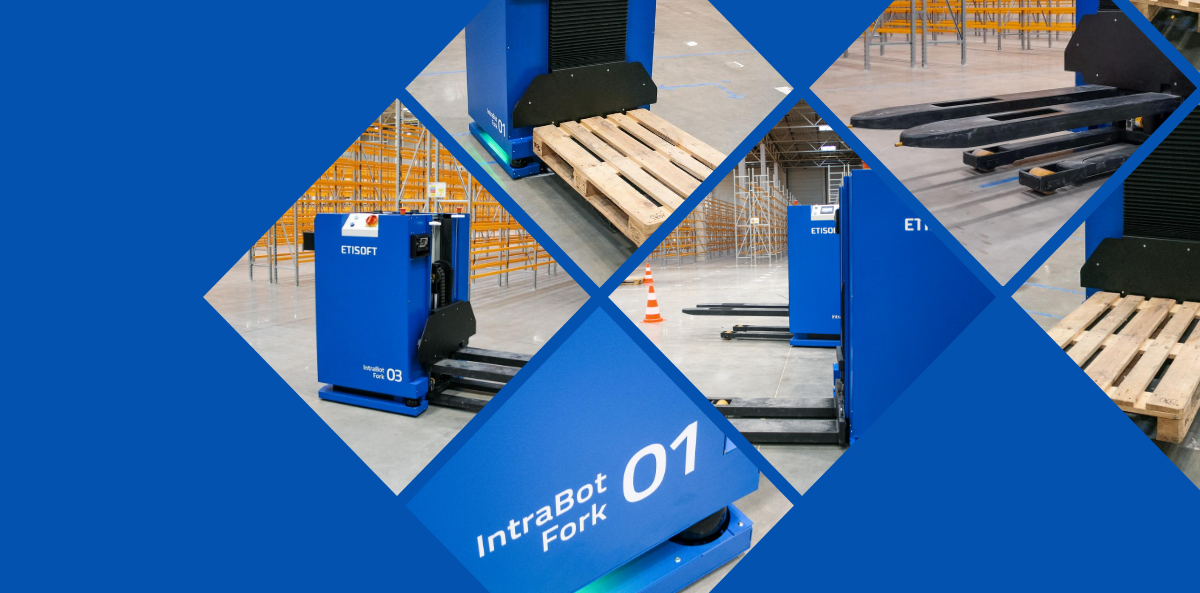
A logistics manager who collects three quotes for a system based on mobile robots usually receives three different figures for three different scopes – and no way to compare them directly. This is not the result of supplier dishonesty. Intralogistics systems are priced per project because, unlike a forklift, you are not buying a device, but throughput in a specific facility.
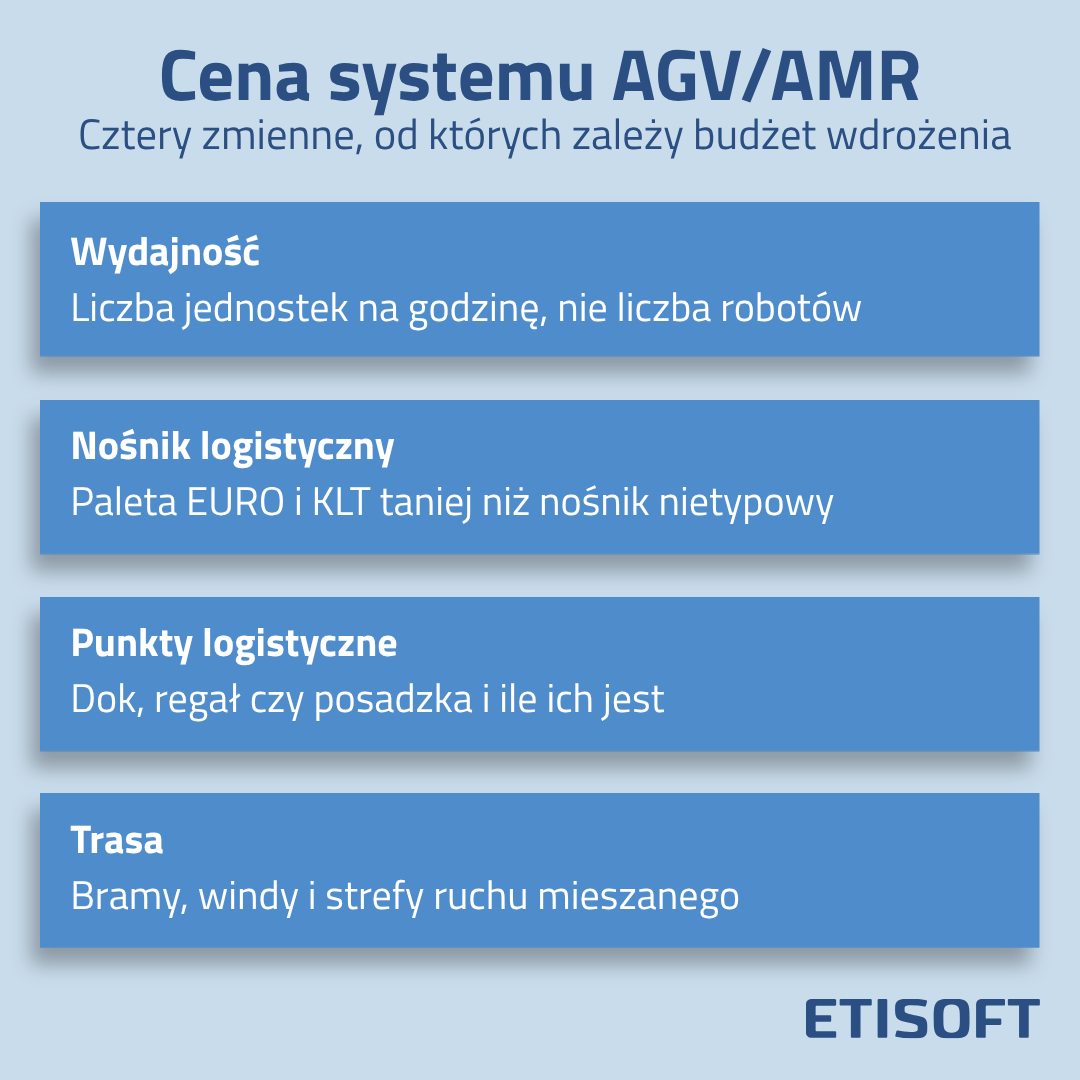
However, it is possible to identify four variables that shape the budget to the greatest extent. Knowing them, you can sensibly ask a supplier why their price looks the way it does.
1. Efficiency, or the number of units per hour
The starting point is not the number of robots, but the number of logistics units that must be delivered per unit of time. Everything else follows from this.
A simple calculation of distance and speed usually fails. Vehicles of this class move at a speed of around 5 km/h – this is the maximum speed of an IntraBot Lift robot – but every docking, stop, slowdown in a pedestrian zone, or obstacle avoidance takes away precious seconds. With a larger fleet, there is also the mutual movement of robots and the risk of congestion in bottlenecks. Therefore, a reliable valuation is based on a process simulation, not on a spreadsheet with catalog speeds.
The order of magnitude we are talking about here: in an implementation awarded in the Eurologistics competition, a fleet of three forklift robots handled component deliveries to lines and finished goods to the shipping zone with an efficiency of up to 30 pallets per hour. Three robots, thirty pallets – this is a much more useful reference point than catalog speed.
Practical conclusion: providing the supplier with real peaks, rather than a daily average, reduces the risk of oversizing the system – and thus the price.
2. Logistics carrier
Most manufacturers design mobile robots for standardized loads: EURO pallets, KLT containers, wheeled baskets. If a non-standard carrier circulates in the plant, the robot’s design – and above all its interface for picking up the load – must be adapted. This is engineering work on the supplier’s side, which translates directly into the system price.
It is not just the carrier itself that matters, but also the way it is picked up. Differences that look like details at the concept stage then determine the choice of model: one autonomous forklift will lift a EURO pallet only from the open side, another – also from the closed side. The same applies to dimensions: two models from the same series can have almost identical load capacity (1400 and 1500 kg), and a curb weight differing by twofold (1080 and 2400 kg), which translates into requirements for the floor and aisle width. If pallets are stored in narrow aisles or arrive in random orientation, this is the difference between a working and a non-working system.
3. Logistics points: type and number
The robot must pick up the load somewhere and put it down somewhere. Some models lift carriers from docks, others pick them up from racks, and still others directly from the floor. Each type of point means different mechanical requirements and different positioning accuracy.
Added to this is the number of points. A system with a dozen or so pick-up and drop-off locations is something different than a “line-to-buffer” relationship, even with the same number of pallets per hour – because the complexity of the mission logic and the number of places where repeatability must be ensured increases.
4. Route and infrastructure
The last variable is the path the vehicle has to travel: its length, but also what is on it. Gates, elevators, bottlenecks, zones with mixed pedestrian and hand truck traffic, level differences, passages between halls – each of these elements means either additional integration (a module for the robot to communicate with a gate or elevator) or additional safety requirements.
This is also where the difference between two classes of vehicles is revealed. AGV trucks carry out pre-planned tasks along marked paths and require permanent infrastructure – magnetic lines, markers, or sensors. AMR robots use cameras, lidars, and sensors to map the environment and dynamically plan the route, so they do not need navigation infrastructure. The cost does not disappear, it just shifts from the floor to sensors, computing power, and software – but changing the hall layout later costs much less because it means updating the map, not rebuilding routes.
The layer that is not in the price list
Beyond the hardware, there is software and integration – an element that is sometimes underestimated in budgets, and which determines whether the system will actually relieve people.
The fleet is managed by fleet manager software: it designs logistics processes, manages robot traffic taking into account hall infrastructure and moving employees, collects process data, eliminates collision risks, and optimizes travel routes. The second question is: where does the transport order come from? If the system is connected to a WMS, ERP, or MES, orders are created automatically based on events from the production process. If not – someone has to enter them, and part of the savings disappears.
Customization is not a luxury, it is the rule
In projects dedicated to a specific plant, system adaptation is the norm, not the exception. Personalization includes both the mechanical part (robot interface for a non-standard carrier) and the software part (communication module with the gate through which the robot is to pass). It is worth knowing this when entering into discussions – expecting a catalog price for a non-standard process usually ends in either disappointment or a system tailored to the price list instead of the process.
How to narrow down uncertainty before making a decision
A standard tool is a pre-implementation analysis, conducted before the ordering stage. Its goal is to assess the plant’s logistics processes and infrastructure and to prepare a concept for transport implementation using AGV or AMR vehicles. Etisoft – a group present on the production and warehouse automation market since 1993, whose company Etisoft Smart Solutions, today Intrabot Robotics, is one of three Polish manufacturers of AGV/AMR mobile robots – has broken this process down into six steps. The client first answers a set of technical questions about the transported load, environment, and logistics processes; then the goal of the system and the state of processes before robotization are described, environmental conditions are determined, the vehicle type is selected, and finally, a system operation map and transport implementation concept are created. A full list of technical questions that are worth preparing answers to before the first conversation with a supplier is included in the description of the six-step intralogistics system pre-implementation analysis.
The result is not just the number of robots. The analysis shows the level of required investment and the benefits after implementation – that is, it provides material for a “go/no-go” decision, not just for choosing a supplier. A supplement is sometimes a process simulation in a virtual environment, which allows verifying throughput before the equipment is ordered.
Summary
The price of an AGV/AMR system is a function of four variables: required efficiency, type of logistics carrier, type and number of logistics points, and route characteristics. Added to this is the software and integration layer, which hides the real value of the implementation.
The conclusion for the buying side is counter-intuitive: to get comparable offers, you must first describe your own process as accurately as possible. The more precise the description of carriers, points, performance peaks, and hall limitations, the fewer assumptions the supplier will make – and the smaller the difference between the quoted price and the final cost.