









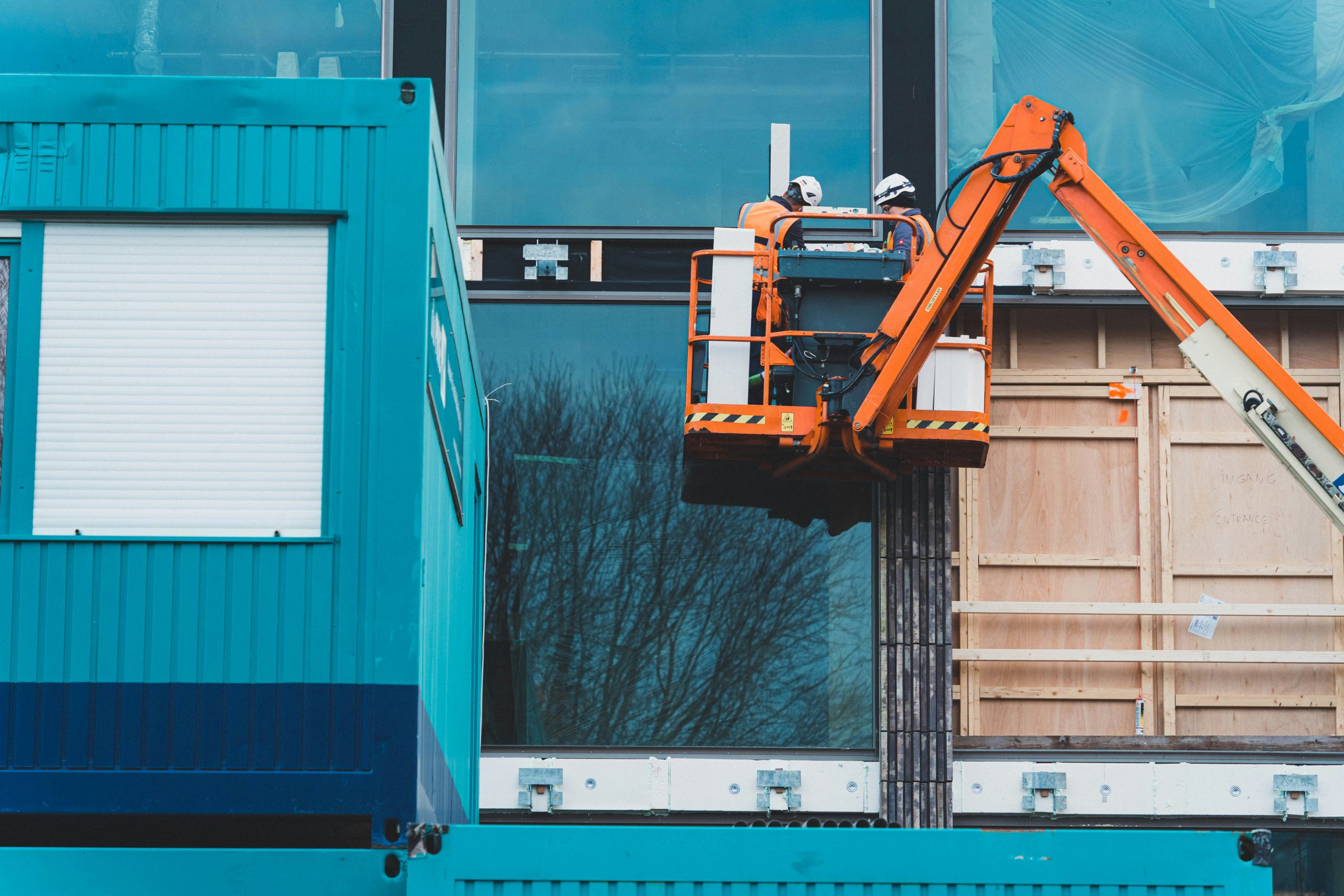
Purchasing a lift – a scissor or boom lift – starts to pay off for year-round work from about 12 working days per month, and permanently (regardless of rental price thresholds) from about 17 days. For seasonal work, the threshold rises to 20-25 days – the shorter the season, the more rental wins, and with 8 months of work per year, purchasing becomes almost impossible to justify. The “15-day” rule popular in guides is therefore close to the truth for companies working all year round – but for seasonal companies, it is definitely too low.
The break-even point (BEP) for a purchase is the number of working days per month at which the cost of owning a machine equals the cost of renting the same equipment. All figures in this article were calculated based on the real rental and service price list of PODNOSNIKI.pl (August 2026), and the reference machine is an exemplary new 12m electric scissor lift from the sales offer, purchased for 87,354 PLN net and financed with a 60-month lease. Transport was omitted from the comparison because it occurs on both sides: a typical construction project lasts about a month, so a company-owned machine has delivery and collection just like a rented one (500-1,500 PLN for each transport, depending on distance and tonnage).
How many days a month do you need to use a lift for renting to stop being profitable?
The cost of owning a 12m scissor lift (colloquially: a scissor lift) is about 2,550-2,810 PLN per month (average: approx. 2,680 PLN) and is fixed – it does not increase with the number of working days. Rental costs increase with every day, but drop significantly at price thresholds: for a 4-14 day rental, the rate is approx. 198 PLN/day, and from 15 days it drops to approx. 146 PLN/day (plus 8.5% insurance).
Values from the rental price list (August 2026), with insurance, excluding transport (symmetrical on both sides):
| Days of use per month | Rental cost (12m scissor lift) | Ownership cost | Cheaper option |
| 5 days | approx. 1,100 PLN | approx. 2,680 PLN | rental |
| 10 days | approx. 2,210 PLN | approx. 2,680 PLN | rental |
| 12 days | approx. 2,650 PLN | approx. 2,680 PLN | threshold – parity |
| 13 days | approx. 2,870 PLN | approx. 2,680 PLN | purchase (minimally) |
| 15 days | approx. 2,440 PLN | approx. 2,680 PLN | gray zone (lower rental threshold) |
| 17 days | approx. 2,770 PLN | approx. 2,680 PLN | permanent threshold |
| 20 days | approx. 3,260 PLN | approx. 2,680 PLN | purchase – savings grow |
An interesting fact you won’t find in a typical guide: at exactly 15 days, renting can be cheaper again than at 13 days because it falls into a lower price threshold. Therefore, the honest answer is: parity appears at about 12 days, but purchasing wins permanently from about 17 days of use per month – for year-round work.
What makes up the Total Cost of Ownership (TCO) of a lift?
The total cost of ownership is the sum of all expenses during the operating period, not just the price on the invoice. Real breakdown for a 12m electric scissor lift (purchase 87,354 PLN net, 60-month lease):
| Component | Amount | Note |
| Financing: 60-month lease (10% down payment = 8,735 PLN, installment approx. 1,530-1,570 PLN/mo, 1% buyout) | effective cost approx. 1,690-1,730 PLN/mo | sum of fees approx. 116-119% of value, APR approx. 6.7% (2026 market); installment in costs, VAT ongoing |
| Comprehensive insurance (AC) | approx. 167 PLN/mo | approx. 2,000 PLN/year |
| Service: maintenance package + UDT handling | approx. 525-580 PLN/mo | Full package 5,500 PLN/year; for a new machine Full+ 6,150 PLN/year (warranty inspections included); + UDT official fee approx. 800 PLN/year |
| Unplanned breakdowns (reserve) | approx. 165-375 PLN/mo | machine up to 3 years: approx. 2,000 PLN/year; older: 3,500-4,500 PLN/year (mainly batteries) |
| TOTAL cost of ownership | approx. 2,550-2,810 PLN/mo | approx. 30,600-33,700 PLN/year |
What is intentionally missing from the table: charging/fuel costs (approx. 150 PLN/mo) and transport. You incur both equally with a rented machine and your own – they are symmetrical, so they do not differentiate the purchase vs. rental comparison and do not affect the threshold.
The down payment trap. A higher down payment lowers the installment but does not lower the cost of the lease – cash leaves the company on the first day. When comparing a purchase with a rental, calculate the effective cost: (down payment + sum of installments + buyout) ÷ number of months. With a total fee sum of 116-119% of the value, it comes out to approx. 1,690-1,730 PLN/mo – regardless of how you distribute the down payment. Comparing only the installment (1,530 PLN) with the rental cost is deceiving yourself by about 160 PLN per month.
Beware of a common mistake: the price of the service package does not include the official fee for the UDT inspection (approx. 800 PLN/year) or the costs of unplanned breakdowns – which is why they appear as separate rows in the TCO table and ARE included in the total. The second trap is a flat reserve for breakdowns: the cost increases with the age of the machine. Fleet service data shows approx. 2,000 PLN per year for a machine up to 3 years old and 3,500-4,500 PLN for an older one – mainly due to battery pack replacement (one-time 8,000-15,000 PLN, once every few years). Amounts in the tens of thousands per year are a disaster scenario, not the norm.
How to calculate the break-even point (BEP) for a lift purchase step by step?
For a company that uses a lift for its own work (does not re-invoice its hours to a client), the correct model is cost parity: we look for the number of rental days per month at which the rental cost equals the ownership cost. The “machine earns X PLN per hour” model is a calculation for a rental company or a subcontractor invoicing work at height – not for a contractor using equipment in-house.
Formula: BEP (days/mo) = monthly ownership cost ÷ daily rental cost
Where daily rental cost = daily rate from the appropriate rental company price threshold + insurance (8.5% of the rate × calendar days the machine is present). For a 12m scissor lift:
- ownership cost: approx. 2,680 PLN/mo (2,550-2,810)
- rental 4-14 days: 197.60 PLN/day, with insurance approx. 221 PLN/working day
- rental 15-30 days: 145.60 PLN/day, with insurance approx. 163 PLN/working day
- BEP in the 4-14 day range: 2,680 ÷ 221 = approx. 12 days
- permanent BEP (15-30 day range): 2,680 ÷ 163 = approx. 17 days
Sensitivity analysis. The ownership cost range of 2,550-2,810 PLN/mo shifts the threshold by about 1 day (11.5-12.5 days in the short range, 16-17 in the long range). The result is therefore resistant to uncertainty regarding service and breakdowns. The biggest impact on the threshold is not service, but seasonality – see the section below.
Update the BEP quarterly – a change in the installment, premium, or rental rates can shift it. It is most convenient to keep the calculation in a spreadsheet with sections: input data, ownership costs, rental rates, result, and sensitivity analysis. Such a spreadsheet also acts as an attachment to a lease application.
New lift, used, or leasing – which option pays off the fastest?
Let’s start with a conclusion that shatters popular intuition: with full monthly occupancy, leasing a new lift (approx. 2,680 PLN/mo total costs, counting the effective cost of financing with a down payment) and long-term rental (approx. 2,640-2,780 PLN/mo) cost practically the same. The real advantage of purchasing appears only after the lease is paid off, when the cost drops to approx. 970 PLN/mo, and in the residual value of the machine.
| Criterion | New lift | Used lift | Operating lease |
| Entry cost (net) | approx. 87,000 PLN | approx. 45,000-65,000 PLN | down payment 0-10% + installment |
| Payback vs long-term rental | cash: approx. 4-4.5 years | shorter, but breakdown risk | no expense to recoup |
| Service / warranty | low, full warranty | medium to high | per contract |
| Hidden cost risk | low | high | low |
| Tax benefit | depreciation | depreciation | installment in costs + VAT ongoing |
Used machine price: 45,000-65,000 PLN
Cash purchase: current ownership costs (without installment) are approx. 970 PLN/mo, so compared to long-term rental you save approx. 1,670 PLN/mo – an investment of 87,354 PLN pays off after about 4.3 years with full occupancy. This is longer than optimistic guides promise (“2 years”), but after this time you have a machine still worth tens of thousands of PLN.
A used lift can be 30-50% cheaper, but hydraulic repairs and battery replacements are 8,000-15,000 PLN for a single breakdown, UDT registration 1,500-4,000 PLN and 2-6 weeks of waiting, and lack of complete documentation (common with imports) can prolong the procedure or make legal use impossible.
The third way is the “buy through rental” model offered by PODNOSNIKI.pl – first you rent the machine and test it in real conditions, and if the occupancy confirms the threshold, you switch to purchase. This minimizes the risk of a bad investment.
How does construction seasonality shift the lift purchase break-even point?
Ownership costs run for 12 months, while a machine in construction actually works for 8-10. The effect is greater than commonly thought – and it is seasonality, not service, that is the factor that most often determines the result:
| Active months per year | Ownership cost per month of work | Break-even point |
| 12 (year-round work) | approx. 2,680 PLN | approx. 12 days/mo (permanently from 17) |
| 10 | approx. 3,220 PLN | approx. 20 days/mo |
| 9 | approx. 3,570 PLN | approx. 22 days/mo |
| 8 | approx. 4,020 PLN | approx. 25 days/mo |
With 10 months of work, the threshold is already approx. 20 days, and with 9 – approx. 22 days – meaning the machine would have to work almost non-stop throughout the season. With 8 months (threshold approx. 25 days), the purchase practically cannot be justified. Conclusion: a company with a short season should rent, not buy – regardless of how intensively it works in the summer.
A proven strategy for year-round companies with a seasonal peak: own a base machine for constant occupancy plus peak rental for excess orders. Instead of buying a second lift for the 3-month peak, it is cheaper to reach for ad-hoc scissor lift rental — repairs and inspections are then on the rental company’s side. For winter survival, you need a cash buffer (equivalent to 3-4 installments saved in the summer) and weekly balance monitoring from November to March. A company can show a profit in the annual balance sheet while simultaneously not having cash for VAT and the installment in January.
What financial and legal risks change the entire calculation?
- Unplanned repairs. Electronics fault diagnostics start from approx. 500 PLN. A more serious breakdown (hydraulic pump, traction batteries) is a one-time 5,000-15,000 PLN. In the base calculation, reserve 2,000-4,000 PLN per year – amounts in the tens of thousands are a disaster scenario, not the norm, and should not be used to scare in the initial calculation.
- Legal consequences. Working with a mobile platform without a valid UDT decision is an offense punishable by a fine or restriction of liberty (Art. 63 of the Act of December 21, 2000, on Technical Supervision). UDT can stop operation with immediate effect. In the event of an accident involving a lift without valid inspections, the insurer may refuse payment – liability falls on the owner.
- Downtime. Every day of downtime is lost revenue plus fixed costs that continue to run. A service contract with a guaranteed response time and backup machine facilities limits this risk to a minimum – especially when the service can react on the same day.
It is worth adding a safety margin of 10-15% to the calculated threshold.
How much does annual service maintenance and UDT cost without a package?
Buying services individually, you will pay approximately: 4 required maintenance inspections at approx. 500 PLN each, service travel 300-1,200 PLN for each visit, maintenance technician assistance during UDT inspection approx. 750 PLN, resource update 1,000-1,500 PLN, and UDT official fee approx. 800 PLN. Total 6,000-11,000 PLN per year – the upper limit for remote service. A service package (5,500-6,150 PLN/year plus official fee) usually comes out cheaper and provides one deadline and one responsible party. Plan the inspection in advance – waiting time for an inspector can freeze the machine.
Can a lift purchase be financed with an EU grant?
Yes, provided the program covers fixed assets. Lifts qualify, among others, for regional operational programs and programs for SMEs. Conditions change with each call – check the current schedule at funduszeeuropejskie.gov.pl.
How much does an annual UDT lift inspection cost?
The fee for a periodic UDT inspection ranges from several hundred to over a thousand PLN, depending on the type of device and the scope of the inspection. In addition, there is the waiting time for an inspector – plan in advance so as not to freeze the machine.
How to check the technical condition of a used lift before purchase?
Order an inspection of the used lift at an independent service center authorized by the manufacturer. Check the completeness of the documentation (DTR, UDT book, service history), verify engine hours and battery condition in electric machines. Lack of documentation is a real risk of problems with UDT registration.
When is renting a lift a better solution than buying?
With occupancy below approx. 12 days per month (year-round work), with a season shorter than 11 months (threshold rises to 20-25 days), with one-off projects, and with a lack of own service facilities. Rental eliminates the risk of downtime – repairs and inspections are on the rental company’s side.
PODNOSNIKI.pl is a Polish company with over 16 years of experience and a fleet of over 400 machines. It specializes in the rental, sale, and service of boom, scissor, articulated, and telescopic lifts, and also conducts UDT training for mobile platform operators. Rating 4.9 from over 550 Google reviews. When it comes to lifts, it’s PODNOSNIKI.pl.