









During peak season, the number of deliveries arriving at a warehouse can increase in a short time without the possibility of proportionally increasing the operational area. This applies particularly to periods such as Black Friday, pre-holiday sales growth, or seasonal clearances.
The problem then becomes not the receipt of goods itself, but the efficient emptying of containers and trailers. Manual unloading requires significant employee involvement, and the time required to handle a single transport unit can limit the throughput of the entire receiving area.
In such conditions, telescopic and flexible conveyors are used. They allow for shortening the distance an employee must travel inside the vehicle and streamlining the transfer of packages directly to the next part of the warehouse process.
Why is unloading a bottleneck during the season?
An increase in the number of deliveries does not just mean more packages to handle. The number of operations performed for each vehicle also increases: positioning the trailer or container, opening the cargo space, unloading, transporting goods to the receiving area, and preparing space for the next delivery.
During manual unloading, employees move between the end of the cargo space and the goods drop-off point. With a larger number of shipments, this means thousands of repetitive movements during a single shift. Extending the handling time of a single trailer can, in turn, cause queues of vehicles in front of the docks.
During the season of increased load, it is not just the number of available employees that matters. The organization of the flow of goods from the moment the vehicle is opened to the transfer of the cargo to the next stage of the process is also crucial.
How does a telescopic conveyor improve the unloading of trailers and containers?
A telescopic conveyor is primarily designed for work at the dock and direct handling of the cargo space. Its design allows the belt or rollers to be extended towards the interior of the trailer or container.
Thanks to this, the pick-up point is located much closer to the employee unloading the goods. They do not have to carry packages a long distance to the exit of the vehicle every time. The goods go directly onto the conveyor and are then transported towards the receiving area.
This is particularly important for:
- unloading cartons and unit shipments,
- deliveries with a large number of packages,
- handling sea containers,
- seasonal increases in the number of deliveries,
- e-commerce warehouses and distribution centers.
The telescopic conveyor can also be extended and retracted depending on the current position of the cargo. This allows the workstation to be adjusted to subsequent stages of unloading without the need to manually move the device.
When is it worth using a flexible conveyor?
Not every unloading area has a fixed, straight layout. In seasonal warehouses, rented spaces, or facilities handling different types of deliveries, a solution that can be easily adapted to the current work organization is needed.
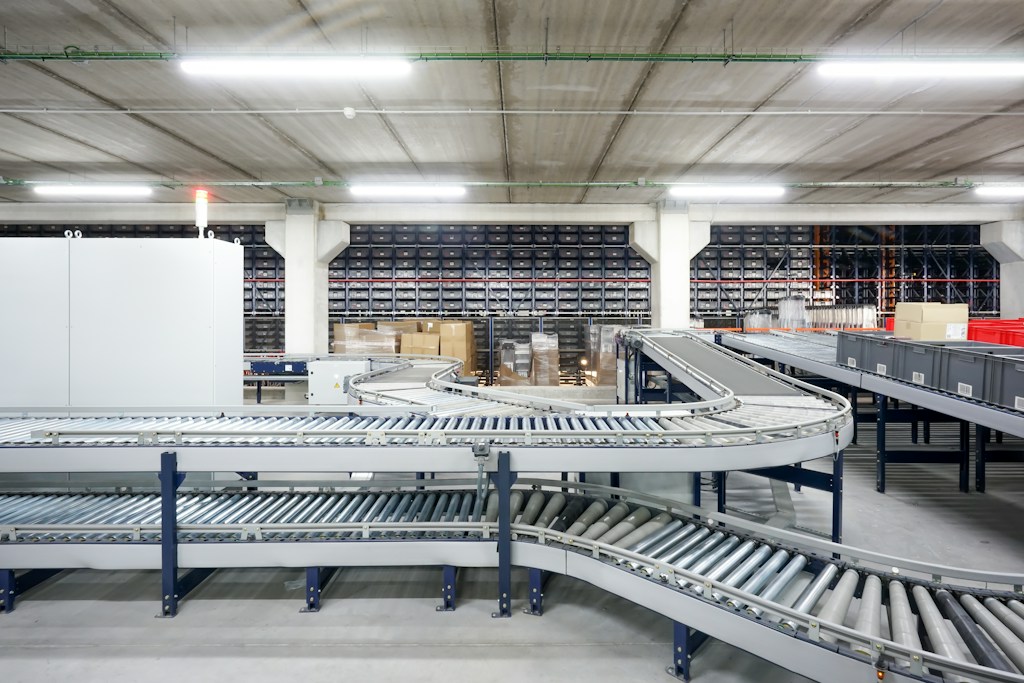
Flexible conveyors perform this function. Their design allows for changing the length and configuration of the transport path. Individual sections can be set in different directions, creating a route adapted to the position of the dock, sorting station, or goods drop-off point.
This is especially useful when:
- one area handles several types of vehicles,
- workstations are periodically reorganized,
- the flow of goods changes depending on the season,
- the conveyor must be used in different parts of the warehouse.
Unlike a fixed transport system, a flexible solution does not require building one unchanging route for the entire process.
How to choose a solution for the type of unloading?
The choice of device should primarily result from the work organization, the type of cargo, and the available space. The mere fact of having a large number of deliveries does not yet determine the choice of a specific type of conveyor.
- A telescopic conveyor will work well for repetitive vehicle unloading at specific docks. It particularly well addresses the problem of needing to reach deep into a trailer or container.
- A flexible conveyor will be more useful where the transport route needs to be changed. It allows the layout to be adjusted to the current workstation and spatial constraints.
In some processes, both solutions can work together. The telescopic conveyor picks up goods from inside the vehicle, and the further section of the flexible conveyor directs them to the designated area. Such a layout allows for separating two problems: access to the cargo and its further transport.
What does the mechanization of unloading change during peak season?
Mechanization does not eliminate the need for operators. Instead, it changes how their time is used. The employee does not have to perform the entire route between the package pick-up point and the cargo transfer point. The device takes over transport for a specific section.
With a high volume of deliveries, this translates into a more repeatable unloading process. It is also easier to organize the work of several people at one station because the flow of packages takes place along a defined path.
It is worth considering not only the efficiency of the device itself. The width and height of the dock, the length of trailers and containers, the method of dropping off shipments, available space, and the next stage of the process are also important. The conveyor should be an element of the entire goods receiving system, not a separate device placed at the dock.
Conveyor rental – a solution for seasonal load increases
Not every warehouse needs additional equipment all year round. If a higher number of deliveries appears primarily in specific months, purchasing equipment permanently may not meet the actual demand.
An alternative is to rent equipment for the period of increased load. It allows you to supplement existing equipment without permanent expansion of warehouse infrastructure. One of the companies that offers telescopic conveyor rental is Intralog. The company provides conveyors for unloading trailers and containers, with the possibility of renting for several months and a 2-month trial period. This allows you to test the solution in actual warehouse working conditions and adjust the usage period to seasonal demand.