









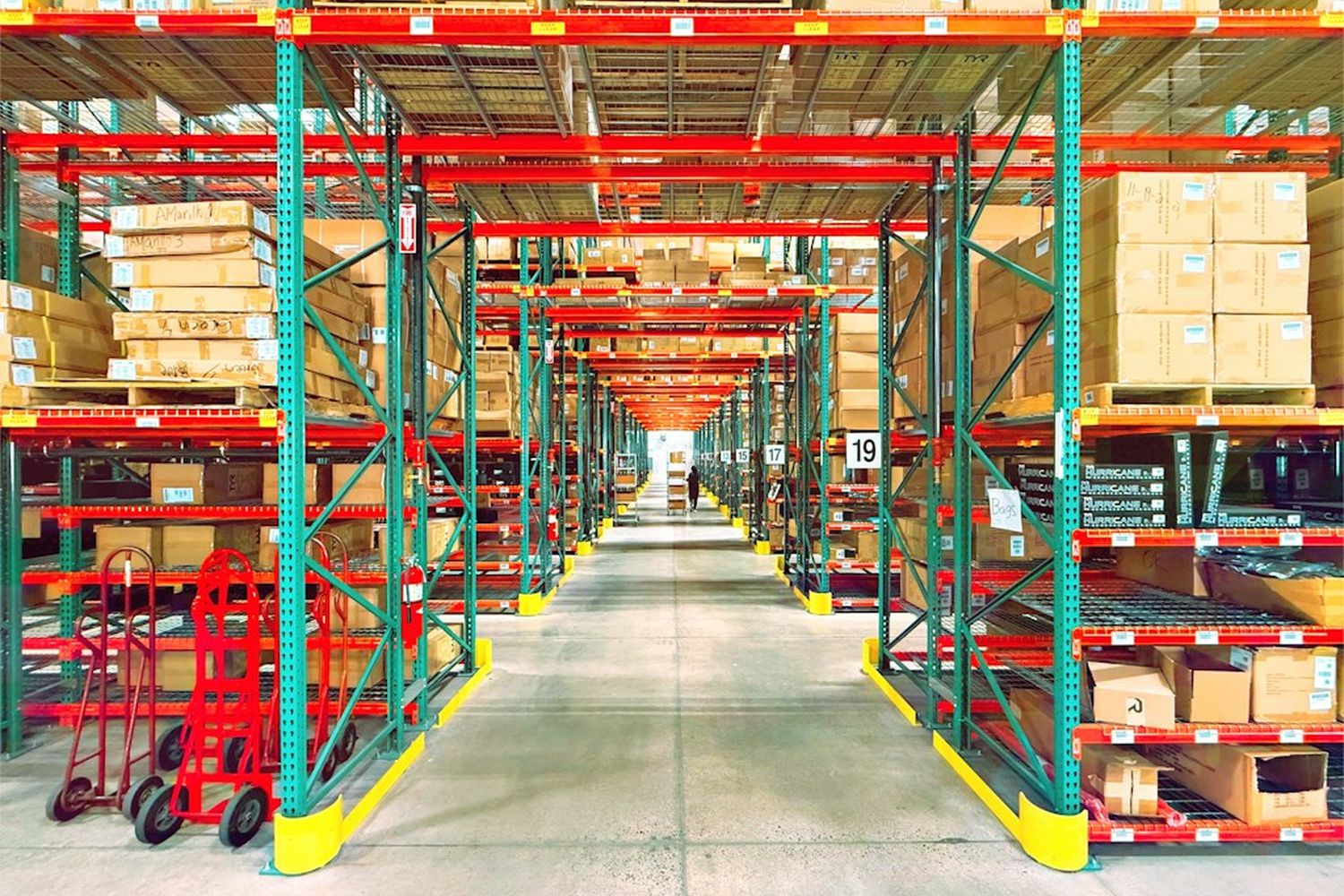
The problem of a bending rack in a warehouse, workshop, or archive is often underestimated until it becomes a real threat. This is a signal that must not be ignored. We explain how to distinguish between permissible, temporary beam deflection and deformation that threatens the structure with collapse and tragic accidents.
First signs that a rack is overloaded
A clearly bent shelf is the most obvious, but often the last, warning sign. Before that, you may notice other, more subtle signs. Pay attention to slight bulges or deformations in the uprights, especially in the lower section. Problems with smoothly inserting and removing pallets may indicate that the structure has lost its geometry under the weight. Another signal is minor paint cracks or peeling of the coating on beams and at weld points – this is proof that the metal is working under too much stress.
What is permanent deformation versus permissible deflection?
Every rack deforms to some extent under load. The key is the difference between elastic (springy) deformation and plastic (permanent) deformation. Permissible deflection is that after which the beam returns to its original, straight shape once the goods are unloaded. Technical standards precisely define its maximum value. However, if the shelf remains bent after the load is removed, we are dealing with permanent deformation. Such a structural element has lost its properties and the entire rack must be immediately taken out of service and designated for replacement.
How to correctly read a rack’s nameplate?
The basis for safe operation is adhering to the limits specified by the manufacturer, not assessing them “by eye.” Every professional warehouse rack must have a nameplate placed in a visible location on one of the frames. It contains key information, including the maximum load capacity per pair of beams (i.e., per shelf) and the maximum load of the entire rack segment (total weight on all shelves in one module). Exceeding any of these values is unacceptable and risks a catastrophe.
Uneven loading – the silent enemy of stability
Even if the total weight of the goods on the rack does not exceed permissible standards, its stability may be compromised by improper load distribution. Among the most common mistakes is storing the heaviest pallets on the highest levels, which raises the center of gravity and destabilizes the structure. Equally dangerous is placing a heavy, concentrated load in the middle of a long beam, which causes excessive deflection. You should also avoid loading only one side of the rack or only the front edge of the shelves, as this leads to uneven stresses throughout the structure.
When do mechanical damages reduce the rack’s load capacity?
A rack’s load capacity is guaranteed only for a fully functional structure. Any mechanical damage drastically reduces it. A dent in an upright caused by a forklift, even if it looks harmless, can reduce its strength by several dozen percent. Corrosion works similarly, weakening the cross-section of steel elements. You must also not ignore missing or loose bolts and anchor bolts, as they provide the rigidity and stability of the entire warehouse rack structure.
What to do when you notice dangerous deflection?
If you notice that a rack is clearly bent, deformed, or damaged in any other way, you must act immediately. The procedure should be simple and known to all employees:
- Secure the area: Immediately cordon off the dangerous area with tape or cones to prevent access by unauthorized persons.
- Inform your supervisor: Report the hazard to your direct supervisor or the person responsible for safety in the warehouse.
- Do not repair it yourself: Attempts to straighten, support, or weld damaged elements on your own are strictly prohibited.
- Unload carefully: Unloading the rack can only be carried out on the express order of a supervisor and only if they assess that it can be done safely, starting from the highest levels.
Warehouse rack inspection as the key to prevention
Responding to threats is a necessity, but the key to safety is prevention. This consists of daily, informal visual inspections carried out by forklift operators and warehouse staff, who should be trained in recognizing damage. However, in addition to this, regulations impose an obligation on the facility owner to conduct periodic, professional technical inspections. An expert then assesses the technical condition of the structure, compliance with documentation and standards, which allows problems to be detected before they become dangerous.
Conscious load management and regular inspections are not bureaucracy, but a fundamental element of ensuring the safety of people working in the warehouse. In the event of permanent damage or when it is necessary to replace the structure with a new one, it is worth choosing proven solutions. Certified metal racks with clearly defined and guaranteed load capacities are offered by the E-regaly store, providing a solid foundation for safe storage: https://www.e-regaly.pl/pol_m_Regaly-magazynowe-1720.html