









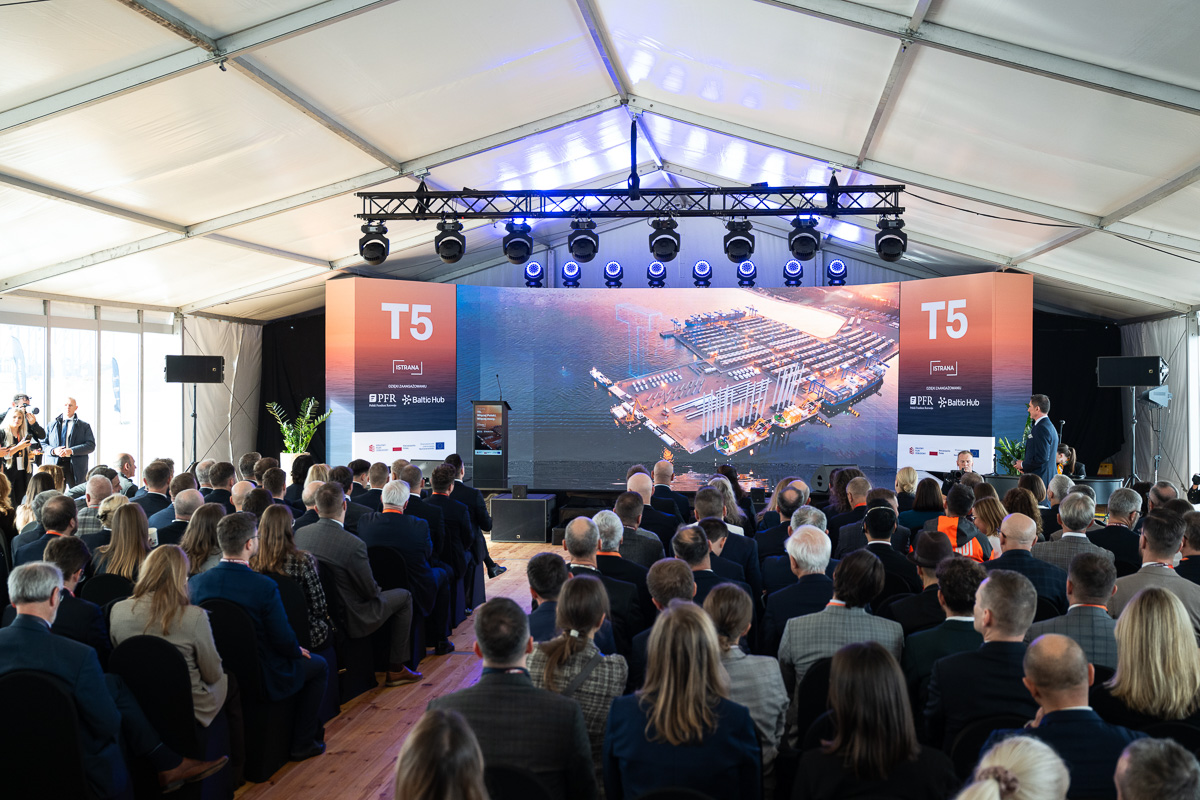
Istrana has opened the T5 terminal at the Port of Gdansk — a new installation base for offshore wind farms in the Baltic Sea. The investment, worth approximately PLN 1.2 billion gross and awarded over PLN 900 million in funding from the National Recovery Plan (KPO), provides over 21 hectares of space for the storage, pre-assembly, and loading of wind turbine components. The project was carried out under the leadership of the Polish Development Fund (PFR), the majority investor and project leader, in cooperation with Baltic Hub Container Terminal Sp. z o.o.
The T5 terminal was built on the premises of Baltic Hub to serve specialized transport and installation vessels used in the construction of offshore wind farms. The new infrastructure provides a base for energy investments in the Baltic Sea, supporting the energy transition and strengthening Poland’s energy security.
The investor is the special-purpose vehicle Istrana, in which the PFR FI FIZ AN fund holds an 85 percent stake, with the remaining 15 percent belonging to Baltic Hub. PFR acted as the majority investor and project leader, engaging in its preparation, financing, and supervision of implementation.
By commissioning the T5 terminal in Gdansk, we are adding 21 hectares of new space for the Polish economy. In the T5 project, PFR acted as the majority investor and project leader. Together with our partners, we have created a base for the development of offshore wind energy. This is an investment in energy security, lower energy prices, and the competitiveness of the Polish economy.
– says Mikołaj Raczyński, President of the Management Board of PFR.
The T5 project combines the development of terminal infrastructure with the needs of the energy transition — an area where Baltic Hub sees its role as an investment partner.
Sustainable development is a direction for Baltic Hub that we pursue both in our operations and through our commitment to the energy transition. Participation in the T5 project allows us to support the development of offshore wind energy, leveraging our experience in creating terminal infrastructure. Together with our partners, we are building a foundation for an economy based on low-emission energy sources.
– says Jan van Mossevelde, CEO of Baltic Hub.
The new infrastructure meets the specific needs of investors preparing for the construction of offshore wind farms — from storing large-scale components to loading them onto installation vessels.
The construction of offshore wind farms requires a base that allows for the safe and efficient preparation of the largest components for offshore installation. By implementing the T5 terminal, we have created infrastructure that meets these requirements and the needs of subsequent projects in the Baltic Sea. The involvement of PFR, cooperation with Baltic Hub, and funding from the KPO allowed us to translate these needs into a concrete investment. For Istrana, the opening of the terminal means moving from project implementation to providing infrastructure that will support the development of offshore wind energy in Poland.
– says Lech Paszkowski, President of Istrana.
Over PLN 900 million in funding from the KPO
The T5 terminal was built using national and European funds. The project was awarded over PLN 900 million in funding from the National Recovery Plan. This support is a significant element in financing the investment, the total value of which is approximately PLN 1.2 billion gross.
Thanks to the implementation of the project, infrastructure has been created that enables assembly and logistics operations in Poland necessary for the construction of offshore wind farms. The terminal also creates conditions for greater participation of domestic companies in the supply chain of this sector.
Infrastructure for handling the largest turbine components
As part of the investment, over 21 hectares of new land were created, and approximately 900 meters of quays with a technical depth of 17.5 meters were built. The terminal allows for the simultaneous handling of two installation vessels. Storage yards and transshipment zones have been prepared to handle large-scale turbine components, including blades, tower sections, and nacelles. In areas with increased load-bearing capacity, permissible loads reach 40 tons per square meter.
The project required extensive hydrotechnical work and ground reinforcement. Approximately 3.5 million m³ of sand were used to create the new area, and nearly 2,700 piles with a total length of approximately 85 kilometers were driven for the infrastructure foundations.
The general contractor for the terminal was the Polish NDI Group. At the peak of construction, approximately 300 people representing several dozen companies and subcontractors were working on-site simultaneously.
The implementation of T5 required the coordination of hydrotechnical, geotechnical, and construction works. For the general contractor, the opening of the terminal is also an opportunity to look at the long-term effects of this investment.
The T5 terminal is proof that when knowledge, responsibility, and ambition meet a bold vision, investments are created with significance that goes far beyond the construction itself. Today, we are commissioning a facility that will be working for the development of the region, the economy, and the people “tomorrow.” That is exactly what building the future means for NDI.
– says Małgorzata Winiarek-Gajewska, President of the Management Board of the NDI Group.
The launch of the terminal increases domestic capabilities for handling offshore investments and creates a base for cooperation between manufacturers, construction companies, logistics firms, and service providers involved in the sector’s development.
Source: Istrana sp. z o.o.