









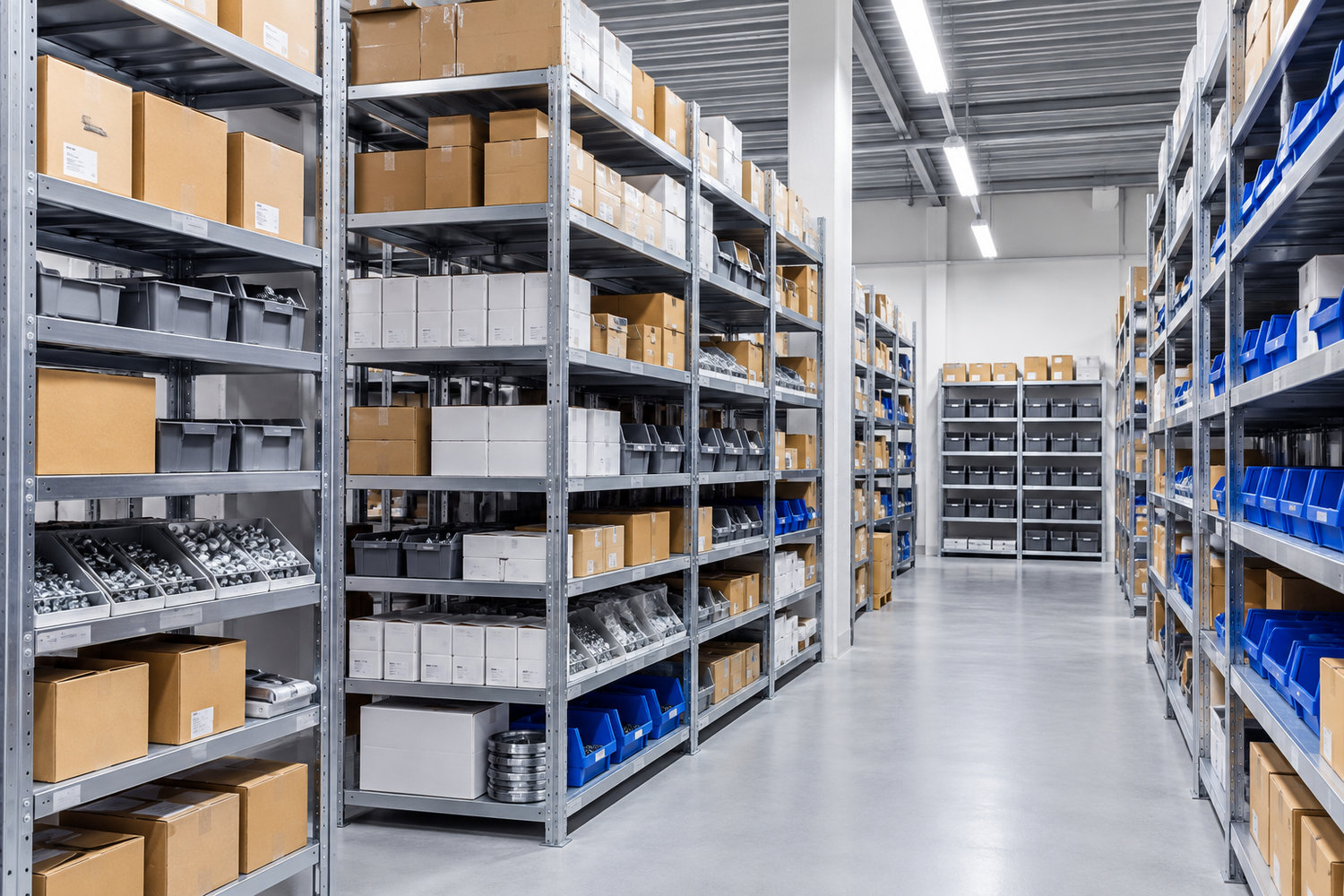
At the stage of equipping a warehouse or archive, a shelving unit seems to be a relatively simple element: we determine the height, width, depth, number of shelves, and the required load capacity. We order it, assemble it, and the topic is closed.
In practice, this very approach is the source of many subsequent problems. The mistake is rarely that the shelving unit does not fit into the room at all. More often, it turns out that the shelves are too deep, the levels are set at the wrong intervals, access to some goods is inconvenient, or after a year, there is no room for further documentation.
Therefore, when designing warehouse shelving units, it is worth looking not only at the structure itself but also at what will be stored on it and how people will use this space every day. In a warehouse, this can mean hundreds of additional employee movements. In an archive – problems with finding documentation and the gradual occupation of aisles by subsequent boxes.
Below, we describe the mistakes that, in practice, most often only come to light after the start of operation.
First we choose the shelving unit, and only then do we wonder what we will put on it
This is one of the easiest paths to a poorly equipped warehouse. The question should not be: “what shelving unit will fit against this wall?”, but: “what will we be storing on it?” A 20 cm high box requires different space, a container with small parts requires another, and a binder or archive box requires yet another.
In practice, it is worth determining at least the following before ordering:
- dimensions of the stored products,
- their weight,
- number of units,
- method of placing and retrieving,
- frequency of access,
- expected inventory growth.
Only then should the structure be selected. In an archive, the principle is identical. First, it must be determined whether mainly binders, folders, or boxes will be stored, and how quickly the documentation is accumulating. When planning an archive, the square footage of the room alone is not enough – the amount of documentation and its future growth are also significant.
A shelf that is too deep seems like an advantage until we start using it
Buyers often assume that a larger shelf means greater capacity. Not always. If a box takes up 35 cm of depth and the shelf is 60 cm deep, a space is created that is difficult to use conveniently in practice. Placing a second box at the back can, in turn, make the goods invisible and difficult to access.
In an archive, the problem is even more visible. With standard binders, a shelf that is too deep leaves empty space behind the documents or encourages placing subsequent items behind the first row. This is an apparent saving of space. A well-chosen depth allows you to use the shelf, not just possess it.
We choose load capacity “by eye”
This is one of the mistakes whose consequences can be much more serious than inconvenience. First and foremost, one must distinguish between the load capacity of a single shelf and the permissible load of the entire structure. The way the weight is distributed also matters.
The declared shelf load capacity does not mean that you can place the entire weight in one point without thinking. Therefore, before choosing a shelving unit, it is good to calculate the heaviest realistic variant, not today’s average. In a warehouse, it is easy to have a situation where light assortment is later replaced by heavier one. Similarly in an archive. One empty binder weighs little, but several dozen binders filled with documents already create a significant load.
We set all shelf levels at the same intervals
A symmetrical shelving unit looks good in a catalog. A warehouse does not have to be symmetrical. If we store 18 cm high boxes on one shelf and 35 cm high boxes on the next, setting all levels at the same intervals usually means wasting space. It is worth leaving a small clearance needed for convenient insertion and removal of the product, but not a dozen or several dozen centimeters of empty space above each level. Multiplied by several shelves, several dozen shelving units, and several rows, this already accounts for a very specific part of the warehouse volume. Therefore, a great advantage of shelving systems is the ability to adjust the height of the levels.
The project ends with the shelving units and ignores how people move
A warehouse is not a layout of shelving units on a piece of paper. It is a workplace. Goods must be brought in, put away, found, and taken out. An employee may use a cart, a ladder, a transport container, or pick several items at once. An aisle that is too narrow reduces convenience and safety. One that is too wide unnecessarily takes up storage area. The same rule applies in an archive. The aisle should allow for easy finding and removal of documentation, not just squeezing between two rows.
The heaviest things end up wherever there happens to be free space
Good organization of a shelving unit does not end at the moment of assembly. Heavier products should be stored at levels that ensure convenient and safe placement and retrieval. Lighter ones can go higher. Thanks to this, the employee does not have to regularly lift heavy elements to shoulder height or above their head. It is similar in an archive. Heavy collective boxes or large collections of documentation should be placed lower than materials that are reached for occasionally and are light.
This is a simple example that storage ergonomics starts with the layout of the shelves, not with employee training.
The warehouse is designed for the opening day, and the archive for the number of documents from today
This is a mistake that often only comes to light after a year or two. The company grows. Products, parts, materials, and documents accumulate. If we use 100% of the available capacity on the first day, every change will mean adding individual shelving units wherever a free fragment of the wall can be found. This is how chaos is created.
Therefore, when designing, it is worth considering:
- the possibility of adding subsequent segments,
- changing the height of the shelves,
- potential new product groups,
- space reserve for growth.
This is where modular systems with a basic segment and subsequent add-on elements work well. In an archive, a reserve is particularly important because documentation can grow regularly over the following years.
We treat the warehouse and the archive as two completely different worlds
The processes are different, but the mistakes are surprisingly similar. In both cases, you have to answer the same basic questions: What are we storing? How much does it weigh? How often do we reach for it? How quickly is the inventory growing? The difference lies primarily in the nature of the stored material.
In a warehouse, these can be:
- cartons,
- components,
- spare parts,
- containers,
- tools.
In an archive:
- binders,
- folders,
- files,
- archive boxes.
Therefore, good archive shelving units are, in practice, a specialized application of the same basic idea: manual storage on well-chosen shelves.
We compare shelving units solely by the price per segment
This is a particularly common mistake with larger purchases.
Two shelving units with a similar appearance can differ in:
- load capacity,
- assembly method,
- adjustment range,
- expandability,
- type of shelf,
- available dimensions.
Therefore, the price of a single shelving unit does not yet tell you how much functional equipment for the entire space will cost. Sometimes a cheaper structure requires a larger number of independent shelving units. Other times, a better fit of width or height allows for reducing the number of segments or using an additional shelf level.
From the company’s point of view, what counts is not only the purchase cost but also the cost of using one meter of available space over the following years.
A good project starts before choosing a model
With shelving units, the biggest mistakes very rarely result from the product itself. Most often, they appear earlier – at the stage of deciding on dimensions, load capacity, layout, or future method of use.
Therefore, before ordering, it is worth preparing a simple set of information:
- room dimensions,
- type of stored assortment or documentation,
- approximate shelf load,
- required number of levels,
- frequency of access,
- expected resource development.
Only with this data can one sensibly compare specific models.
At AWIZ, we specialize in metal shelving units for manual storage. This means we do not try to fit one solution to every type of warehouse. We match the structure to the products, documents, and space in which the shelving units will actually work. Because a well-designed warehouse or archive should be convenient not only on the day of assembly. It should still work well in a few years.
Mariusz Wizła AWIZ