Almost 20% of EU road transport passes through Poland, making our country one of the most important logistics hubs in Europe. At the same time, the transport industry must face mounting problems – from a shortage of drivers and rising prices to increasing customer demands.
All of this is compounded by constantly changing legal regulations and geopolitical instability. Simultaneously, sales processes are becoming longer and more complex, involving multi-stage rate negotiations, route profitability analyses, verification of regulatory requirements, and individual customer cooperation models. Contractors expect instant quotes, full transparency of order status, and access to real-time data.
In the face of such challenges, support from an advanced CRM system becomes crucial, allowing for the automation of quoting processes, workflows, contract profitability monitoring, and precise KPI reporting. One such system, favored by TSL market leaders, is Salesforce. Its flexible architecture enables integration with TMS and ERP systems, as well as telematics solutions, creating a unified digital environment covering the entire operational chain: from customer acquisition to transport execution and service settlement.

Real Operational Challenges in the TSL Industry
An advanced CRM system allows for effective operational risk management and literally helps companies “survive” in conditions of drastically increasing market requirements, which include, among others:
- Cost volatility and “guessing” margins: Traditional pricing models based on static spreadsheets fail because fuel prices, road tolls, and labor costs change very dynamically – even on a weekly basis.
- Legal paralysis: Manual registration of shipments in the SENT system and monitoring changing EU regulations (e.g., regarding minimum wages in different countries or CO₂ emissions) generates bureaucracy and the risk of high financial penalties.
- Information chaos: Sales teams waste time switching between email, TMS, ERP systems, and telematics platforms, which results in salespeople promising deadlines that cannot be met.
- Pressure to stay up-to-date: Customers from the e-commerce and manufacturing sectors expect quotes in minutes and real-time ETA previews. The “we will call you back with an offer” model is no longer competitive. Speed of response is becoming an element of market advantage.
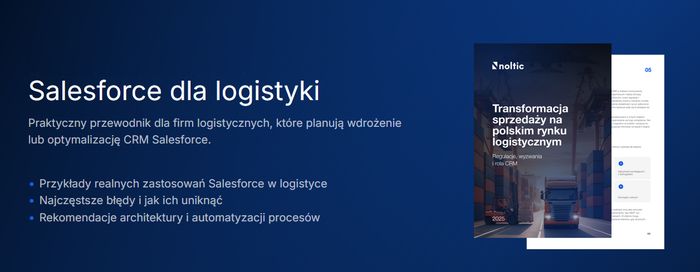
Download the article by Noltic to learn about market trends, practical CRM strategies, and implementation tips tailored for logistics companies.
Key Salesforce CRM Features for Logistics
A modern CRM addresses these challenges, becoming a real tool for reducing costs and increasing company efficiency – using proven implementation practices and quality testing of Salesforce QA and professional Salesforce data migration services.
- Contact and Account Management: Integrating CRM with TMS, ERP, and telematics systems allows for gathering all data in one place. This provides full visibility of fleet availability and up-to-date analysis of route and contract profitability.
- Opportunity and Pipeline Management: The system enables precise monitoring of the sales process, which is crucial for long and multi-stage contracts.
- Service Case Management: Thanks to Salesforce Experience Cloud, logistics companies can offer portals for customers and partners. This feature supports direct reporting of problems and monitoring their status by the customer, and ensures a faster response from the logistics team.
- Process and Workflow Automation: Automation allows for embedding legal and operational rules directly into daily tasks: handling the SENT system and document flow.
- Reporting and Dashboards: Management gains the ability to track market trends and identify disruption risks (e.g., border delays) and receives clear reports on the profitability of individual routes and sales team performance.
- Mobile Access for Field Teams: The CRM system allows for automatic delay notifications that reach sales teams without the need to contact a dispatcher and provides access to the full context of the customer and operations from anywhere.
- Predictive Analytics: Artificial intelligence allows for predicting driver shortages, warehouse congestion, or route slowdowns before they affect the customer. It also helps optimize pricing and processes to increase measurable sales.
Thanks to these features, Salesforce ceases to be just a database and becomes the foundation of modern logistics, allowing for rapid response to market and regulatory changes.
Common Use Cases in Logistics and Transport
In logistics, efficient information flow determines profitability just as much as fleet efficiency. Traditional, fragmented tools cannot cope with today’s market complexity, which is why industry leaders are opting for CRM systems like Salesforce as their digital operational foundation.
- Freight Forwarders: In this segment, Salesforce creates a single database of current data, integrating information about shippers and carriers. By centralizing transaction history and commercial terms, teams can respond instantly to customer inquiries. Standardized processes eliminate errors resulting from working on scattered spreadsheets.
- 3PL Operators and Contract Logistics: Salesforce enables tracking of multimodal shipments and document management in one system. Solutions like Experience Cloud allow partners and customers to check statuses and upload documents themselves. This ensures full process transparency.
- Fleet Management and Operations: Thanks to integration with telematics and tachographs, the platform supports real-time coordination of vehicle statuses. The system can automatically schedule inspections and trigger service notifications, which helps minimize costly downtime.
- Customer Service Centers: The system automates responses to shipment status inquiries via email or forms. Using AI (Agentforce) allows for proactive notification of route disruptions before the customer reports a problem. Cases are handled according to established SLAs, which builds trust and competitive advantage.
Practical Example
Noltic worked with a Polish logistics operator providing road, rail, inland, and sea transport. As the business grew, the sales process became increasingly difficult to manage using existing tools. Quotes were prepared in various formats and stored in multiple files, which hindered price control and slowed down communication between sales and operations. The lack of a single tool also limited visibility into what had been sent to customers and how prices were changing.
Implementing Salesforce allowed the company to build an orderly sales process based on consistent data. Sales teams gained a single place to manage leads, sales opportunities, and quotes, standardized pricing data taking into account cargo type, route, and service variants, and faster quote preparation thanks to shared templates.
Support for Logistics Companies
Noltic has practical experience in implementing Salesforce solutions for companies in the logistics and transport industry. The team combines certified Salesforce architects, developers, and business analysts who understand both CRM architecture and the specifics of industry processes.
Noltic supports logistics companies in the following areas:
- organizing complex sales cycles,
- integrating Salesforce with operational systems,
- increasing visibility of shipment and contract data,
- building dashboards reflecting actual business performance,
- preparing systems for AI utilization and further development.
Instead of one-off implementations, Noltic focuses on long-term value, system transparency, and measurable business impact.
A properly tailored Salesforce ceases to be just a CRM system. It becomes an operational foundation for sales, customer service, and logistics management.
Download the article by Noltic to learn about market trends, practical CRM strategies, and implementation tips tailored for logistics companies.