









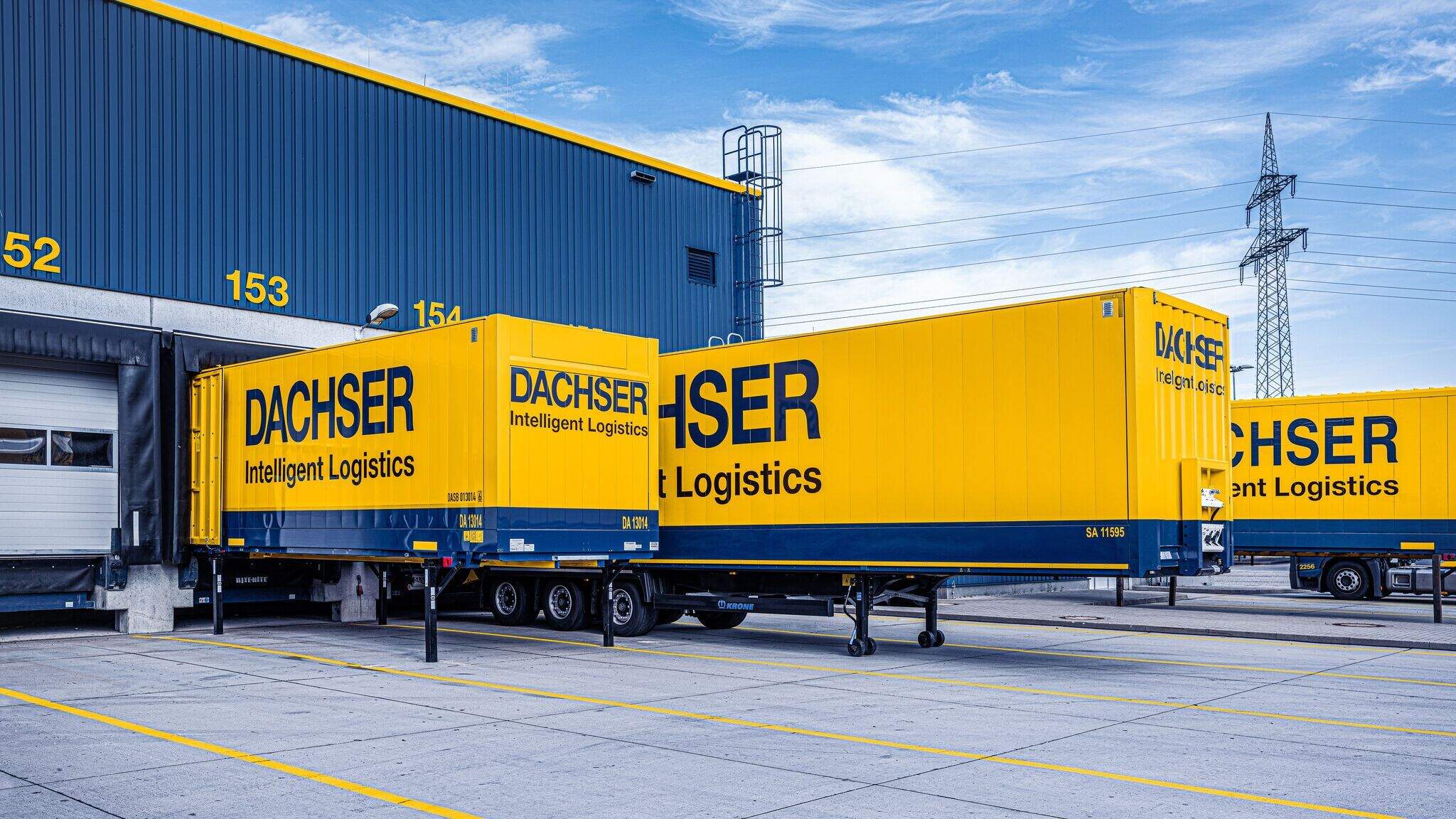
According to Statistics Poland (GUS) data, container transshipments in Polish ports increased by over 15 percent in the first seven months of this year. This growth and the expansion of terminals strengthen Pomerania’s position as a logistics hub for Poland and other Central and Eastern European countries. There is also an increasing demand for road transport, warehouse space, and contract logistics services. In response to these changes, DACHSER is preparing to relocate its Gdańsk branch to a larger facility. The company is celebrating its 20th anniversary in Poland and has been present in Gdańsk for 16 years.
The ports in Gdańsk and Gdynia play a very important role. It is one of the most dynamic port complexes in Europe, breaking transshipment records every year, especially for containers and general cargo in imports and exports. The region is becoming a gateway for the entire Central and Eastern Europe, not just for Poland.
– emphasizes Kamil Tarnacki, branch manager of DACHSER Gdańsk, in an interview with the Newseria agency.
In the first half of 2026, the Port of Gdańsk handled 41.7 million tons of cargo, which is 9 percent more than a year earlier. Transshipments of general cargo, i.e., goods transported in cartons, crates, or on pallets, increased by 17 percent to 15.2 million tons. Meanwhile, Baltic Hub handled nearly 1.6 million TEU (in terms of standard containers approx. 6 m long), 23 percent more than a year earlier. At the Port of Gdynia, total transshipments increased during this time by 3.5 percent to over 13.5 million tons. This growth was driven primarily by grain and feed, liquid fuels, and the ro-ro segment. At the same time, containerized general cargo transshipments in tonnage terms fell by 5.12 percent year-on-year. It is worth remembering that in 2025, the Port of Gdynia achieved a historic result in the container segment, handling over 1 million TEU for the first time, 5.27 percent more than a year earlier.
In 2025, the construction of the T3 terminal with an area of 36 hectares was completed at Baltic Hub. Among other things, a deep-water quay with a length of 717 m was built, adapted to handle the largest container ships with a capacity of over 24,000 TEU. Thanks to this investment, the annual transshipment capacity of Baltic Hub increased by 1.5 million TEU, to 4.5 million TEU. The entire complex currently occupies over 124 hectares and has 2.1 km of deep-water quays.
In Pomerania, we have many warehouses where contract logistics services are provided. In our operations, we combine them with road, sea, and air transport.
– says Kamil Tarnacki.
A report by the international consulting firm Savills, “Market in Minutes: Tri-City. Industrial and Logistics Market,” shows that at the end of 2025, there were 1.82 million sqm of modern warehouse and industrial space in the Tri-City – 4 percent more than a year earlier. Gross demand increased by 21 percent to 351.7 thousand sqm, and net demand by 37 percent to 273.3 thousand sqm. Another 197.4 thousand sqm remained under construction, 69 percent more than a year earlier, with 84 percent of this space already leased.
The expansion of the ports in Gdynia and Gdańsk is of great importance for our sector, especially since it includes container terminals for general cargo, and this is what we specialize in. We see a high demand for warehouses and contract logistics services in the region. The investment in a new facility is intended to provide us with greater capabilities to serve our customers. Along with the region, our branch has also been developing over the last few years. The current facility is starting to limit us, which is why we are facing another important step – moving to a larger, modern warehouse that is better suited to our current and future needs.
– says the branch manager of DACHSER Gdańsk.
As the expert emphasizes, the new warehouse is intended to increase the branch’s capabilities in handling export general cargo and contract logistics. DACHSER will remain in the same part of the region, close to the port, airport, and main road routes.
One of the key advantages of the Tri-City is its location, which facilitates the combination of different types of transport. The ports in Gdańsk and Gdynia, with the Baltic Hub and GCT terminals, create a base for maritime logistics, distribution, and export activities. This infrastructure is complemented by the A1 motorway and the S7 and S6 expressways. Savills points out that this advantage also influences the decisions of manufacturing and technology companies that are looking for locations combining efficient distribution with access to industrial facilities.
DACHSER is associated today with road transport and general cargo. And rightly so, because this is the foundation of our business. However, we operate globally, and thanks to the Global Groupage strategy, we can use the strength of our European network also in intercontinental transport. I am glad that I can talk about this strategy right here in Gdańsk, because this is where road, air, and sea transport meet naturally.
– emphasizes Anna Błażkiewicz, regional sales manager at DACHSER Gdańsk.
DACHSER employs over 37,000 people worldwide. In 2025, the company achieved 8.3 billion euros in revenue and handled 86.2 million shipments with a total weight of 46.7 million tons. In Poland, the operator has 10 branches. Last year, the company’s Polish network handled 2.2 million shipments with a total weight of over 743 thousand tons.
For customers, general cargo remains general cargo, regardless of whether they are sending their goods to Stuttgart, Lyon, Tangier, Shanghai, or Chicago. They do not have to look for many different operators – they have one partner who understands their business and can tailor solutions.
– says Anna Błażkiewicz.
The planned relocation of the Gdańsk branch is another stage in the development of DACHSER in Poland. In June 2026, the branch in Szczecin began operations at a new location, where the transshipment terminal area increased from 1.6 thousand to 3.5 thousand sqm. The terminal in Poznań was also expanded – by over 2.6 thousand sqm, to 5.6 thousand sqm. Including the part intended for contract logistics, the Poznań facility currently has over 10 thousand sqm. In 2026, DACHSER plans to allocate over 350 million euros for investments worldwide, compared to 325 million euros in 2025.
Source: Newseria