









Modern logistics is looking for solutions that not only automate processes at a global level but also realistically address everyday, micro-operational problems. One of the most critical points in the supply chain is the planning and execution process for mixed loads. Discrepancies in information between the forwarding office, the warehouse dispatch area, and the driver’s cabin generate massive time and financial losses. LOG-MAG Planner meets these challenges – a modern 2D tool that connects these three worlds into one flawless organism.
One application, two platforms: Full synergy between PC and mobile devices
The key to the successful implementation of any innovation in the TSL industry is the flexibility of the work environment. People working in the office have different habits and hardware needs than employees operating directly at the ramp or drivers on the road. LOG-MAG Planner has been designed with a hybrid architecture, offering perfect synchronization between two interfaces:
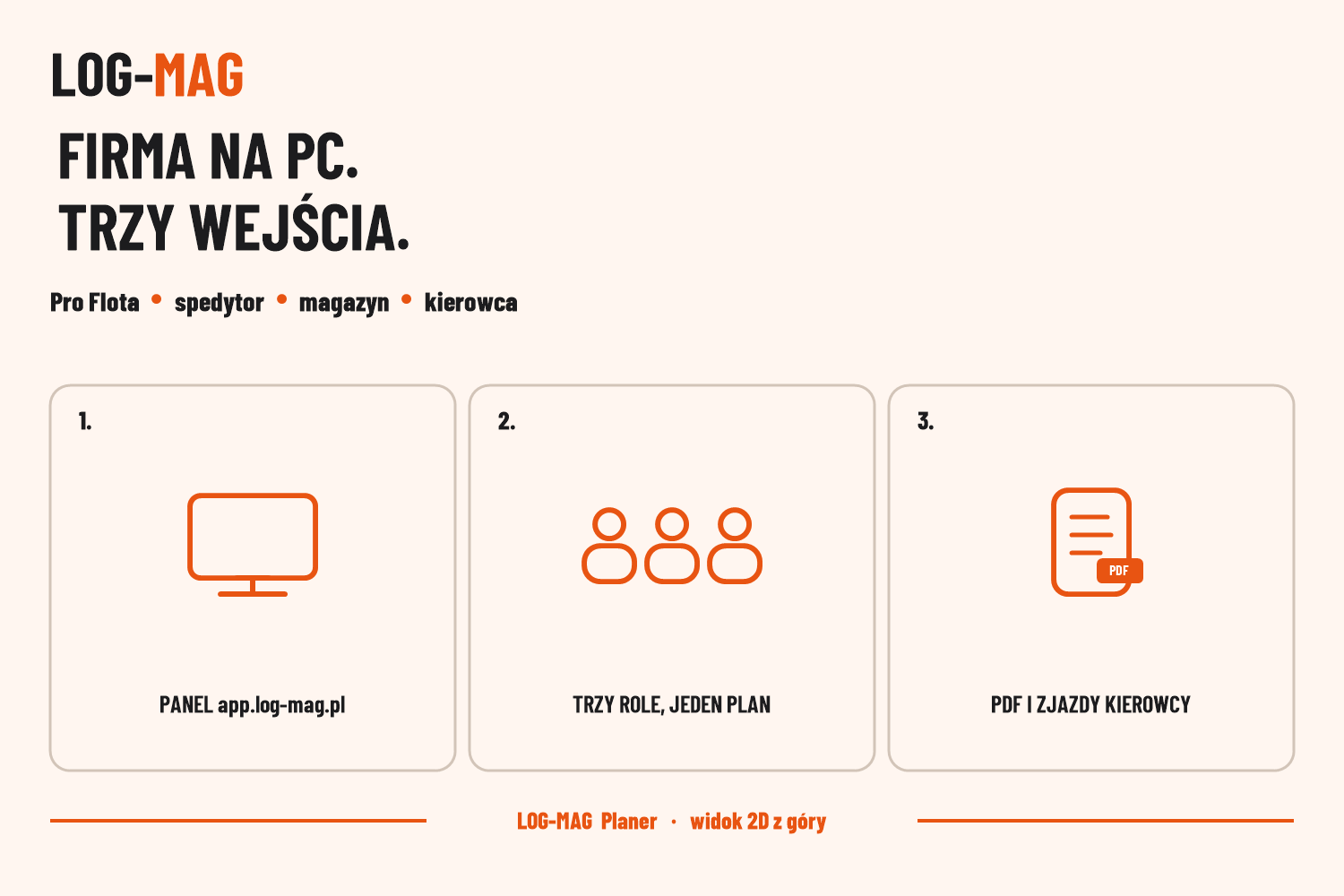
- PC Panel (Web Desktop) at app.log-mag.pl: Dedicated to forwarders, logistics specialists, and operations managers. It allows for comfortable work on a large office computer screen. This is where mass cargo data is quickly imported from Excel or CSV files, the entire vehicle fleet is managed, and unloading stages are strategically planned.
- Mobile Application (Android): Available directly in the Google Play store. This is a mobile command center for people on the “front line” – warehouse workers and drivers. It allows for instant viewing of the plan created in the office directly on a smartphone, without the need for cumbersome printing of paper diagrams.
Because the same program works identically on a phone and a computer, the entire company uses the exact same, real-time updated image of the loading space.
Station perspective: What does the application provide in practice?
Most market systems look at loading only from a bird’s-eye view, forgetting about the ergonomics of specific people’s work. LOG-MAG Planner precisely defines the benefits for each of the key participants in the process:
For the Forwarder and Logistician (Office convenience)
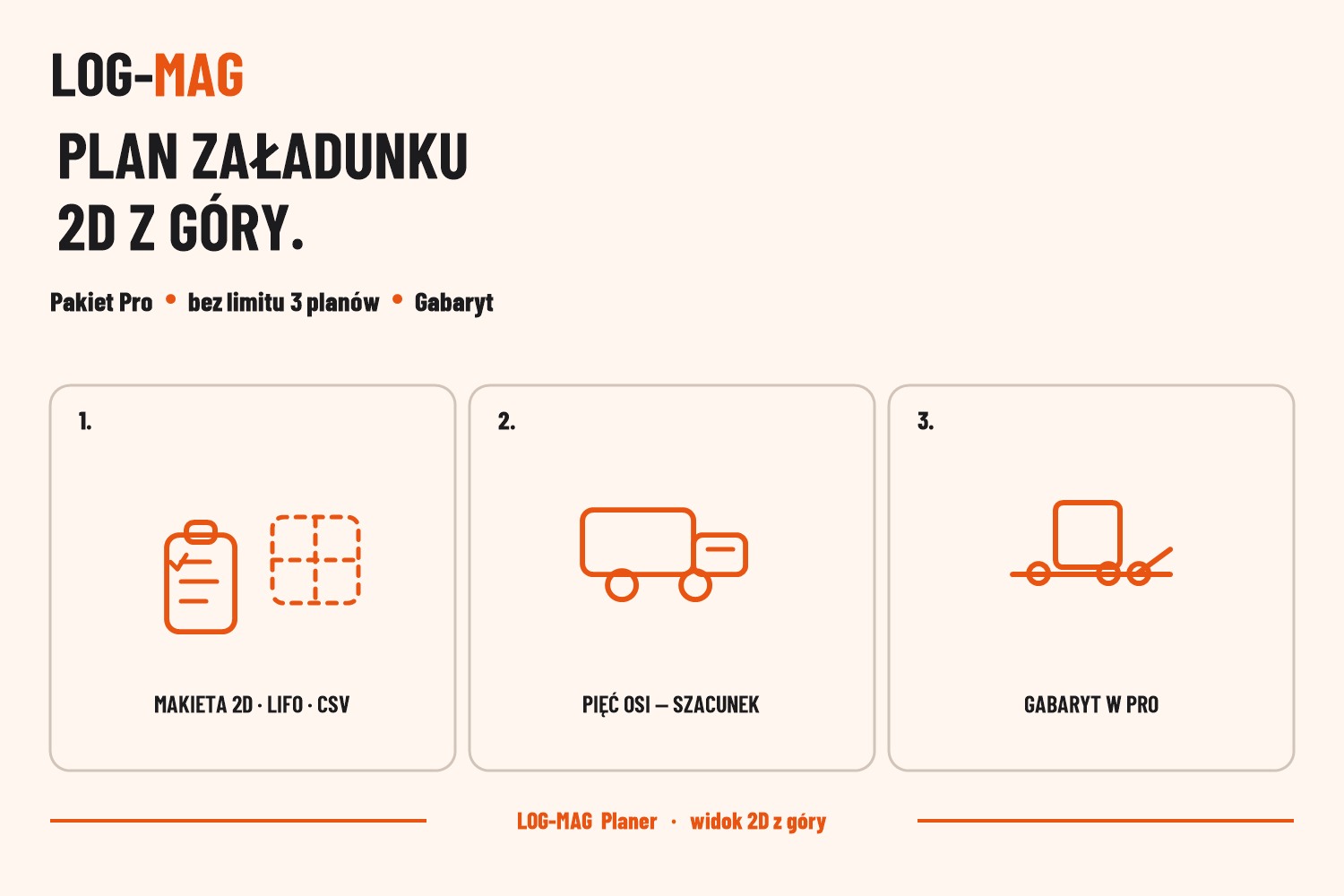
The forwarder gains a powerful verification tool. Before deciding to purchase a mixed load, they can “dry run” check in the PC panel whether the additional cargo will physically fit on the vehicle. They also receive a visual overview of axle loads for the tractor and trailer. By moving cargo blocks on the 2D layout from above, the application calculates the load chart in real-time, protecting the company from drastic fines for axle overloading during road inspections.
For the Warehouse Worker (No more guesswork)
The manual worker responsible for loading no longer needs to calculate meters on paper or arrange pallets by trial and error. Opening the application on their phone, they see a clear diagram: cabin, pallet rows, block arrangement, and doors. Most importantly, the application automatically takes into account the LIFO (Last In, First Out) principle. The warehouse worker receives precise instructions: in what order to place the goods so that packages intended for the first stop on the route are not blocked against the front wall of the trailer.
For the Driver (Safety and peace of mind)
The driver is no longer a hostage to a situation where they find out about the cargo structure only when the trailer doors are closed. Through the application on their smartphone, they have insight into the full route plan and cargo placement. They know how the vehicle’s weight is distributed and are assured that during the first stage of unloading, they will not have to manually move tons of cargo in the maneuvering yard to get to the right pallet.
Extensive ecosystem of functions: Tools for special tasks
LOG-MAG Planner is an auxiliary application that does not attempt to replace complex TMS systems, but focuses on perfect, intuitive, and flawless space visualization. Beyond basic cargo arrangement, the system offers a range of advanced modules:
- Dedicated sea container transport mode: In response to the specific requirements of port, intermodal, and international forwarding logistics, the application includes a specialized module for standardized containers. It allows for precise loading planning inside “ocean cans,” where proper balancing, maintaining a safe center of gravity, and optimal volume utilization are crucial due to strict maritime and rail law regulations.
- Oversize Module: Designing loads for goods with non-standard shapes, oversized dimensions, and weights (such as construction machinery, steel structures, or long industrial elements). The user can manually define a non-standard space outline, making the application a universal tool for both classic general cargo logistics and specialized transport.
- “My Fleet” system based on vehicle registration documents: Instead of operating on purely theoretical, universal templates, the user has the ability to map their real machine park. The program supports curtain-siders (standard and mega), solo trucks, vans (tarpaulin and panel vans), and reefers. Each vehicle can be named and assigned exact technical parameters from the registration document.
- Intelligent cargo list import (Excel/CSV): Eliminates the need for tedious, manual entry of every pallet’s dimensions. The user generates a cargo specification from their ERP or WMS system, uploads the file to the PC panel, and LOG-MAG Planner instantly transforms dry text data into ready-made, colorful cargo blocks on the vehicle layout.
- Full multilingual support from the first launch: The application automatically adjusts the interface language (available versions: Polish, English, and Ukrainian) without requiring complex phone configuration. This is a huge implementation advantage in multinational warehouse teams and among foreign drivers. The binding terms and conditions remain clearly in Polish.
Scalable solution: From individual worker to corporations
The system designers ensured that the software does not create entry barriers and is maximally flexible regarding the organizational structure of users. LOG-MAG Planner was designed with two main usage models in mind:
- For individual workers and owner-operator drivers, the system serves as a personal, mobile tool to support daily work, facilitating quick verification of orders taken from transport exchanges and allowing for flawless, independent space planning on a single smartphone.
- For business entities – from small transport companies to extensive logistics centers and forwarding departments in manufacturing companies – an automated multi-user model (PRO FLOTA) has been prepared. In this variant, the entire company account on PCs is registered centrally based on the tax ID number (the system automatically retrieves registration data from official ministerial databases). Authorization of office staff, warehouse workers, and drivers is carried out in a fully secure manner using unique verification codes sent to email addresses. This allows for seamless management of permissions within the organization without fear of fleet data or logistics plan leaks.
Summary: The digital standard of modern TSL
LOG-MAG Planner does not replace large TMS-class systems or transport exchanges and does not act as a scale. Its goal is to provide a common, reliable, and flawless operating scheme. The decision to safely hit the road is always made by the loader, the carrier, and the driver – but thanks to LOG-MAG Planner, for the first time, this decision is based on precise 2D visual data, not on intuition and guesswork. It is a simple step toward digitization that brings immediate savings on every kilometer.