










In logistics, an IT system failure can mean much more than just an IT department problem. The unavailability of a warehouse system, lack of information about shipments, or interrupted communication with contractors can quickly translate into delays, additional costs, and disruptions across the entire supply chain.
This is precisely why cybersecurity is becoming an increasingly important element of managing transport and logistics enterprises. An additional impetus is provided by the new provisions of the Act on the National Cybersecurity System (KSC), which have been in force since April 3, 2026, and implement the EU’s NIS2 directive.
For some companies, these mean new obligations that must be implemented by April 2027. It is therefore worth knowing who the regulations apply to and how to reasonably prepare an organization to meet them.
Does every transport and logistics company fall under NIS2?
No. And this is one of the most important issues to clarify at the beginning.
The new regulations cover specific entities operating in, among others, air, rail, water, and road transport, as well as postal and courier service operators. However, this does not mean that every transport, forwarding, or warehousing company is automatically subject to the regulations.
What matters most is the actual type of business conducted, the size of the enterprise, and additional criteria specified in the Act.
Importantly, even companies not directly covered by NIS2 may feel the effects of the new requirements. Enterprises subject to the regulations must take into account the security of their suppliers and service providers. This may mean additional requirements for carriers, warehouse operators, technology companies, or other business partners.
Therefore, the first step should be to verify whether and to what extent the regulations apply to a specific organization.
October 2026. What should have already been done, and what is still ahead for companies?
The amendment to the KSC has been in force since April 2026. The first significant deadline has already passed.
October 3, 2026 was the primary deadline for self-registration in the KSC Register for entities that met the statutory criteria on the date the amendment entered into force and were subject to the obligation of self-registration.
If an enterprise has not yet verified its status, it should do so immediately and determine whether it had an obligation to register.
The next important date is April 3, 2027. By this time, entities covered by the indicated adjustment period should implement the required organizational and technical solutions and begin using the S46 system, used, among other things, for reporting incidents.
For specific essential entities, the next deadline falls on April 3, 2028, when the time for conducting the first mandatory security audit expires.
In practice, this means that the coming months should be used to organize cybersecurity, rather than putting off all actions until the end of the adjustment period.
What does NIS2 mean in practice for a logistics enterprise?
Preparing for the new requirements does not boil down to creating documentation. It is primarily about the company being able to recognize threats, limit their effects, and maintain business continuity.
In the case of transport and logistics enterprises, several areas are particularly important.
Security of key systems. It is worth knowing how WMS, TMS, ERP systems, network infrastructure, warehouse equipment, and solutions used for data exchange with clients are protected.
Business continuity. What will happen if the warehouse system stops working in the middle of a shift? Does the company have up-to-date backups, tested emergency procedures, and the ability to quickly restore operations?
Supplier security. Controlling risks associated with external systems, IT services, warehouse automation, and technology partners is becoming increasingly important.
Incident response. The organization should know who is responsible for detecting threats, making decisions, and responding, even outside of standard working hours.
Responsibility of management and employees. Cybersecurity requires a clear division of duties, risk oversight, and proper preparation of people using company systems.
These areas have a direct impact on an enterprise’s ability to deliver services on time, regardless of whether it is subject to NIS2.
Where to start? You don’t have to do everything at once
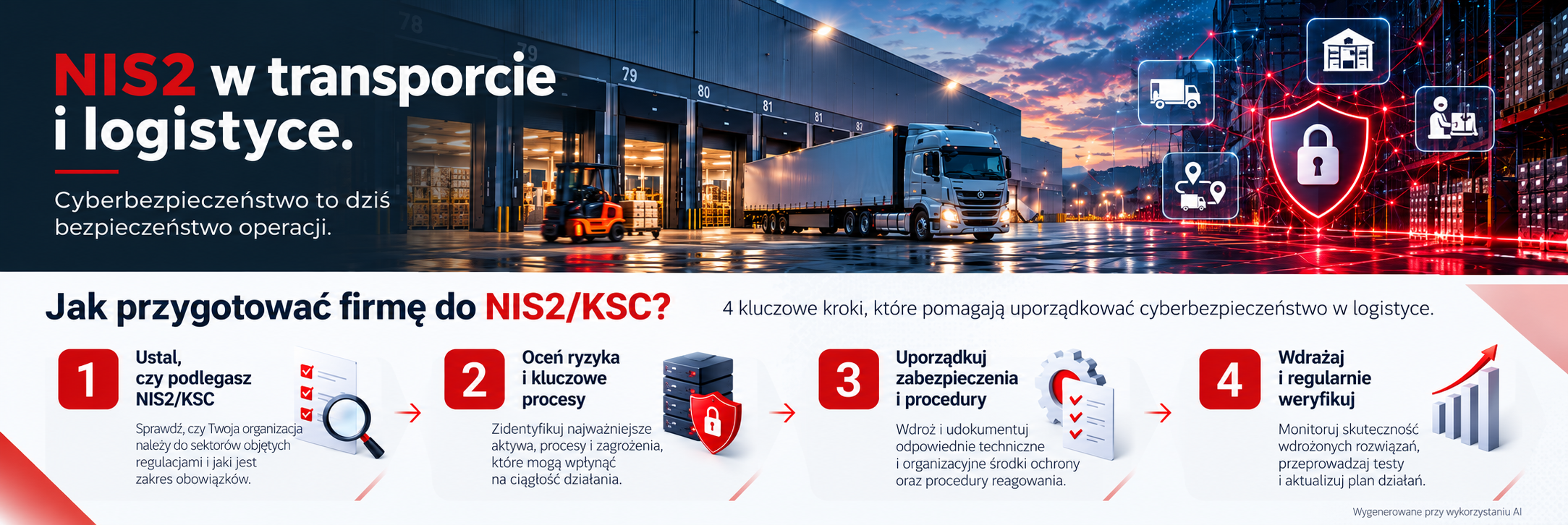
Preparing a company for new obligations is best treated as an orderly process, divided into specific stages.
- Determine if you are subject to NIS2/KSC. Verify your business profile, organization size, and obligations resulting from the regulations.
- Assess the current level of security. Check which requirements you already meet and where there are gaps. Identify the systems and processes most important for operational continuity.
- Prepare an action plan. Define priorities, responsible persons, deadlines, and necessary security measures. Not every company needs to start with expensive technological investments.
- Implement and verify. Supplement procedures, implement necessary security measures, train employees, and regularly check the effectiveness of the adopted solutions.
Such an approach allows you to use existing resources, better plan expenses, and focus on risks that can actually disrupt the enterprise’s operations.
From requirements to concrete actions
One of the challenges associated with implementing NIS2/KSC is combining regulatory requirements with the daily functioning of the enterprise. Especially in the logistics industry, where the security of IT systems is closely linked to the execution of warehouse and transport processes and customer service.
Therefore, preparation for new obligations should include both organizational issues, such as risk management, procedures, and responsibilities, as well as appropriate technical security measures, threat monitoring, and preparation for incident response.
In practice, enterprises can use the support of specialized technology partners who help combine these areas into one coherent process.
We apply such an approach at Network Experts, combining audit, advisory, and technological competencies. It includes, among other things, NIS2/KSC compliance analysis, risk identification, preparation of action plans, implementation of IT and OT infrastructure security, as well as security monitoring and incident response.
Tools supporting the management of the entire process also play an important role. An example is our proprietary vCISO Tool, which allows you to organize requirements, tasks, responsibilities, documentation, and implementation progress. Thanks to this, management and those responsible for security can monitor the implementation of actions on an ongoing basis and prepare the organization for subsequent audits.
Most importantly, however, the adopted solutions should be tailored to the actual needs and scale of the enterprise’s operations. The goal should not be to implement more tools or create documentation solely for the purpose of regulatory compliance, but to build a security system that actually supports the company’s daily functioning.
The coming months are worth using well
There are still a few months left until April 2027. This is time that enterprises covered by the new obligations can use to calmly plan and implement the necessary actions, instead of carrying them out in a rush just before the deadline.
It is worth remembering that not everything has to be built from scratch. In many organizations, there are already security measures, procedures, and solutions in place that can be used, supplemented, or properly organized. The most important thing is to know where to start and what to focus on first.
Regardless of whether an enterprise is directly subject to NIS2/KSC or must meet the security requirements of its contractors, well-prepared procedures and effective security measures have a very practical significance.
In transport and logistics, it is not just about compliance with regulations, but above all about ensuring that warehouses can operate, transport is carried out according to plan, and customers receive their orders on time.
Dariusz Piaścik, Cybersecurity Governance & Business Development Manager
Network Experts Sp. z o.o. sp. k.