










A customer places an order and immediately checks its location. They expect it to arrive quickly, even on the same day. All the pressure associated with delivery accumulates on the shortest leg of the goods’ journey – between the warehouse and the recipient’s door. This is last-mile logistics: the stage that determines customer satisfaction while simultaneously consuming the most costs and causing the most problems in the entire supply chain. Learn how to increase your competitiveness in this area.
What is last-mile logistics and why is it so difficult?
The last mile is the final stage of the route – from the local distribution point to the destination address where the package is to arrive. Theoretically, it should be the simplest, but this is usually where the greatest difficulties arise: traffic jams, lack of parking space, the recipient’s absence, or trouble finding the right building. Each of these obstacles can mean a delay. The result? This shortest leg accounts for a significant portion of delivery costs. And because it is the point of contact with the customer, every delay or failed delivery reflects poorly on the seller’s image.
Key challenges of last-mile transport
Companies dealing with delivery to the end customer point to several recurring difficulties. These are:
- time pressure – same-day or within-a-few-hours delivery is becoming a standard, not a differentiator;
- cost – last-mile transport is often the most expensive link in the chain, difficult to optimize with scattered orders;
- urban restrictions – traffic jams, clean transport zones, and a lack of parking spaces hinder movement in city centers;
- returns – reverse logistics in e-commerce can match the scale of deliveries;
- recipient expectations – flexible time windows, shipment tracking, and free delivery are often a requirement, not a bonus.
The common denominator of these challenges is distance. The further the warehouse is from the customer, the longer, more expensive, and less reliable the last mile of transport becomes. The conclusion? A very important issue is locating final warehouses as close as possible to delivery addresses. This is a way to minimize the risk of delays and problems.
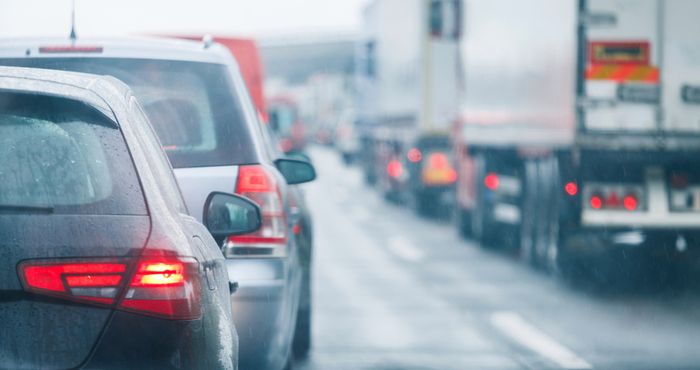 Last-mile logistics can be hindered by heavy urban traffic – to avoid delays, it is worth locating “last-mile” warehouses as close as possible to the shipment recipients.
Trends changing the last mile
Last-mile logistics has been undergoing a real transformation in recent years. Among the trends, the following play an important role:
- warehouses closer to the customer – instead of one central facility on the outskirts of a metropolis, companies are opting for a network of smaller units in cities, including dark stores serving only online orders;
- micro-fulfillment – small, densely distributed picking points shorten distance and fulfillment time;
- automation – WMS systems, route optimization, and demand forecasting allow for getting more out of every trip;
- low-emission deliveries – cargo bikes, scooters, and electric vehicles work well where delivery vans get stuck in traffic.
In last-mile logistics, success is not determined by the fleet, but by the location. A warehouse located close to recipients shortens routes, lowers costs, and provides what the customer expects most – a short delivery time – says Jakub Paradecki, an expert at the Platis agency specializing in renting halls, warehouses, and other commercial spaces in Łódź (https://platis.pl/nieruchomosci/hale-i-magazyny-do-wynajecia/). – That is why when choosing space for e-commerce, location is often more important today than square footage or cost per square meter.
The warehouse as the foundation of efficient delivery
Optimizing last-mile transport therefore begins long before the courier sets off on their route – at the stage of selecting the facility. A warehouse close to customer clusters, with good access for light vehicles and efficient loading, influences delivery time more than the best route planning application.
So, if you are growing your online sales and looking for space that will shorten last-mile transport, start by checking halls and warehouses for rent in locations near where your recipients live. This is the first step to success!