









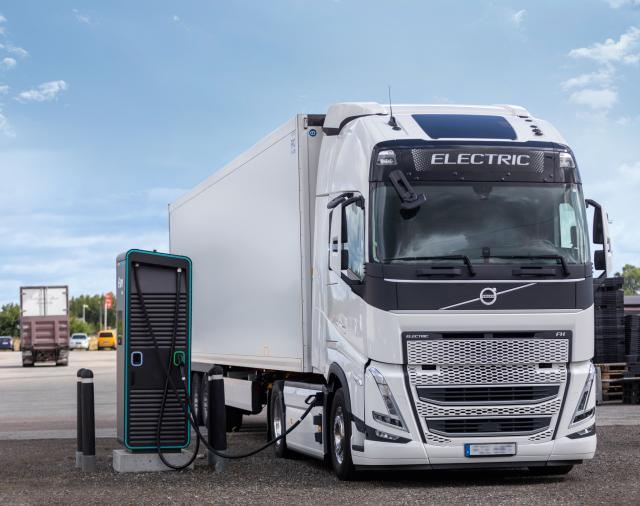
Poland is one of the European leaders in road transport, but the market for electric trucks is only just developing in our country. Such a vehicle can be a profitable business tool if a company matches it to its route profile, uses it intensively, and properly plans its charging and financing. Experts from the E.ON Talks podcast discuss the conditions for the success of such an investment.
There are approximately 200 electric vehicles of the N3 category registered in Poland, i.e., trucks for transporting goods with a gross vehicle weight exceeding 12 tons. Their implementation requires parallel planning of transport tasks, charging infrastructure, access to power, and a financing model.
In the latest episode of E.ON Talks, Anna Karanik talks to Szymon Szenicer, electromobility manager at Renault Trucks Polska, and Sebastian Ziętara, director of the Green Assets Department at mLeasing. The experts explain what the economics of the investment depend on, what tasks electric trucks are ready for today, and how to combine the transport, energy, and financial perspectives.
From a transport project to an e-truck
The starting point is the vehicle’s work profile: the type and weight of the load, the length and repeatability of routes, planned stops, and annual mileage. Charging capabilities must be assessed separately – both at the company base and on the route. Only on this basis can the vehicle configuration and battery capacity be selected for daily tasks.
Implementing a heavy-duty vehicle today is always a project created from scratch. These trucks cannot simply be bought and immediately deployed for any job. They must be tailored to the specific task for which the vehicle will be used for years to come.
– says Szymon Szenicer, electromobility manager at Renault Trucks Polska.
The technology used in electric trucks is developing rapidly. Currently available models offer a range of about 300 – 400 km, which is why they can already handle selected tasks in urban and regional distribution as well as on repeatable routes. Subsequent generations of vehicles will gradually expand the scope of their applications.
Investment profitability depends on vehicle utilization
The economic result is not determined solely by the purchase price. The calculation should include the total cost of ownership, including financing, energy, service, and the projected value at the end of the financing period. The higher cost of an electric truck can be gradually offset by lower operating costs. Therefore, annual mileage and the price of energy in the adopted charging model are of primary importance.
Electric trucks must rack up the kilometers. For us, 100,000 kilometers per year is normal. We are also talking about mileages of 120 or 140 thousand kilometers performed by a single vehicle.
– notes Szymon Szenicer.
Financing institutions evaluate such projects based on the realism of the business plan assumptions, the financial condition of the carrier, the share of own funds, and the projected residual value of the vehicle. It is crucial to demonstrate that the investment can generate positive cash flows.
The basis is a good business plan and the client’s financial commitment. The project should generate positive cash flow so that the vehicle can pay for itself.
– says Sebastian Ziętara, director of the Green Assets Department at mLeasing.
Transport and energy in one project
The vehicle project and the energy project should be developed in parallel. The company must check the available connection power, the cost of building or expanding the installation, and the charging schedule. One model is slower overnight charging at the base, supplemented by energy at publicly accessible stations during the route. The total cost is then determined by energy prices, tariffs, fleet contracts, and the share of individual charging methods.
Initial implementations help reduce the risk of subsequent investments
Companies starting electrification with a limited number of vehicles gain practical knowledge about operation, charging, financing, and energy management. Such experience facilitates the subsequent scaling of the fleet and infrastructure, as well as preparing the organization for further development of electromobility and requirements regarding emission reduction.
The latest episode of E.ON Talks shows that the profitability of an electric truck depends on the consistency of the entire project – from the selection of the route and vehicle, through the charging method, to financing. The conversation organizes the most important questions that a company should ask before starting an investment.
More information can be found on the E.ON Talks podcast website.
Source: E.ON Polska