









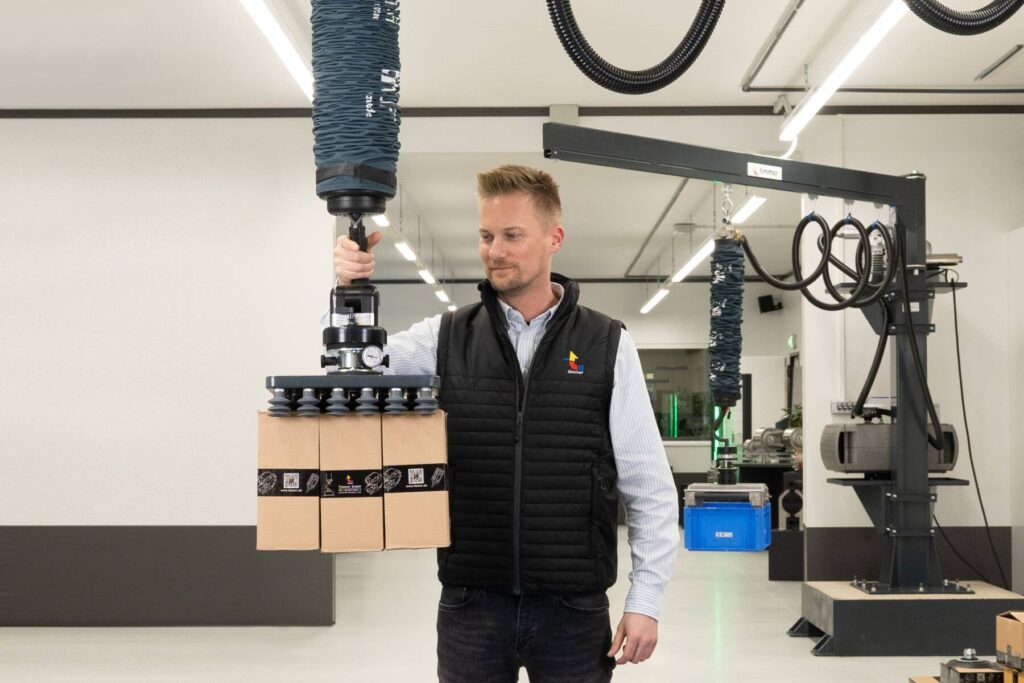
In the warehouse and at the end of the production line, there is a zone that is difficult to automate. The pallet is already there, the forklift has left, and someone has to move fifty cartons, thirty bags, or twenty rolls of film from one carrier to another. The task is too variable for a robot and too heavy for a human. This is exactly where industrial manipulators come in: material handling devices that balance the weight of the load, leaving the direction, precision, and the decision of what and where to place it to the operator.
How it works in practice
A manipulator consists of a support structure (articulated arm on a column or suspended, overhead crane or telescopic system, mobile version), an arm, an interchangeable gripper, and a drive and control system. The balancing system makes the load in the operator’s hands “lose weight.” A person can guide a carton weighing several dozen kilograms with one hand, while the device takes on the entire weight. Lifting capacities range from a few to several hundred kilograms.
Four places in the chain where a manipulator makes sense
Palletizing and depalletizing. Stacking cartons or bags on a pallet involves dozens of repetitions per hour in a forced posture. A manipulator with a vacuum gripper picks up a carton from a conveyor and places it on a pallet, with the operator only designating the location. Intelligent INDEVA rope manipulators automatically recognize the load mass and confirm a secure grip, which is important for cartons with variable contents.
Unloading bags. Bags weighing 25–50 kg (flour, sugar, granules, cement) are gripped with a suction cup for smooth packaging or a jaw gripper for contents that shift. Big bags are a separate category: hundreds of kilograms, suspended by handles and controlled emptying over a filling station.
Machine loading. Machining center, press, assembly station. The workpiece has a shifted center of gravity and must be positioned precisely. This is where a rigid arm proves useful, as it takes over the reaction moment and guides the load even outside the device’s axis.
Picking zone. Many stations, variable assortment, no space for permanent installation. A mobile manipulator, in a compact design or portable with a ballast plate, serves several points at the cost of lower lifting capacity and stability.
Manipulator vs. forklift, manipulator vs. robot
A forklift transports pallets between zones. A manipulator works on the last meter: it moves individual load units from carrier to carrier, from conveyor to machine, from pallet to rack. An industrial robot performs a programmed cycle and usually requires a fenced-off zone. A human controls the manipulator at all times, so it works in a shared space with people, and retooling when changing the assortment usually comes down to changing the gripper. Rule of thumb: a fully repeatable and unchanging process is a candidate for robotization, while a process requiring operator judgment with variable loads is the territory of a manipulator. Both solutions are increasingly working side-by-side, with autonomous mobile robots transporting material between stations.
What changes after implementation
Three effects appear together. The first is health-related: the operator stops lifting, so the source of spinal strain typical of repetitive work disappears. The second is efficiency: an employee who is not fighting the weight maintains a steady pace throughout the entire shift without increasing the headcount. The third concerns quality: a secure grip prevents damage to the packaging and spilling of material, which is a tangible cost for expensive raw materials.
Where to start the selection
Start with the load: mass, dimensions, surface, center of gravity. Then the reach and layout of the station, followed by the drive. Pneumatic, when the plant has an efficient compressed air installation and the loads are heavy. Electric, when the process requires precision, the mass of the loads changes, and operator safety is a priority. Vacuum for fast handling of cartons, boards, glass, and sheet metal. A review of devices, including INDEVA industrial manipulators, can be found in the offer of DHC from Katowice, the exclusive Polish distributor of this brand, which has been selecting and servicing material handling systems throughout Poland for over 30 years.