









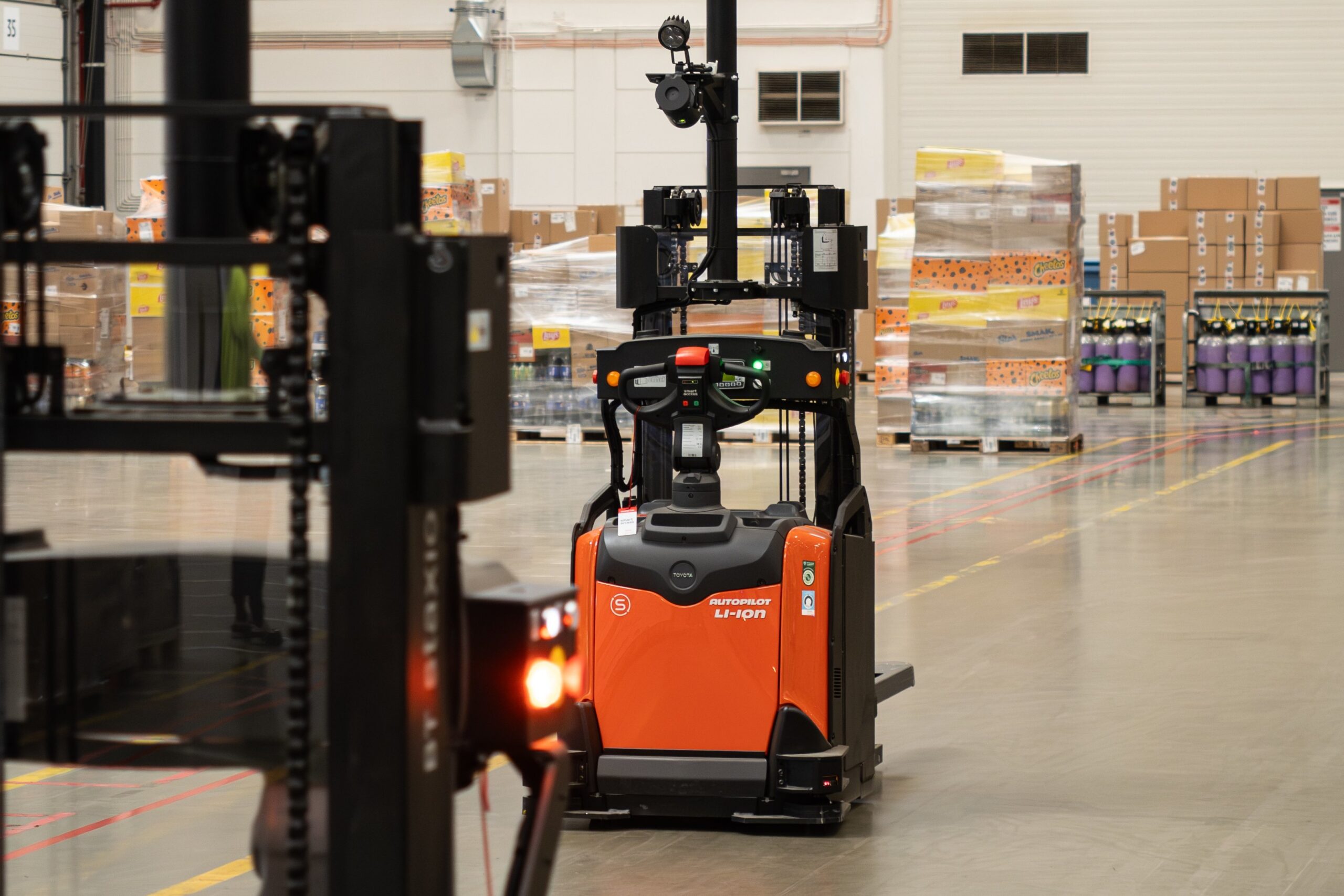
ID Logistics, a contract logistics operator, has implemented Automated Guided Vehicles (AGVs) at its logistics center in Mszczonów, which serves PepsiCo products. Three vehicles are responsible for moving pallets ready for shipment from the wrapping line to the loading docks, completing over 860 pallet transports every day. The automation is intended to increase the quality and repeatability of the process, reduce the risk of errors, and ensure full control over pallet flow in the outbound zone.
The implementation of AGVs covered one of the stages of PepsiCo’s logistics operations – the transport of finished pallets between the wrapping line and the loading docks. Previously, this task was performed manually.
The project was preceded by an analysis of pallet flows and Proof of Concept (PoC) tests. When designing the solution, factors such as varying pallet heights, the throughput of the wrapping line, the availability and capacity of loading docks, and significant fluctuations in the number of pallets prepared throughout the day were taken into account.
Our goal was to increase the stability and quality of this part of the process, reduce the possibility of human error, and replace repetitive manual tasks with an automated solution. This is particularly important in the outbound zone, where a large volume of pallets is handled every day, and correctly directing each one to the appropriate zone has a direct impact on the efficiency of subsequent operations.
– says Wojciech Karaś, Project Manager at ID Logistics.
From launch to stable operational performance
The official production launch of the solution and its technical acceptance took place in July of this year. The first months of operation were dedicated to a ramp-up phase, i.e., gradually fine-tuning the solution to actual operational conditions.
The launch process included monitoring the performance of the vehicles, verifying their efficiency, identifying bottlenecks, and correcting the logic controlling vehicle movement. Based on the first weeks of operation, changes were introduced to the software directing vehicle traffic, the method of supplying individual docks, and communication between vehicles in the pallet pickup zone.
Automation reduces the risk of error
One of the most important changes after the AGV implementation is greater control over pallet flow. The vehicles direct them to locations defined in the system, eliminating the possibility of incorrect cargo placement. The solution also allows for real-time tracking of the location of a specific pallet.
AGVs also help identify incorrectly prepared pallets. If the system identifies a problem, e.g., related to labeling, they are directed to a special zone where they can be verified.
As part of the process optimization, ID Logistics and PepsiCo introduced additional operational improvements, including reducing fluctuations in the number of pallets entering the system at different hours, changing the timing of their scanning, and adjusting the wrapping method. These actions allowed for better utilization of the vehicles’ capabilities and increased process stability.
Measurable effects and further optimization
The project assumes approximately 10% savings in the automated process, with a projected return on investment period of four years. At the same time, ID Logistics points out that the main measure of the implementation’s success is the improvement in quality, stability, and control over pallet flow, as well as the reduction of repetitive manual labor.
After the first months of operation, the solution is achieving 90–102% of its target efficiency, depending on the day. In the case of new, complex technologies, reaching full efficiency can take many months, which is why ID Logistics and PepsiCo evaluate the results of the implementation so far as good. Further improvements introduced by the operations team are intended to allow for continued utilization of the potential of the automated vehicles in Mszczonów.
When implementing solutions, we focus primarily on ensuring they address a specific operational problem. We are committed to improving individual elements of the process and achieving measurable effects in daily warehouse work. The AGVs in Mszczonów are an example of such a practical approach to automation.
– adds Wojciech Karaś.
At PepsiCo, we are constantly looking for opportunities to improve our processes, and automation is a tool for us to build an increasingly efficient and reliable supply chain. This is particularly important in Poland, where our production plants supply not only the domestic market but also those in other EU countries. Therefore, just as important as the development of the plants themselves is modern warehouse and logistics infrastructure that allows us to efficiently handle this scale of operations. The implementation of AGVs in Mszczonów is a good example of this approach: step by step, we are perfecting specific elements of the process, using technology where it translates into higher quality, predictability, and operational efficiency.
– says Marcin Chmielewski, National Logistics Manager at PepsiCo.
Source: ID Logistics