









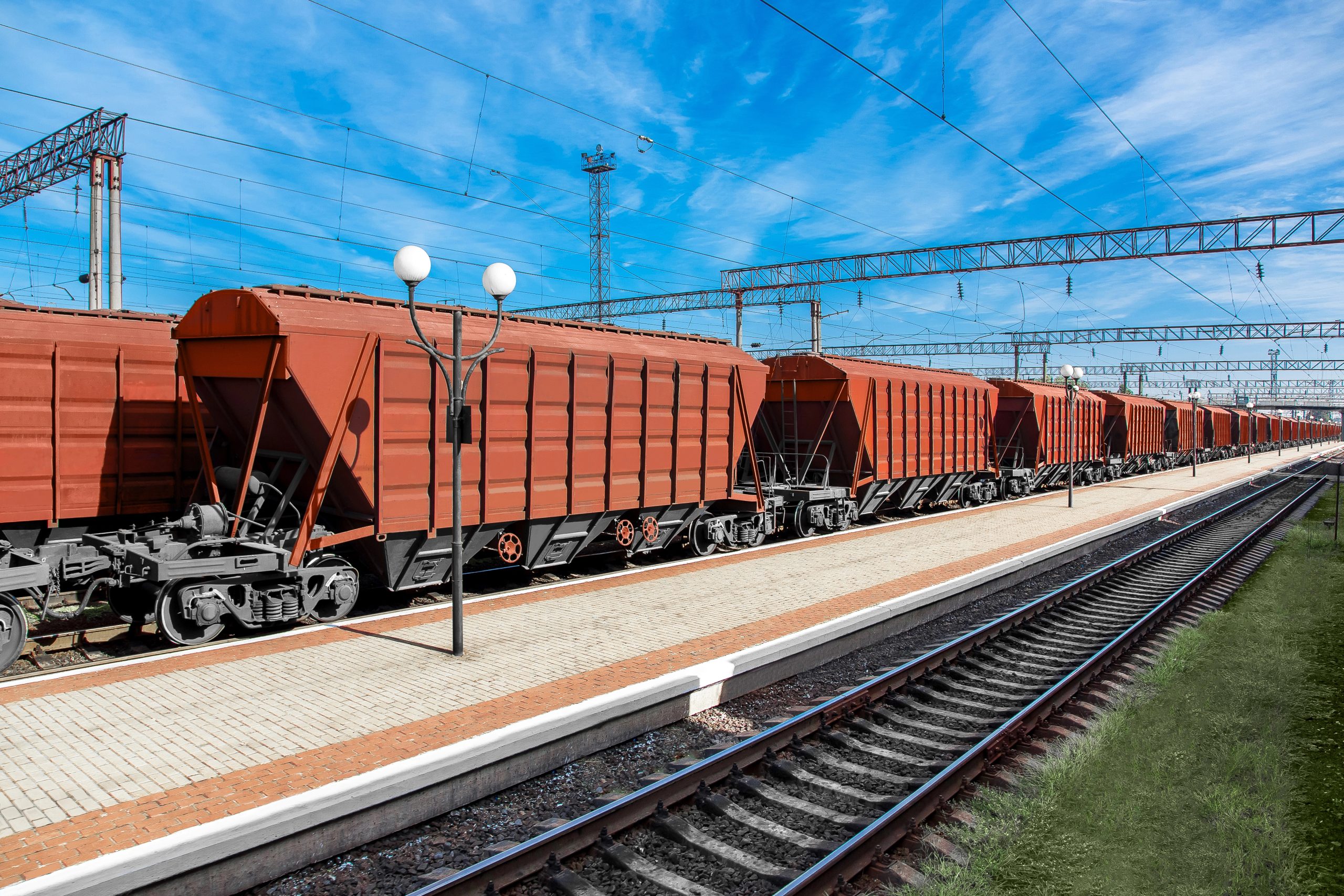
The rail freight market in Europe has been in a downward trend for several years. A weakening tendency in the segment has been visible since 2019. After a period of temporary recovery in 2021–2022, both the mass of transported goods and transport performance have been falling since 2023.
In 2025, a total of 1.5 billion tons of goods were transported across 31 European countries (including Poland). Compared to 2024, this represents a 3% decrease (since 2024, Eurostat data has also included statistics on freight transport in Ukraine, which significantly impacted the data for the entire market).
Out of the 31 countries, 23 experienced a decline in the mass of transported goods, with the largest drops recorded in Ukraine, Germany, and Poland. These 3 countries together accounted for over 47% of the freight transport market share (transport in these countries totaled 707 million tons, of which 328 million tons were in Germany, nearly 218 million tons in Poland, and 161 million tons in Ukraine).
The largest decline in absolute numbers occurred in Ukraine, where transport decreased by 13.6 million tons. The largest increase in mass (by 4.7 million tons) was recorded in Norway, which also meant the highest year-on-year growth rate at 15.9%. Among the European leaders in freight transport, growth was also recorded by: Austria (up 2.3% from 94 million tons to 96.2 million tons), France (up 1.2% from 78.3 million tons to 79.2 million tons), and Italy (up 0.5% from 94.4 million tons to 94.9 million tons).
Freight transport dynamics fell the most in Ireland (by 37.7%), where rail freight transport has been regularly declining over the last few years. This situation is influenced by having the shortest network of electrified lines in Europe. In 2025, there was also a significant restriction on rail connections accessing port infrastructure in Dublin due to the modernization of the so-called “Alexandra Road,” which is the direct access route to port terminals. The modernization is scheduled to last until the autumn of 2026. The lack of direct rail transport to the port resulted in the redirection of all cargo to road transport until the modernized line reopens.
Apart from Ireland, the largest percentage drops were dominated by smaller and medium-sized European countries in terms of area. Against this background, Poland was one of the countries that felt the declines most mildly. A year-on-year decrease in mass of 2.5% placed our country, along with Germany, closest to the European average for 2025 (the average decline rate for 31 countries was 3%).
Falling ton-kilometers
Transport performance for the 31 countries reached 474.4 billion ton-kilometers in 2025. Compared to 2024, this parameter recorded a decrease of 4.8%. Even larger declines were seen in those countries for which Eurostat had been collecting data since at least 2016 (thus excluding Bosnia and Herzegovina, Serbia, and Ukraine). The largest volume of transport performance was attributed to Germany. In 2025, 123.5 billion ton-kilometers were realized there, which translated into a 26% share. Ukraine is second with a 20.9% share. Poland, with an 11.9% share, is the third country in Europe in this respect. However, these three countries recorded declines in transport performance in absolute values.
Growth in transport performance and European market share was recorded by France, Italy, and Austria. In 2025, France simultaneously recorded the highest growth in transport performance in absolute values (1.71 billion ton-kilometers more than in 2024, 34 billion ton-kilometers compared to 32.2 billion ton-kilometers in 2024). Austria and Italy, on the other hand, saw increases of 0.66 and 0.63 billion ton-kilometers, respectively. The largest decline in transport performance by absolute value was in Ukraine (a decrease of 14.2 billion ton-kilometers), Germany (2.8 billion ton-kilometers), and Poland (2 billion ton-kilometers).
The highest growth rate in transport performance (14.7%) occurred in Montenegro, even though transport by mass of goods increased in that country by only 2.1%. The second highest growth rate in transport performance (8.7%) was recorded in Greece, and the third in Finland (6.3%). The largest declines in transport performance dynamics were seen in the same countries that also recorded the largest percentage drops in mass. In 2025, as many as 15 countries had a share in total transport performance of less than 1%.
The average transport distance of 1 ton in 2025 decreased compared to 2024 by only 5.9 km and amounted to 316.2 km. The highest values for this metric were in Ukraine (614.3), Greece (454.1), and France (428.7 km). In Poland, the average transport distance was lower than the European average and amounted to 258.1 km.
The 31 countries in the Eurostat study are: Austria, Bosnia and Herzegovina, Bulgaria, Croatia, Montenegro, Czech Republic, Denmark, Estonia, Finland, France, Greece, Spain, Netherlands, Ireland, Lithuania, Luxembourg, Latvia, North Macedonia, Germany, Norway, Poland, Portugal, Romania, Serbia, Slovakia, Slovenia, Switzerland, Turkey, Ukraine, Hungary, and Italy.
For more data related to passenger and freight rail, it is worth consulting the Report on the functioning of the rail market. The current edition, with data for 2025, can be found on the Office of Rail Transport website.
Source: Office of Rail Transport