









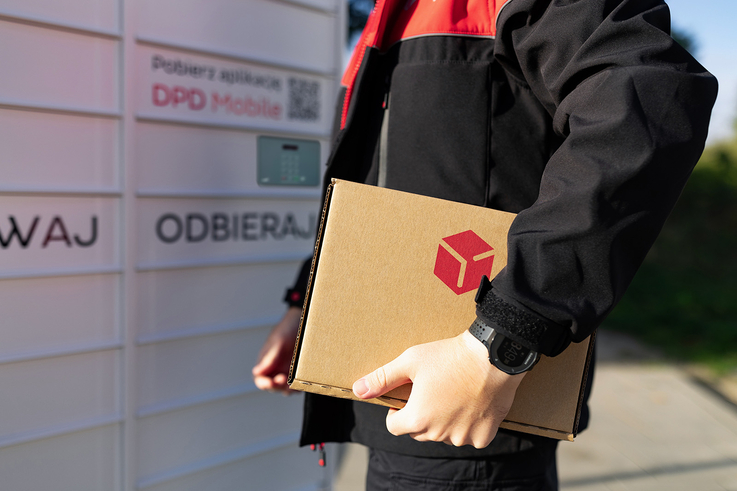
DPD Polska, in cooperation with the Maritime University of Szczecin and the Polish Association of the Blind (Pomeranian District), has conducted a comprehensive study on the accessibility of parcel lockers – the first of its kind in Poland. Based on the conclusions from experiments involving people with visual and mobility impairments, the company has introduced a series of changes to DPD Pickup lockers and the DPD Mobile application, making it easier for people with limited mobility, the blind and visually impaired, and seniors to use the services.
In 2025, DPD Polska, in cooperation with the team from the Faculty of Transport Engineering and Economics at the Maritime University of Szczecin and the Polish Association of the Blind (West Pomeranian District), conducted comprehensive research on the accessibility of parcel lockers. This is the first initiative of its kind in Poland.
The study included four experiments involving people with various types and degrees of disability, including wheelchair users, blind and visually impaired individuals, and those with mobility limitations. We also used an age simulation suit, which allowed us to experience the barriers that elderly people face on a daily basis. Every aspect of operating the locker, from the ability to approach it, through the accessibility of the compartments, to the usability of the mobile application, was evaluated under real-world conditions and translated into specific recommendations.
– comments Dr. hab. Stanisław Iwan, Prof. PM, Dean of the Faculty of Transport Engineering and Economics at the Maritime University of Szczecin.
Audit of DPD Pickup parcel machines
Based on the recommendations of the Maritime University, DPD has taken concrete actions, both at the machines themselves and in the application. Pin-pad panels have been lowered in all DPD Pickup parcel lockers so that people in wheelchairs or with limited hand mobility can conveniently enter the pickup code. Tactile markings have also been added to make it easier to locate the panel. Furthermore, an Easy Access Zone has been designated in the lockers – compartments placed at a height of 80-130 cm, which is the most convenient range for wheelchair users, the elderly, and those with limited mobility.
The audit also covered the placement of individual machines – adapted parcel lockers are located on flat, paved surfaces, with a minimum of 1.5 m by 1.5 m of free space in front of the machine and no vertical obstacles, such as bollards or road signs.
In parallel, DPD has adapted the DPD Mobile application to VoiceOver and TalkBack technologies. As a result of the changes made, 87 percent of the people participating in the study rated the accessibility of the application as “very good” or “good,” and 80 percent considered the navigation to be intuitive and logical.
The company declares further implementation of accessibility solutions in the DPD Pickup parcel locker network.
According to the “E-commerce in Poland” report [1], the percentage of online shoppers aged 50+ increased from 12 percent in 2015 to 35 percent in 2024. This is a nearly threefold jump in less than a decade. At the same time, more than 4 million people with disabilities live in Poland. Furthermore, according to Statistics Poland (GUS) data, the percentage of people aged 60 and over in Polish society exceeds 26 percent, representing a group of nearly 10 million people. For us, this is a clear signal: the accessibility of parcel lockers is not just a matter of social responsibility, but above all a response to the real needs of a growing group of customers. Our goal is to adapt as many points in our network as possible to the needs of the elderly and people with disabilities.
– comments Rafał Nawłoka, CEO of DPD in Poland.
[1] “E-Commerce in Poland” report [E-Commerce in Poland. Gemius for e-Commerce Polska, Gemius Polska 2015] and “E-commerce in Poland 2025” [E-commerce in Poland, Gemius Polska 2025]
Source of information: DPD