










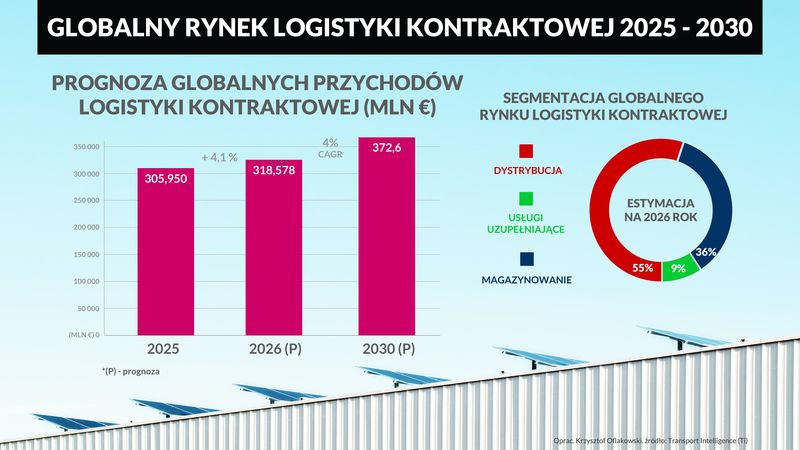
By 2030, the contract logistics market will grow at a rate of approximately 4% annually, reaching a value of about 372.6 billion euros by the end of the decade. At the same time, 81% of contractors declare an increase in the outsourcing of logistics services, but in an uncertain economic environment, expectations regarding future business relationships are changing. Clients want strategic partnership, resilience, automation, and digitalization of processes. Value-added services are gaining importance, and one of the key selection criteria is the operator’s technological advancement.
The latest data from Transport Intelligence (Ti) shows that the contract logistics market reached a value of 305.95 billion euros in 2025, which is a 4.4% year-on-year increase and represents the fastest annual growth rate since 2021. This year may be similar, as sector revenues are estimated at 318.58 billion euros, a jump of 4.1%. The next four years also look promising. The market value in 2030 is expected to approach 372.6 billion, with a compound annual growth rate (CAGR) for 2025-2030 of 4%.
By 2030, the market in different parts of the world will develop at significantly different rates. The highest growth will occur in the Asia-Pacific region, where the CAGR is estimated at 6.6%, well above the global average. Second place will belong to North America, where contract logistics will grow at an average annual rate of 2.6%. In the years 2025-2030, Europe can expect a CAGR of 1.8%. Ti explains this by a more mature growth profile, based less on expansion and more on efficiency, margin protection, and operational consolidation. Alongside these factors, automation and value-added services are expected to characterize mature markets. Other major centers analyzing the logistics sector also point to similar features, especially automation and additional services.
Downward revision reflects macroeconomic conditions
Current estimates still provide reasons for satisfaction, but they represent a slight downward revision compared to the assumptions from December 2025, when the market value for this year was estimated at approximately 320 billion euros, and the CAGR for 2025-2029 was expected to be 4.2%. These results are also weaker than those observed in the 2020-2024 period, during which the compound average growth rate was 4.6%. However, this does not mean trouble for the contract segment itself, but rather reflects the changing macroeconomic situation characterized by high uncertainty, escalating geopolitical tensions, high energy commodity prices, and global trade disruptions. These are factors similar to those that, according to WTO baseline forecasts, are expected to contribute to a slowdown in this year’s merchandise trade growth to 1.9%, and to 1.4% in the pessimistic scenario. For comparison, in 2025 it was 4.6%.
Lower growth dynamics until 2030 also apply to a number of other industries important for contract logistics and fueling its growth. For example, the compound annual growth rate in e-commerce logistics for 2026-2030 is estimated at 6.09%, while in 2022-2025 it was over 13.3%. Weaker results in this segment are reflected in the declining revenue growth rate in the entire e-commerce sector. According to recent ECDB data, the CAGR in global B2C e-commerce in 2025-2030 will reach approximately 8%. The previous period covering 2017-2024 was characterized by dynamics reaching 14%.
Shift towards warehousing and additional services
In addition to a slightly slower growth rate in contract logistics, it is worth noting the shift in the main sources of revenue within the sector. According to Ti estimates from mid-2025, distribution accounted for 59% of the market value, while the remaining part, i.e., 41%, was attributed to warehousing along with supplementary services. In the current estimate, the segmentation favors warehousing (approx. 36%) and value-added services (approx. 9%), which are expected to generate a total of approx. 44-45% of revenues. The remaining part will belong to distribution.
Ti analysts also identify three factors that will define the overall competitive landscape in 2026. The first element is continued activity in mergers and acquisitions, both in terms of geographical and sectoral expansion. Another determinant will be technological evolution, including robotics and AI, and the transition from pilot projects to operational applications. The last of the most important trends generating competitive advantages is the shift towards greater reliability and flexibility, including the duration of contracts.
As a logistics operator specialized in contract logistics, we still see very significant growth potential, also in mature markets such as Europe or North America. Our ambition is to grow significantly faster than the entire market, leveraging the structural changes occurring in our clients’ operational models. One of the key drivers of this growth remains the further outsourcing of logistics. Manufacturers and retailers are increasingly focusing resources on their core business, entrusting the management of logistics operations to specialized partners. At the same time, the supply chain is ceasing to be perceived solely as an operational function – it is becoming a strategic element of competitiveness, business resilience, and customer service quality. In this context, the importance of value-added services such as co-packing, product personalization, or returns management is growing. Increasingly, they are an integral part of our clients’ business model and a source of real competitive advantage. For logistics operators, this means the opportunity to move from the role of a service provider to that of a strategic partner, actively supporting the transformation and development of the client’s supply chain – says Yann Belgy, Managing Director at ID Logistics Polska, which provides comprehensive logistics and transport solutions.
The operator-client relationship today means a strategic partnership
Interesting data covering the broadly understood 3PL market and logistics outsourcing is also provided by the 30th edition of the 2026 Third-Party Logistics Study, conducted among both operators and clients operating in various sectors of the economy around the world. The report indicates, among other things, that 88% of contractors using logistics services rate their relationships with operators as successful. The same percentage claims that operators are able to solve their specific needs and can meet the challenges encountered. This is a clear increase from 69% in the previous edition of the study. There is also a very high share of contractors (81%) who declare an increase in outsourcing services, although it should be noted that this indicator fell from 87% a year earlier.
There is also consensus that in an increasingly difficult global environment, both parties are looking for a strategic partnership that brings long-term value while supporting innovation and building resilience. Contractors point to specific motivators that lead them to build such strategic partnerships. The largest number, as many as 81%, point to supply chain disruptions and complexity, and 76% to cooperation enabling joint cost optimization. For more than half (57%), digital transformation and technological integration are an important factor, with 90% of clients considering the operator’s technological capabilities a key selection criterion.
In an increasingly complex, volatile, and unpredictable environment, logistics is becoming one of the key elements of competitive advantage. Today, clients expect logistics operators not only to provide high-quality service delivery but, above all, to act as a strategic partner who understands their business and actively supports the realization of their goals. This means the ability to react quickly and flexibly to changing needs, continuously improve the efficiency and quality of operations, and consistently implement innovations. The ability to quickly transfer proven solutions between operations and countries and scale them across the client’s entire organization is also becoming increasingly important. At ID Logistics, this is exactly what we want to build our advantage on. We stay close to our clients to understand their priorities well, anticipate changes, and work with them to develop solutions that increase the resilience, flexibility, and efficiency of their supply chains. Our ambition is to be not just a logistics operator, but a long-term partner in the development of their business – adds Yann Belgy from ID Logistics Polska.
Cooperation is intended to build resilience and the ability to respond adequately
The results of the 2026 Third-Party Logistics Study report indicate that relationships built on strategic partnership are intended to address specific challenges generated primarily by rising tariffs and changing trade policies, which create serious business dilemmas, including forcing a revision of procurement, production, or distribution strategies. Despite the high degree of risk, the parties assure that they are well prepared for such challenges. High flexibility is declared especially by operators, among whom as many as 33% claim to have absolute confidence in their ability to adapt. Another 28% feel very confident, and 33% claim to be moderately prepared. There is slightly less enthusiasm regarding absolute certainty on the part of contractors (14%), but as many as 38% of them declare high adaptability.
The authors of the analysis rightly emphasize that the issue of tariffs is significant because it has a huge impact on operators not from the perspective of costs themselves, but rather from the side of supply chain architecture and the ability to respond adequately to changes appearing in them. It is precisely the competence in responding that is crucial for cargo owners, as it helps to avoid many serious problems in reality. As a result, high competence in this area is a component of the decision influencing the extension or expansion of contracts.
High share of companies declaring outsourcing of logistics operations
A clear thread regarding the high share of companies using logistics outsourcing can also be seen among the respondents of this year’s analysis carried out by Miebach, a global strategic consulting firm for, among others, engineering, supply chains, and logistics. The report covering 362 entities, including 198 companies commissioning logistics services and 164 operators, published in mid-2026, indicates that as many as 60% of respondents have already completely outsourced transport, and 25% have outsourced warehousing. 12% and 21% of entities, respectively, see the potential to further increase the outsourcing of these services. Future plans also look ambitious, as 34% of companies already have specific outsourcing projects in the transport sector, 57% in the warehousing sector, and 46% in order picking.
The prospects for outsourcing remain definitely positive, as as many as 65% of all respondents, i.e., both operators and their clients, expect further development in this area. In the previous edition, it was 63%, and in 2020, 58%. At the same time, the report emphasizes that with automation, traditional cost arguments when making outsourcing decisions are losing some of their importance, and partnership and transparency are being sought much more eagerly. Hence, among the main factors motivating companies to outsource operations, alongside the flexibilization of the cost structure (80%) and avoiding their own capital expenditures (79%), were, among others, focus on core competencies (77%), increasing flexibility and operational capabilities (73% and 68%), and leveraging synergy effects (67%). As in other analyses, competencies such as digitalization and automation have become independent arguments in favor of entrusting operations to a specialized operator.
Gartner experts also looked at the future of the contract market this year, according to whom every third supply chain manager expects that budgets allocated for outsourcing logistics tasks will increase by at least 10% over the next two years. The criteria for selecting an operator are also changing, which, with the growing expectations of clients, go beyond simple economic calculation, and alongside a wide range of offered services, technological advancement and the level of automation also count.
Confirmed resilience and the role of the VAWD segment
This year’s analysis of the global logistics outsourcing market published by Armstrong & Associates (A&A) points to a similar direction, taking into account a broad portfolio of services, and especially the VAWD (Value-Added Warehousing and Distribution) segment, i.e., warehousing covered by a long-term contract, distribution center management, and value-added services. The authors emphasize that in recent years, VAWD services have shown particular resilience and were even the only significant 3PL segment that maintained positive dynamics in 2023, when the market was undergoing a clear slowdown. In 2025, revenues from such operations were already 39.1% higher than in 2019, and last year alone they achieved a growth rate of 4.7%, which is very close to the estimates presented in mid-2026 by Transport Intelligence.
A&A links these results not only to the growing importance of complex warehousing and distribution services but also to the willingness to transfer further business competencies to operators, including in the scope of e-commerce fulfillment, returns handling, or technological solutions. Besides emphasizing the high resilience of the VAWD segment, Armstrong & Associates analysts place it in a broader trend, namely the acceleration of the global pace of logistics outsourcing. The reason is exactly the same as in other industry studies, i.e., numerous and serious disruptions, ranging from trade tensions to problems and blockades on transport routes. In such a market environment, companies expect specialized competencies from operators that allow for building more flexible and resilient supply chains.