









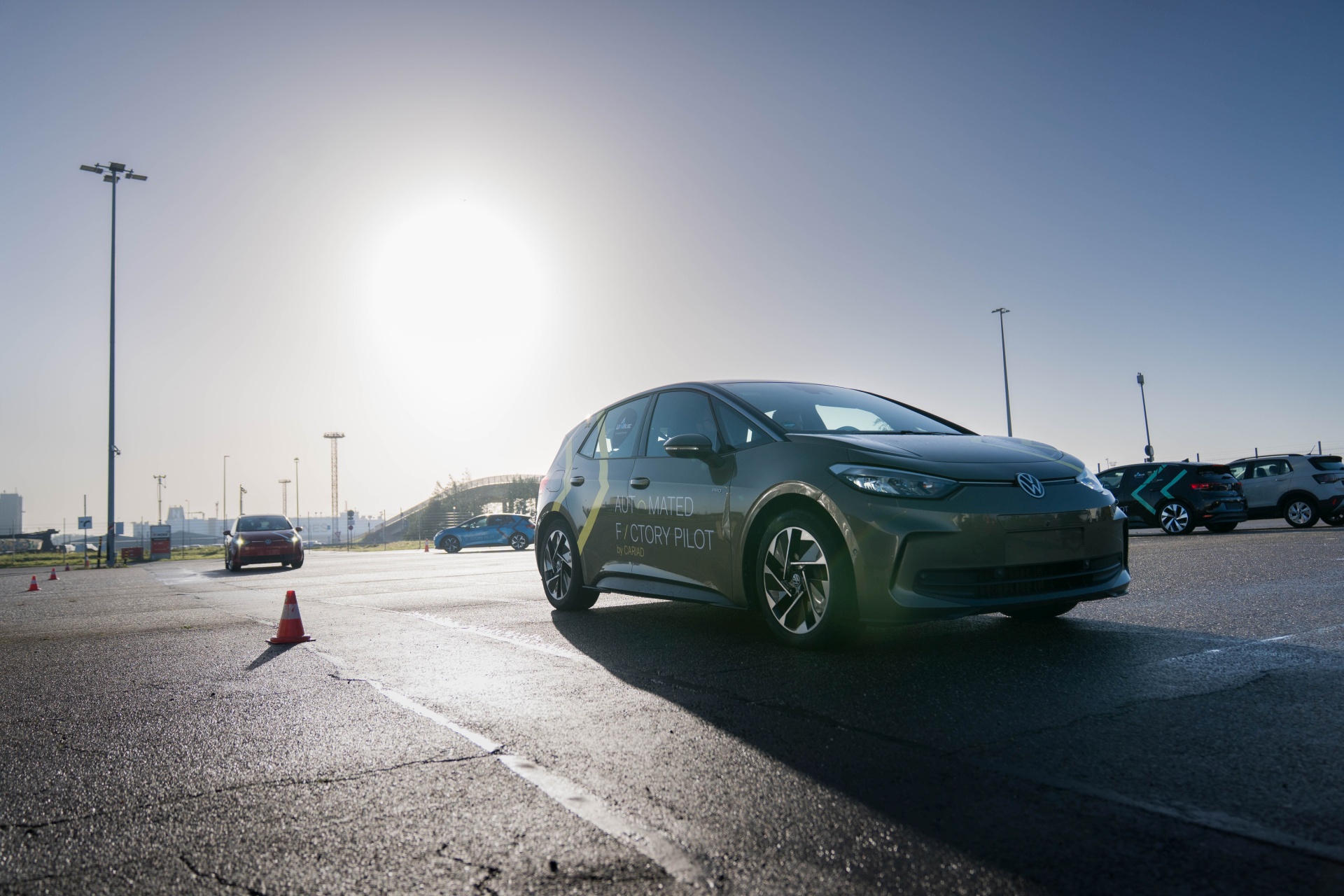
How to automatically move cars in logistics areas and safely integrate this into existing processes? For the past two years, Volkswagen, Deutsche Telekom, the Finnish technology company Unikie, and the Institute for Production and Logistics at the University of Bremen (BIBA) have been seeking answers to this question at the port of Emden. The goal of the innovative AutoLog project, funded by the German Federal Ministry for Digital and Transport (BMV), was to investigate the potential of automated vehicle movement for more efficient and sustainable port logistics.
The test site is located in a logistics area near the port of Emden. In addition to parking lots and internal roads, it also includes a busy roundabout, which allowed the project partners to test the technology in a wide variety of traffic situations. The greatest focus was placed on how automated vehicles interact with human-driven cars during normal terminal operations, as well as how to integrate the new technology into the existing rhythm of logistics activities.
AutoLog shows the potential that automated driving has in our logistics. It is crucial for us not only to develop new technologies in laboratory conditions but also to test them in practice – where we conduct our daily logistics operations. Together with our partners in Emden, we have gained valuable knowledge on how to more intelligently automate vehicle movement in the future and further develop logistics processes. We will use these experiences in our further work on this technology.
– says Christian Vollmer, member of the Board of Management of the Volkswagen Passenger Cars brand responsible for Production and Logistics and member of the Extended Executive Committee of the Volkswagen Group.
Technologies working as a single system
AutoLog combines several technological components into an integrated automated vehicle logistics system. The Unikie Marshalling Solution (UMS) provides superior traffic control and coordination of the cars. For the whole system to work, vehicle technology, environment recognition systems, communication infrastructure, and logistics software must reliably work together.
Planning and coordination of maneuvers are facilitated by a digital map of the parking areas. Deutsche Telekom’s public 5G network, expanded with additional features tailored to the requirements of this application, was used for communication between the system and the vehicles.
The UMS system operates in an edge cloud. Data is processed via a high-speed fiber-optic link in the immediate vicinity of the mobile network. As a result, the solution meets the technical requirements of applications where response time is critical.
AutoLog shows that connectivity prepared for industrial applications can become the digital backbone of automated processes throughout vehicle logistics. The combination of reliable, low-latency communication, edge infrastructure, and intelligent vehicle control creates the technical foundation for implementing automated car distribution on a large scale – from the end of the production line, through rail and sea transport, to the end customer.
– says Klaus Werner, Managing Director for Business Customers at Telekom Deutschland.
Conclusions for the further development of vehicle logistics
The project also focused on standardized communication and safe human-technology collaboration. AutoLog is based on the ISO 23374 standard for Automated Valet Parking systems and explores how automated vehicles can be integrated into a complex logistics environment. This concerns both interaction with people and other road users, as well as synchronizing automated maneuvers with existing logistics processes.
In Emden, we demonstrated that automated vehicle movement can be tested even in a demanding logistics environment where human-driven cars also move. The interaction of our system with existing infrastructure and human-driven vehicles is an important step. The experience gained helps us develop the technology and assess how ready it is for commercial use in other logistics environments.
– says Vesa Kiviranta, Business Director for Automotive & Marshalling Solutions at Unikie.
From parking lot to rail car
Work on automating vehicle movement is also underway in other parts of the Volkswagen Group. As part of the AutoLog project’s cooperation with the Audi plant in Ingolstadt, the partners tested the automatic loading of cars onto rail cars. The focus was thus on the next stage of vehicle logistics: precise positioning of cars during their transfer to rail transport. The successful pilot expands the experience from Emden with another application and shows how many tasks in the logistics chain can be reorganized thanks to automated driving.
The completion of the AutoLog project concludes the joint testing phase. The knowledge gained will serve the further development of automated logistics processes and will be a starting point for evaluating further applications. In the long term, automated vehicle movement can make logistics more flexible, safe, and sustainable, while also opening up new possibilities for organizing car transport within plants and terminals.
Source: Volkswagen Group