









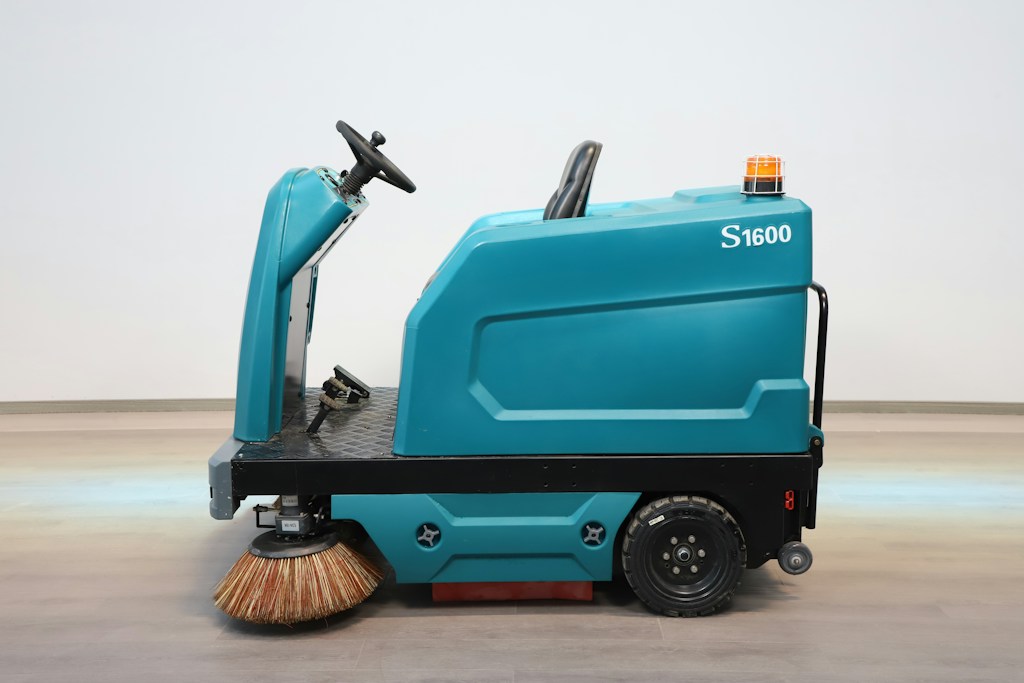
Maintaining cleanliness in warehouses, production halls, logistics centers, and transshipment areas affects both employee safety and process efficiency. Large surfaces, forklift traffic, and various types of dirt mean that manual cleaning is often insufficient. The solution is professional cleaning machines. How do you choose a device tailored to the specifics of the facility and the type of contamination?
Which cleaning machines work well in warehouses?
Dust, sand, and packaging waste accumulate in warehouse aisles. Near loading ramps, however, mud, leaves, and gravel appear. Sweepers are used to remove loose debris, collecting dirt with brushes and directing it into a container. Filtration systems limit dust dispersion during operation.
Another solution is scrubber-dryers designed for cleaning floors with water and cleaning agents. They remove stubborn dirt that cannot be effectively eliminated by sweeping. In many logistics facilities, both types of equipment complement each other.
How do professional sweepers differ?
Professional sweepers differ in terms of operation, drive, efficiency, and container capacity. For smaller spaces, workshops, and narrow corridors, walk-behind models may be suitable. Their compact design facilitates maneuvering in areas with limited space.
In large facilities, it is worth considering ride-on sweepers. They allow for efficient cleaning of vast areas, such as warehouses, parking lots, and halls. During intensive use, the container capacity is also important, as it affects the frequency of breaks needed for emptying.
An overview of available solutions, taking into account different designs and drive types, can be found at https://www.karcher.com/pl/professional/profesjonalne-zamiatarki.html.
Which technical parameters of cleaning machines should be compared?
An important parameter is area performance, expressed in square meters per hour. It allows for an initial assessment of the device’s capabilities, although the actual cleaning time also depends on the number of obstacles, aisle widths, and the need for turns. Working width is important. A larger width allows covering a larger area at once but may make it difficult to move in narrow aisles. Another parameter is the waste container capacity. With a large amount of waste, a larger container reduces the number of breaks.
In warehouses and production plants where fine dust is present, the filtration system is also significant. Depending on the model, filters can be cleaned manually, mechanically, or automatically.
Which cleaning machine drive should you choose?
The type of drive should correspond to the conditions of use. In indoor facilities, it is worth considering battery-powered machines. They do not emit exhaust fumes in the workplace, and the lack of a power cord makes it easier to move between warehouse zones. In large outdoor areas, devices with a gasoline or diesel engine can be used. LPG-powered solutions are also available. When choosing, consider the intensity of use and emission requirements. Also, check the operating time on a single charge or tank. In the case of battery machines, the charging time is also important and should be included in the cleaning schedule.
How to match the machine to the type of floor and dirt?
The equipment of the device should correspond to the surface being cleaned. Concrete, paving stones, and asphalt require the appropriate selection of brushes. The hardness of the bristles and the ability to adjust the pressure are also important. When removing sand, gravel, and larger waste, it is worth paying attention to the design of the sweeping system. In the case of fine dust, filtration efficiency will be more important.
The nature of the dirt should also be taken into account. Different equipment will work for daily dust removal from a warehouse, and different equipment for cleaning an area after construction work. In facilities with special hygiene requirements, it is necessary to additionally check the device’s compliance with internal procedures.
How to plan the operation of cleaning machines?
Purchasing a device is only one element of organizing cleanliness maintenance. It is worth developing a cleaning schedule for individual zones, taking into account traffic intensity and the hours when cleaning work least disrupts the facility’s operations. Operators should be trained in device operation, safety rules, and maintenance. Regular filter cleaning, brush inspection, checking battery status, and emptying containers help maintain equipment efficiency. When evaluating costs, consider both the purchase price and energy or fuel consumption, consumables, service, and operator labor time. This will allow you to compare the total cost of ownership of different solutions.
The selection of cleaning machines should result from an analysis of the surface, the type of contamination, and the organization of work in the facility. A properly matched device facilitates maintaining cleanliness in warehouses, halls, and outdoor areas, and also allows for better planning of time and resources allocated to cleaning tasks.