









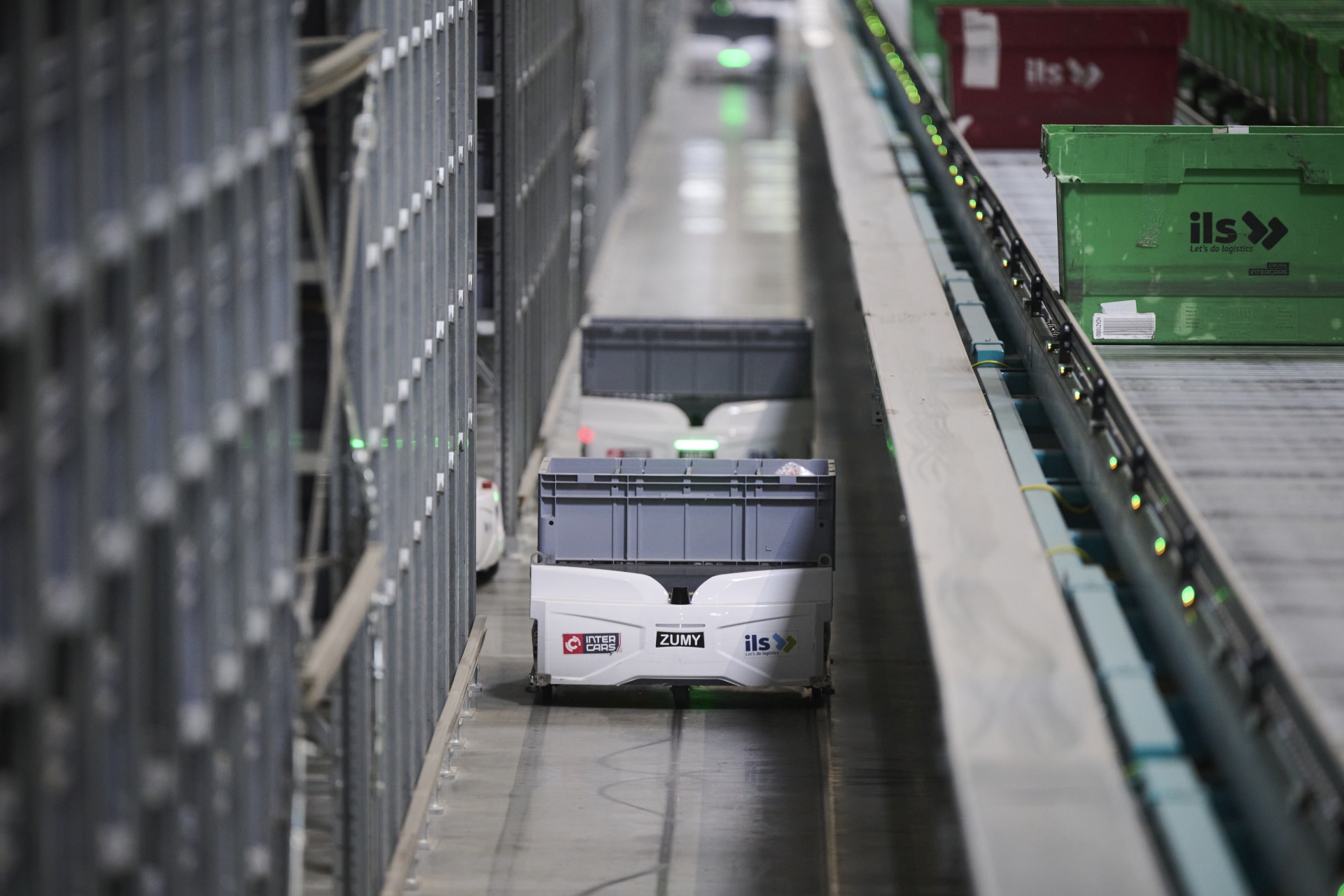
The growing scale of logistics operations and the need to increase process efficiency mean that automation is playing an increasingly important role in modern logistics centers. The pace of these changes is also evidenced by the successive expansions of existing installations.
At the ILS logistics center in Zakroczym, the Skypod system from Exotec, launched in September 2024, has undergone the next stage of development. According to the operator, it now employs 555 autonomous robots that support warehouse processes every day, increasing the efficiency and fluidity of operations.
Large market, greater operational requirements
Poland has an extensive logistics base. According to Knight Frank, at the end of 2025, modern warehouse space resources exceeded 36.6 million m², and the annual demand for leasing amounted to 6.6 million m². At the same time, new supply fell by 35% year-on-year, to 1.7 million m². This is a market where high tenant activity coexists with a more cautious approach to building new facilities.[1]
In such conditions, the importance of the question of how to increase the operational capabilities of available space is growing. Automation can help make better use of hall height, reduce internal transport, and streamline picking. Its value depends on matching the solution to the assortment, order structure, and actual warehouse loads.
Labor costs and staff availability accelerate decisions
One of the strongest impulses for change remains the staffing situation. In the ManpowerGroup study “Where are you heading, logistics? 2026 Edition,” as many as 68% of organizations performing logistics functions declared difficulties in finding new employees in the previous six months. For 60% of respondents, rising employment costs were a major or very major recruitment barrier. The study covered 239 company representatives.[2]
For operators, this means the need to build efficiency that can be maintained even with limited personnel availability. In the goods-to-person model, robots deliver containers with goods to picking stations. This reduces walking between racks and allows employees to focus on preparing orders. The Exotec Skypod system operates on this principle.
E-commerce increases logistics complexity
Another factor is handling online sales alongside traditional distribution channels. According to Statistics Poland (GUS), in 2025, the share of the internet in retail sales covered by the survey was 9.1%, compared to 8.9% a year earlier. In the textiles, clothing, and footwear category, it reached 25.2%.[3]
For a warehouse, combining deliveries to stores with the fulfillment of individual consumer orders means different order sizes, picking methods, and shipping rhythms. When choosing automation, the ability to handle a variable order profile and seasonal peaks is therefore important. Maximum device efficiency alone is not enough – an efficient flow of goods through the entire process is needed.
Scaling in practice: Exotec and ILS in Zakroczym
An example of the phased development of automation is the ILS European Logistics and Development Center in Zakroczym. The first Skypod installation was launched there in September 2024. In February 2026, ILS announced the completion of its expansion, carried out with Exotec and the integrator A1 Sorter. According to the operator, the configuration after the expansion includes 555 robots, and the investment has brought an additional 20 picking stations and four replenishment stations. Racks 11.3 meters high allow for the use of the facility’s cubic capacity. ILS links the development of the installation to the growth of its business and order volume.[4]
This shows the practical importance of modular design. The ability to expand the system along with the company’s needs. In Exotec solutions, increasing the number of robots and expanding racks allow the installation’s capabilities to be adjusted to changes in order flow and storage demand.
The operational account determines the pace of investment
The further development of automation in Poland will depend on how effectively technology responds to the specific needs of companies. When evaluating investments, the cost of order fulfillment, throughput during peak periods, space utilization, and the possibility of subsequent expansion are key. Integration with existing systems and preparing the team to work with new tools are also important. Exotec’s actions are a practical dimension of scalability: adapting automation to the growing needs of an operating warehouse.
[1] https://content.knightfrank.com/research/3066/documents/en/warehouse-market-in-poland-q4-2025-12738.pd
[2] https://biuroprasowe.manpowergroup.pl/459655-blisko-7-na-10-firm-w-logistyce-ma-trudnosci-ze-zrekrutowaniem-nowych-pracownikow
[3] https://ssgk.stat.gov.pl/01.2026/Rynek_wewnetrzny.html
[4] https://ilslogistics.eu/2026/02/06/ils-rozszerza-wykorzystanie-systemu-skypod-kolejny-etap-automatyzacji-w-europejskim-centrum-logistyki-i-rozwoju/
Source: Exotec