









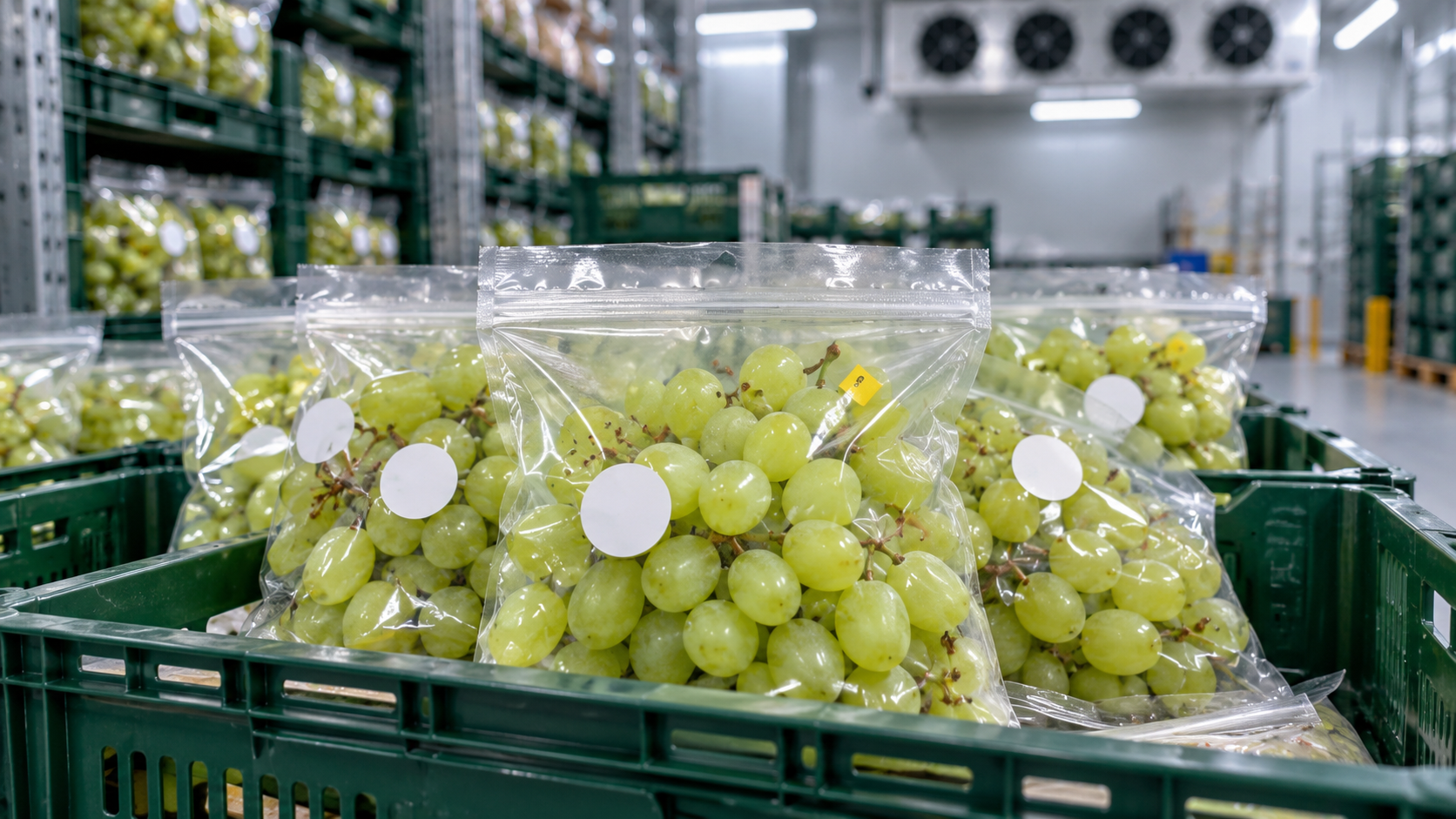
A new analysis of nine post-harvest trials conducted in Europe shows that the Vidre+ post-harvest technology extends the shelf life of table grapes by approximately 35%. Improvements are observed in rachis appearance, berry integrity, and quality parameters related to decay.
A significant difference for the global grape industry
In the international table grape industry, maintaining fruit freshness from the vineyard to the supermarket shelf has long been one of the greatest post-harvest challenges. Grapes often travel thousands of kilometers and spend weeks in cold storage, refrigerated transport, and distribution channels before reaching consumers.
Even under carefully controlled conditions, quality degradation can reduce the commercial value of the fruit. Browning rachises, damaged and shattered berries, and fungal decay can discourage consumers, leading to shipment rejections, retail markdowns, and food waste.
Fresh Inset’s Vidre+ is a freshness-extending technology that expands the application possibilities of 1-MCP – even where conventional post-harvest treatment methods have proven difficult to implement or impractical. Designed for integration throughout the fresh produce supply chain – from growers and packing houses to retail packaging – the solution provides a flexible and easy-to-use approach to ethylene control for a wide range of crops. Unlike traditional 1-MCP application methods, which often require specialized infrastructure or controlled treatment conditions, Vidre+ can be placed directly into existing packaging formats – as a sticker, label, or print.
The newly published analysis by Fresh Inset indicates that Vidre+® technology can help address these challenges. According to the company’s latest case study on grapes, Vidre+ stickers extended the shelf life of the fruit by an average of 4.95 days, or approximately 35% compared to the control group.
The results are based on nine post-harvest trials conducted in Italy, Greece, Spain, and the UK, covering 38 variants of Vidre+ stickers and 354 paired quality comparisons.
The findings point to potential benefits for the international fresh produce supply chain, where even a relatively small extension in shelf life can provide valuable extra time for transport, distribution, and retail.
For grapes, five extra days is a lot. It can determine whether the fruit is sold at full price or needs to be marked down. It also opens the door to more distant markets. We tested Vidre+ on various varieties, under different storage conditions and packaging formats, because that is the reality that producers, packing houses, and retail chains face every day.
– says Krzysztof Czaplicki, co-founder and CSO of Fresh Inset.
What the tests showed: stronger rachises, less decay, and better berry integrity
The Fresh Inset analysis looked at several grape quality parameters of greatest commercial importance, including rachis browning, fungal decay, berry shatter, and mechanical damage. The results indicate improvements in all three main quality categories evaluated.
Rachis browning: 5.6 days more (+35%)
Green, healthy-looking rachises are one of the most visible signs of grape freshness. Even if the berries are still edible, brown or dried rachises can lower the perceived quality of the fruit in the eyes of customers. Throughout the test program, the use of Vidre+ delayed the onset of the same level of rachis browning by an average of 5.6 days compared to the control group.
For retail chains, maintaining a green rachis color longer can help keep the fruit attractive on the shelf and reduce the need for premature markdowns.
Berry shatter and damage: 10.5 days more (+65%)
The calculations for berry shatter and damage showed the greatest improvement.
Vidre+ stickers extended the time to reach the same level of quality degradation in this area by an average of 10.5 days, representing a 65% improvement compared to control samples.
Berry shatter, where individual fruits fall off the bunch, is particularly troublesome during handling, transport, and retail display. Loose or damaged berries can lower the visual quality of the entire package, making this result particularly significant for packing houses and retail chains handling grapes in complex distribution systems.
Quality degradation related to decay: 4.8 days more (+28%)
The tests also evaluated quality parameters related to fungal decay, including Botrytis cinerea and Mucor species. Vidre+ stickers extended the time to reach the same level of decay-related quality degradation by an average of 4.8 days, or 28%. For exporters and distributors, delaying visible signs of quality degradation can mean greater flexibility in long-term storage and transport.
From European vineyards to international supply chains
The research program covered several commercially important table grape varieties, including Italia, Soultanina, Aledo, Dominga, and Sweet Celebration. The tests were conducted under diverse post-harvest conditions, accounting for different storage periods, temperatures, and packaging formats. Researchers evaluated grapes packed in standard crates, non-perforated and perforated films, and retail containers wrapped in flow-pack film.
This diversity is important because grape quality depends on more than just the variety. The type of packaging, storage time, temperature control, and distribution conditions – all these factors influence the rate at which fruit loses quality after harvest.
Although the tests were conducted in Europe, their results may be relevant to grape-growing and exporting regions worldwide. Leading exporters such as Peru, Chile, South Africa, and India face a similar challenge: how to deliver attractive, high-quality grapes to distant markets. For these industries, post-harvest technologies that maintain commercial quality longer can mean greater flexibility in export logistics.
What five extra days can mean for producers, packing houses, and retail chains
For grape producers and exporters, a longer shelf life can provide more freedom in planning harvests, managing cold storage, and organizing international shipments. This can be especially valuable when delays occur in the supply chain or when exporters need to coordinate deliveries to multiple markets.
From the perspective of packing houses, better berry integrity and delayed rachis browning can help maintain fruit quality during handling, storage, and distribution. The technology may also allow for maintaining commercial quality longer without fundamental changes to the product presentation.
For retail chains, the potential benefits are closely tied to product appearance, shelf availability, and inventory management. Grapes are a fresh produce category that customers evaluate primarily visually – often by the color of the rachis, berry firmness, and the overall condition of the bunch. Maintaining these characteristics longer can help chains offer more consistent quality while reducing product rejection and waste.
In a broader perspective, the results align with the industry’s growing efforts to reduce food waste and use resources more efficiently in fresh produce supply chains. A longer shelf life does not automatically guarantee less food waste, but it can create additional opportunities to sell fruit before its quality drops below the level acceptable for trade.
Fresh Inset provides a conservative estimate of a total relative improvement of approximately 35%, although depending on the averaging method, results ranged from 33% to 40%.
The observed improvement in rachis appearance, berry integrity, and decay-related quality parameters suggests that the technology can influence several factors determining whether grapes remain commercially acceptable.
The most important conclusion from the latest Fresh Inset report is clear: in the analyzed European trials, grapes with Vidre+ maintained comparable commercial quality for about five days longer.
In a global industry where freshness directly translates into commercial value, these extra days can become a significant competitive advantage.
Source: Fresh Inset