









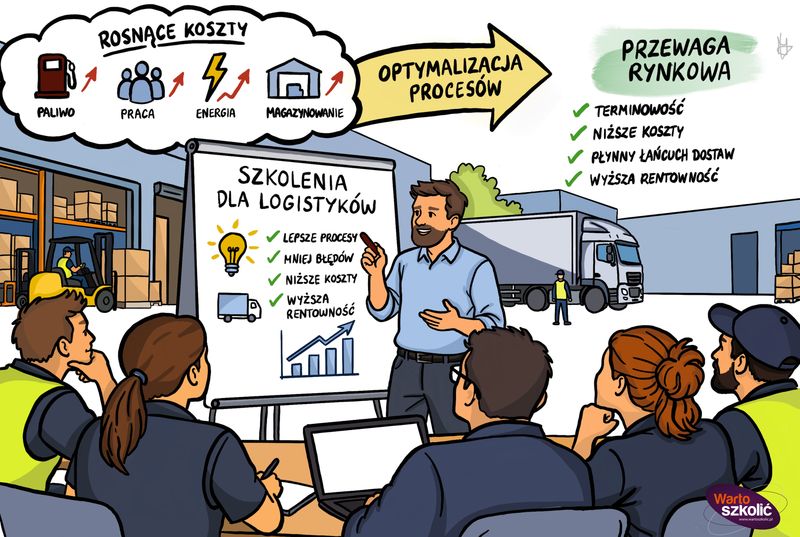
Why are specialized training courses for logistics professionals the key to a competitive advantage? Because with rising fuel, labor, energy, and warehousing costs, less depends on the scale of operations alone, and more on the quality of decisions made by the team every day. In TSL, even a minor error in route planning, order picking, or information flow quickly turns into a real loss.
Therefore, companies that want to improve profitability should not look solely at budget cuts. Often, streamlining processes and supplementing employee competencies yields a greater effect. Well-prepared logistics training helps eliminate bottlenecks, shorten operation times, and better utilize the resources the company already possesses.
Rising costs do not stem from a single source
In the TSL industry, cost pressure acts on many levels simultaneously. Enterprises face more expensive transport, greater demand volatility, staffing shortages, and increasing customer requirements. On top of that, there are delays, complaints, and the need to react quickly to supply chain disruptions.
In practice, high operating costs often result not only from the market but also from daily process imperfections. It is worth checking if the problem lies in:
- poorly planned loading windows,
- unclear division of responsibilities between departments,
- a lack of common work standards in the warehouse and transport.
Such areas are difficult to improve with procedures alone. Current team competencies and a common way of working are needed. This is where training for logistics professionals becomes a tool for streamlining operations, rather than an additional cost.
Team competencies affect every stage of operations
The efficiency of the supply chain depends on the people who plan, coordinate, and supervise the process. If foremen, forwarders, planners, and warehouse managers work according to outdated patterns, the company loses time and money on corrections. Conversely, well-chosen logistics training gives teams practical tools for faster error detection, better change management, and smoother inter-departmental cooperation.
Most problems arise when a procedure exists only on paper, and each team has developed its own workarounds. As long as nothing extraordinary happens, the company does not feel it. It only takes the absence of two people, a delayed delivery, or a sudden spike in orders for local “hacks” to start colliding with each other. – says Marcin Grzelak, owner of the training company Warto Szkolić.
The greatest value appears when the training addresses the company’s specific problems. It could be congestion at ramps, long picking times, poor communication between the warehouse and transport, or the overload of operational managers. This is why many organizations choose training for logistics professionals that focuses on real-life situations from daily work, rather than general definitions.
Training tailored to the company’s reality yields the greatest effect
In TSL, a one-size-fits-all solution rarely works. Every organization has a different supply network, warehouse layout, shift work system, level of automation, and model of cooperation with carriers. Therefore, the best business results are usually brought by closed training courses for companies, conducted as dedicated in-house training.
This form has several practical advantages. First, the program can be based on actual indicators and processes. Second, participants work on their own cases, making it easier to translate knowledge into action. Third, the training supports team building and organizes the way managers and operational staff communicate. For many enterprises, it is also important that training for companies can be prepared for specific goals, such as shortening order fulfillment times, reducing warehouse errors, or better implementing organizational changes.
How to finance development without overstraining the budget?
Managers often postpone the decision to train because they fear an additional expense. This is understandable, especially when the company is already fighting to maintain margins. However, it is worth remembering that training subsidies are available, which allow for significantly reducing the project cost and spreading the investment over time without disrupting the operating budget.
For enterprises, a good starting point is how to obtain subsidies, as it shows how to approach the formalities and what to look for when planning a program. In practice, training grants for companies help finance activities that strengthen managerial competencies, improve work organization, and increase the efficiency of entire departments. This is important because in TSL, what counts is not a one-time improvement, but a lasting change in the way of working.
Competitive advantage is born in well-structured processes
Logistics companies win today not only through price but also through predictability, punctuality, and the ability to react quickly. This cannot be achieved without a well-prepared team. When employees understand the process, can identify risks, and cooperate more efficiently, the number of downtimes, complaints, and costly mistakes decreases.
Therefore, training for companies in the TSL industry should be treated as an element of operational management, not an addition to HR policy. If they are well-matched to the infrastructure and supported by reasonable training subsidies, they quickly start paying off. Skillfully obtained training grants for companies then become a strategic investment that pays off in the form of a smooth supply chain, better work organization, and higher business profitability.