









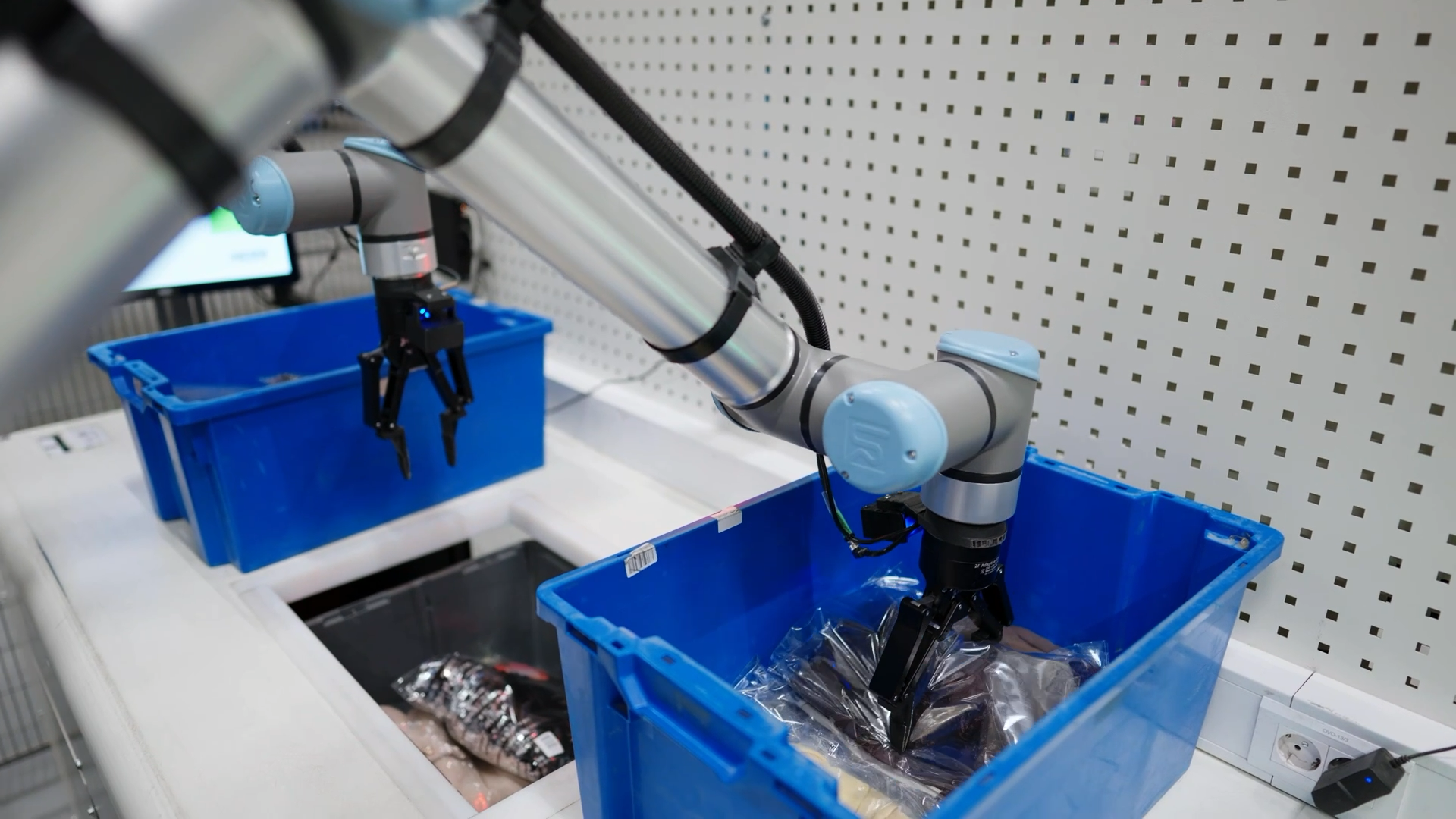
The partnership combines Sereact’s physical AI platform with Universal Robots (UR) industrial collaborative robots, enabling intelligent and adaptable automation of operations that have previously been difficult to automate, such as returns processing in the fashion industry.
Teradyne Robotics – the company behind Universal Robots and Mobile Industrial Robots – and Sereact, a pioneer in physical artificial intelligence for robotics, have announced an official partnership to accelerate the use of industrial AI in retail, logistics, and manufacturing solutions.
As part of the collaboration, Sereact’s physical AI platform, Cortex, operates Universal Robots’ robotic arms, providing retailers and logistics operators with a proven way to automate non-standard tasks such as returns processing and single-item picking.
The companies have already delivered hundreds of UR robots in dual-arm configurations to operational customer sites across Europe.
Physical AI only has value when it is applied in real-world operations, and it is in these environments that Universal Robots has been proving the effectiveness of its solutions for years. Our robots are designed for the AI era: open, connected, and proven in over 100,000 industrial deployments. These are the reasons why Sereact chose our platform. Combined with Sereact’s Cortex platform, the solution handles mixed assortments, unknown items, and various packaging. We have moved well beyond the demonstration or pilot stage, and the solution is currently being successfully deployed at customer sites. Our technologies complement each other perfectly, and thanks to this partnership, we will rapidly expand the use of AI-based solutions into new industries, applications, and markets.
– said Jacob Pascual Pape, Chief Commercial Officer, Teradyne Robotics.
To meet rapidly growing demand, Sereact opened its US headquarters in Boston, Massachusetts, this summer to introduce the joint solution to the North American market as well.
One model, many applications
The solutions from Sereact and Teradyne Robotics deliver tangible benefits across many key logistics and manufacturing applications, including returns processing, store replenishment, retail picking and sorting, order induction, machine tending, bin consolidation, kitting, packing, and material handling.
Returns, replenishment, kitting: with Cortex, each of these applications runs on the same production model. All robots are controlled by the same ‘brain’ without the need for retraining for every new item or task. What one robot learns serves all the others. Partnering with Teradyne Robotics and its global network of distributors and integrators makes it easier for us to reach customers worldwide, allowing retailers and logistics operators to deploy AI-based automation faster across all areas of their operations.
– said Dr. Ralf Gulde, CEO and co-founder of Sereact.
Live demonstration at NVIDIA GTC in Berlin
The companies are sealing their partnership with a joint demonstration at the NVIDIA GTC Berlin 2026 conference. At the NVIDIA booth, Cortex, Sereact’s VLA (Vision-Language-Action) model, controls two Universal Robots UR12e robots with a 1300 mm reach, showcasing live returns processing already deployed in operational logistics centers.
The deployments were carried out in collaboration with CEVA Logistics for Zalando, a European technology platform for fashion and lifestyle, providing 62 million active customers access to over 7,000 brands across 29 markets. In Zalando’s logistics centers in Greven, Germany, and Świebodzin, Poland, the robots independently process clothing returns. This is the first stage of a broader initiative aimed at scaling up returns automation across Europe.
Returns are one of the most difficult tasks in logistics. Returned items never come back in an order conducive to robotic handling. They have different shapes, orientations, and packaging, and this diversity is constantly changing. The Cortex platform, working in tandem with the Universal Robots platform, was created for tasks of this type. By quickly preparing returned goods for resale, this solution also helps retailers comply with European Union regulations prohibiting the destruction or disposal of returns.
– said Dr. Gulde.
Powered by NVIDIA technologies
A key component of the Sereact and Universal Robots demonstration at the GTC conference in Berlin is NVIDIA’s technical solutions. Cortex is trained in NVIDIA Isaac Sim, an open simulation environment, using the open NVIDIA Cosmos world model platform. It is then fine-tuned with reinforcement learning using the NVIDIA Isaac Lab environment, and each model is tested with Teradyne Robotics hardware before deployment. In production deployments, Cortex runs on NVIDIA Jetson Thor directly at the workstation, where the AI system must make real-time decisions, while NVIDIA DGX Spark is used for development, validation, and model updates on-site at the facility.
Teradyne Robotics also utilizes the computing power of NVIDIA cards in its products, both UR and MiR. Teradyne Robotics provides SimReady OpenUSD robotic assets to the SimReady Central Library on Hugging Face for both Universal Robots and MiR products, allowing developers to discover and reuse robot models in simulations with less effort.
Source: Teradyne Robotics/ Sereact