









Under the SAFE program, Poland has signed an agreement to secure 43.7 billion euros, or over 183 billion PLN, for the development of defense capabilities. As the Polish government announces, 89 percent of the funds obtained are to go to the Polish industry and economy. Such a large scale of funding means not only larger orders for armaments but also the development of the entire ecosystem of suppliers – from manufacturers of components and materials to companies supporting logistics, warehousing, and transport.
The defense industry is more than just arms manufacturers
The development of national defense capabilities does not end with companies that produce finished weapon systems. Behind every vehicle, unmanned system, radar, or communication device stands a network of suppliers responsible for components, materials, electronics, sub-assemblies, service, and logistics.
At the same time, Poland has signed an agreement under the EU’s SAFE instrument, which provides preferential loan financing for defense investments in the years 2026-2030. According to the declarations of the Polish government, 89 percent of the funds obtained are to go to the Polish industry and economy. The funding covers, among other things, artillery systems, air and missile defense, unmanned and anti-drone systems, ammunition, and missiles. With a larger scale of production, the efficient functioning of the logistics base becomes an essential element of the entire process – from warehousing and equipment preparation to its transport and delivery to the recipient.
The development of the defense sector creates a demand for a much broader ecosystem of services and products than just armaments. In the case of every device or component, one must also consider its storage, preparation for transport, and the method of securing it at subsequent stages of the supply chain. These are areas that can also be handled by companies operating outside the traditionally understood defense industry.
– says Jarosław Kamiński, Managing Director of RAJA Polska.
From component to finished system
The military supply chain can involve many levels – from a supplier of a single component to a manufacturer of a complete system. At each of them, different requirements arise regarding transport, storage, and the selection of packaging and protective solutions.
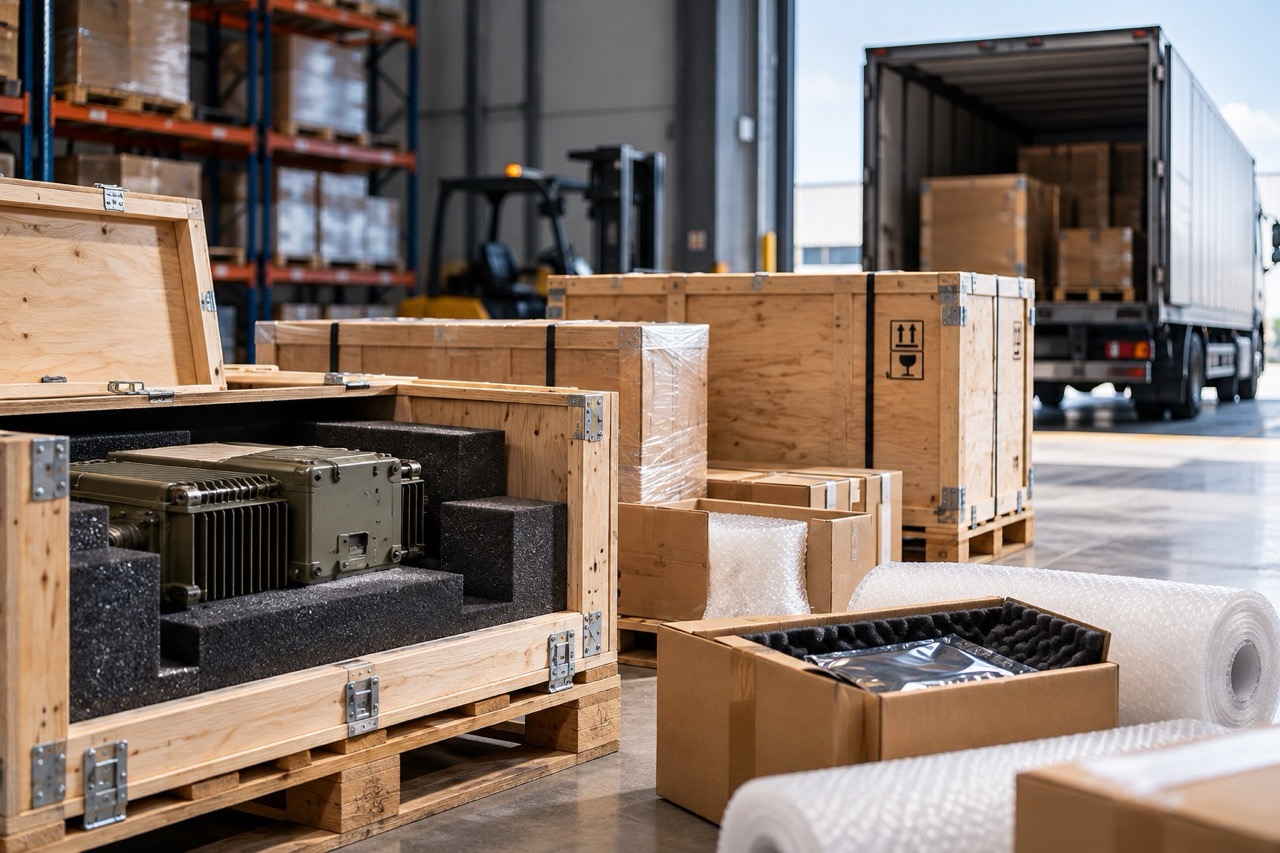
Electronics or optical elements are prepared for the road differently than industrial materials, and differently still for equipment transported by air, sea, or land. Factors such as resistance to shocks and vibrations, protection against moisture and static electricity, and load stabilization are important.
Indicators placed on the shipment allow for the detection of exceeding specific tilt or shock thresholds during transport. Their activation can be a signal for a more thorough inspection of the cargo’s condition upon receipt. When transporting electronic components sensitive to electrostatic discharge, appropriately selected ESD protections are used. Solutions of this type are selected according to the specifics of the cargo and the potential threats it may encounter during transport.
In defense logistics, there is no single universal way to secure a load. A precise electronic component requires different solutions than a metal element prone to corrosion, and equipment that will be reloaded multiple times requires yet another. Therefore, it is crucial to identify risks along the entire route and select protections for the actual transport conditions. This allows for reducing the risk of damage, but also for faster identification of situations where the cargo may have been exposed to undesirable conditions. That is why, currently, suppliers are expected to provide not only the delivery itself but also expert advice and the preparation of a comprehensive solution.
– says Jarosław Kamiński, Managing Director of RAJA Polska.
Military logistics also needs civilian capabilities
“Military mobility” means the ability to efficiently move troops, equipment, and supplies – both within individual countries and between them. The European Commission points out that one of the challenges remains, among others, the limited availability of some transport capabilities, infrastructure bottlenecks, and differences in procedures.
An important element of the European system is civilian and dual-use capabilities, i.e., solutions that can serve both civilian and military purposes. This applies, among other things, to transport infrastructure, means of transport, and parts of logistics services. In practice, this means that the efficient movement of military equipment may require the cooperation of not only military structures but also enterprises operating in the civilian market.
At the intersection of these two areas, proper preparation of the cargo for transport becomes significant. Depending on the type of equipment and the planned route, the selection of packaging, protective materials, and solutions allowing for the control of conditions in which the shipment was transported is important. These may include, among others, protection against moisture and electrostatic discharge.
Photo: RAJA Group