









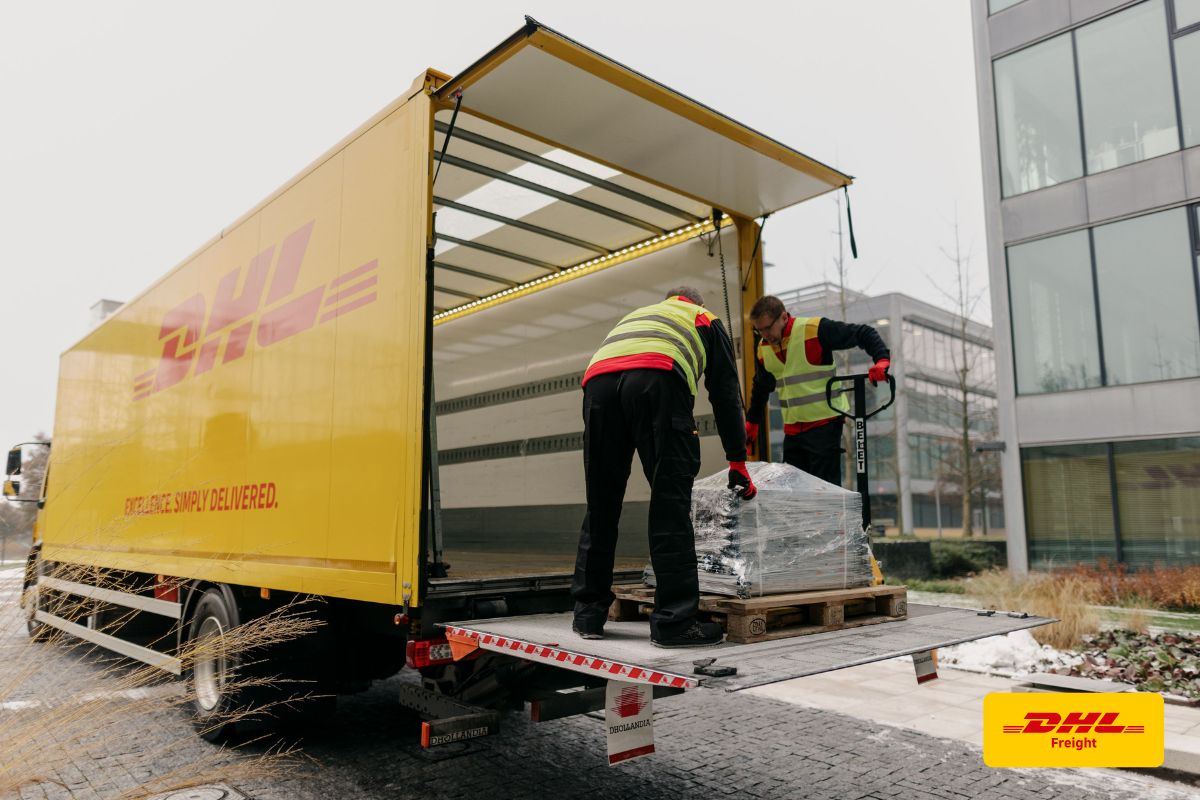
Every AI query, every cloud connection, and every streaming request ultimately ends up in a data center. In recent years, the development of such facilities has accelerated significantly, as has the growth of this logistics segment. Servers worth millions must be transported between continents, delivered on time, and installed with millimeter precision. DHL Freight points out that as data centers grow, the importance of specialized road transport, which connects the successive stages of their supply chain, is increasing.
Data center logistics – what is it?
Data Center Logistics (DCL) involves the planning and execution of all transport and handling processes related to the construction, operation, and decommissioning of data centers. This concept goes far beyond transport alone: it includes receiving equipment from the manufacturer, temporary storage, delivery, and on-site installation of the hardware.
DCL (Data Center Logistics) differs from traditional IT logistics primarily in scale and virtually zero tolerance for errors. It is not about individual devices, but entire server racks, cooling systems, power supplies, and network infrastructure for facilities that cannot afford downtime during operation.
The data center logistics market is growing
According to forecasts, the data center logistics market will grow by approximately 52% in just five years. The most important growth factor is the increasing demand for computing power generated by artificial intelligence applications. Training models and performing inference require significantly more resources than previous cloud applications. Such demand can only be met through the development of physical infrastructure. To be able to sell computing power, the appropriate equipment must first be installed.
This has a direct impact on the volume of logistics services. The value of the data center logistics market in 2025 was estimated at approximately 23 billion dollars, and it is expected to grow to at least 35 billion dollars by 2030. This development is global in nature. In addition to the United States, Europe, India, Australia, Indonesia, and the Middle East are actively expanding their infrastructure.
There is also a second, often overlooked factor: equipment replacement cycles are becoming shorter. This means that data centers are not one-off investment projects, but generate constant logistics needs throughout their entire operational life.
What does a data center supply chain look like?
The supply chain begins at the manufacturer and only ends when the equipment is retired from use. It typically involves six stages, five of which require road transport. Each of these stages involves distinct requirements regarding documentation, security, and shipment traceability. The moments of handing over equipment between different service providers are critical, as this is when it is easiest to lose accountability and process transparency.
- Receipt and supplier management
Coordination of pickups from factories, often from multiple suppliers simultaneously, within precisely defined time windows. Transport to a port or airport is almost always carried out by truck. - Main transport
For intercontinental shipments, sea or air transport is used. In particularly urgent cases, charter flights are also used. The situation in Europe is different: if the equipment comes from a European factory or port, the main part of the route takes place by land. - Staging and warehousing
Temporary storage of equipment near the destination, often combined with initial configuration, quality control, and picking according to construction phases. - Delivery to the construction site
Delivery to the data center involves increased security requirements and must be strictly synchronized with the construction schedule. Depending on the type of component, it may involve standard trailers or special transports requiring administrative permits. - Installation in the data hall
Positioning and leveling server racks, grounding systems, and connecting cabling are tasks that require specialized technical knowledge and high precision. - Lifecycle support
Delivery of spare parts during ongoing operation, as well as dismantling, refurbishing, or relocating equipment after its use ends.
In data center logistics, road transport handles those segments of the route that no other means of transport can cover. It connects seaports and airports with intermediate warehouses and then delivers equipment directly to the construction site. These are often locations far from large urban areas, as data centers are built where appropriate space and network infrastructure are available.
DHL Freight supports this area through pan-European road and rail transport solutions, used, among other things, in internal transport and the secondary market. From the perspective of the entire supply chain, this means that road transport remains one of the key links connecting the individual stages of data center logistics.
Source: DHL Freight