









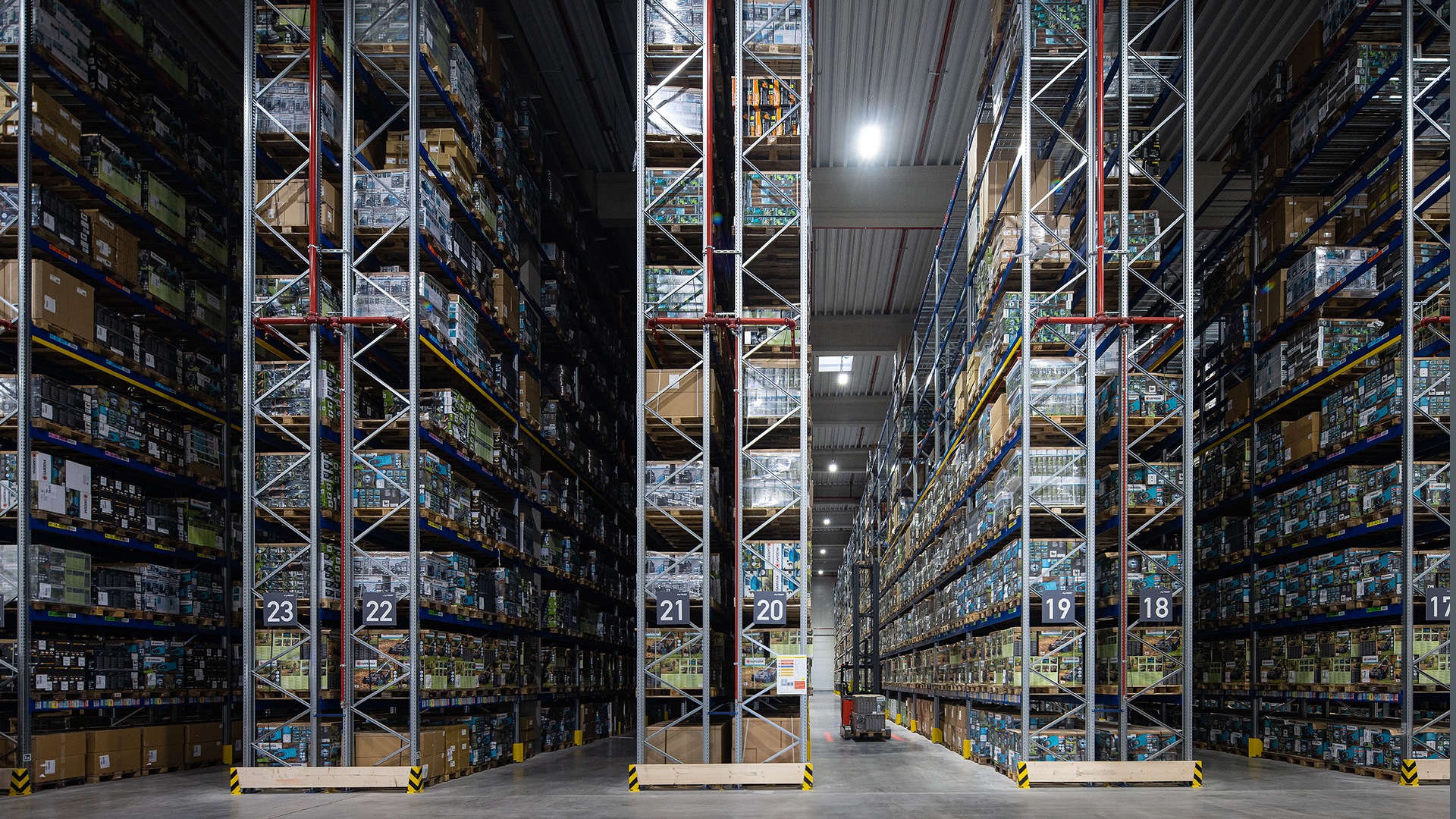
When a truck pulls up to the loading dock, it is the start of something more than just unloading. Goods must be received, counted, labeled, put away, picked, packed, and shipped out. And when orders suddenly increase, everything must work faster — without adding new problems. That is why manufacturers and sellers are increasingly looking not for more square meters, but for a partner who will take over logistics from start to finish. They are turning to “all-exclusive” logistics!
Renting a warehouse alone might look attractive on paper. There is a hall, a ramp, a floor, and space for racks. The problem starts later — when you have to make the warehouse actually start working.
You have to organize almost the entire logistics system. You need racks, forklifts, pallets, packaging equipment, label printers, scanners, a warehouse management system, and properly trained personnel. On top of that, there is training, shift planning, inventory control, complaint handling, safety, insurance, and transport organization. A warehouse without people, technology, and processes is a bit like a car without an engine. It might look good, but it won’t go anywhere – says a specialist from Seifert Polska directly.
– says Krzysztof Szymendera, Warehouse Manager at Seifert Polska.
Four walls are not enough
When does organizing your own logistics make sense? – Only in the case of companies with stable volume, extensive experience, and appropriate resources – industry specialists say. However, with variable demand, seasonality, or rapid business growth, having your own warehouse often means high fixed costs and the need to constantly monitor many processes simultaneously.
For many manufacturers or sellers, this is simply very difficult to manage. Especially in the modern market, where sales spikes happen often. Let’s take sales, for example, which are organized practically every season. We once served a client who produced candles. In such an industry, you produce all year round to sell almost the entire production around All Saints’ Day. A small warehouse, i.e., your own four walls, can be managed on your own with a constant, small volume, but with such spikes, overproduction, seasonal sales, or even upcoming “back to school” campaigns, a logistics partner is worth its weight in gold.
– emphasizes the Warehouse Manager at Seifert Polska.
Full logistics service, or fewer fires to put out
What can a logistics service include? Depending on the needs: unloading and receiving goods, quantitative and qualitative control, warehousing, inventory management, order picking, packing and securing products, labeling, wrapping and kitting, handling returns and complaints, organizing transport, reporting, and ongoing data exchange. – In short, we call it “all-exclusive” warehousing – Szymendera smiles. – Because it’s like being on vacation, you don’t have to worry about anything, everything is taken care of – he adds.
It was from such a need that this type of service was born. Thanks to the logistics service, a seller or manufacturer can focus on their core business, grow their company, and not waste time on “order processing,” analyzing why one pallet is missing, or who is supposed to prepare an urgent shipment.
What’s more, many industries are hard to even imagine without a logistics service. – A professional logistics operator knows, for example, how to store and handle hazardous materials – our warehouse in Luboń near Poznań meets the requirements for an ADR hazardous materials storage facility. And these are stringent requirements regarding advanced safety systems – the specialist emphasizes.
There is one more important difference between just renting warehouse space and a logistics service – people.
By renting only the space, a company still has to organize employees, equipment, systems, and daily operations on its own. In a comprehensive model, many of these responsibilities are taken over by the logistics operator.
From truck to truck
For whom is a comprehensive logistics service particularly beneficial? – Among others, for manufacturers of machines and components, for the automotive industry where repeatability, precise labeling, and deliveries in accordance with an established schedule count – says Michał Musielak from Seifert Automotive Polska.
A logistics service also seems indispensable for the e-commerce and retail industry.
Stores today need speed, accuracy, and efficient service. Here, every stage matters. Not every product should wait long for its turn. Sometimes the best place for a shipment is not a rack, but the next truck.
– notes Jarosław Leszczyński, Warehouse Manager at Seifert Polska in Stryków.
This is what cross-docking is all about. Goods arrive at the logistics center, are received, identified, sorted, and directed directly for further shipment. The warehouse becomes a place for efficient transshipment and consolidation, not long-term storage. – For this reason, cross-docking, or in short: logistics from truck to truck, also works for us – emphasizes Leszczyński.
No empty square meters. You pay for what you store
And what about costs? At first glance, the cost of a comprehensive logistics service may seem higher than just renting a warehouse.
However, such a comparison does not take into account expenses for racks, equipment, IT systems, employees, training, insurance, and maintaining operational readiness — even when the warehouse is not fully utilized.
– the logistics experts point out.
And how much can risk cost? For example, the risk that goods will be damaged, sent by mistake, etc. The price of risk is difficult to estimate, and in the logistics outsourcing model, it is often borne by the logistics operator.
One cannot ignore the potential costs of repairing damages incurred during the use of the facility. After the lease ends, the hall should be restored to its original state – just as is the case with renting an apartment. Such work can generate very high costs, especially at the end of the lease period.
A benefit of choosing a logistics service is also the synergy effect. What does it consist of? – The client uses the operator’s infrastructure, technology, and competencies when they actually need them, paying for performed operations and used resources, instead of maintaining the entire logistics background on their own.
Also beneficial to the client is the so-called pallet-based billing. In short, it frees the client from flat rates and applies only to the space actually used in the warehouse.
Companies should focus on their core business – production, sales, and business development – and entrust logistics to a specialized operator. Thanks to comprehensive logistics service, such as that offered by Seifert Polska, they can grow without having to build their own infrastructure from scratch.
– emphasizes Szymon Szczepanik, Member of the Board at Seifert Polska.
Source: Seifert Polska