









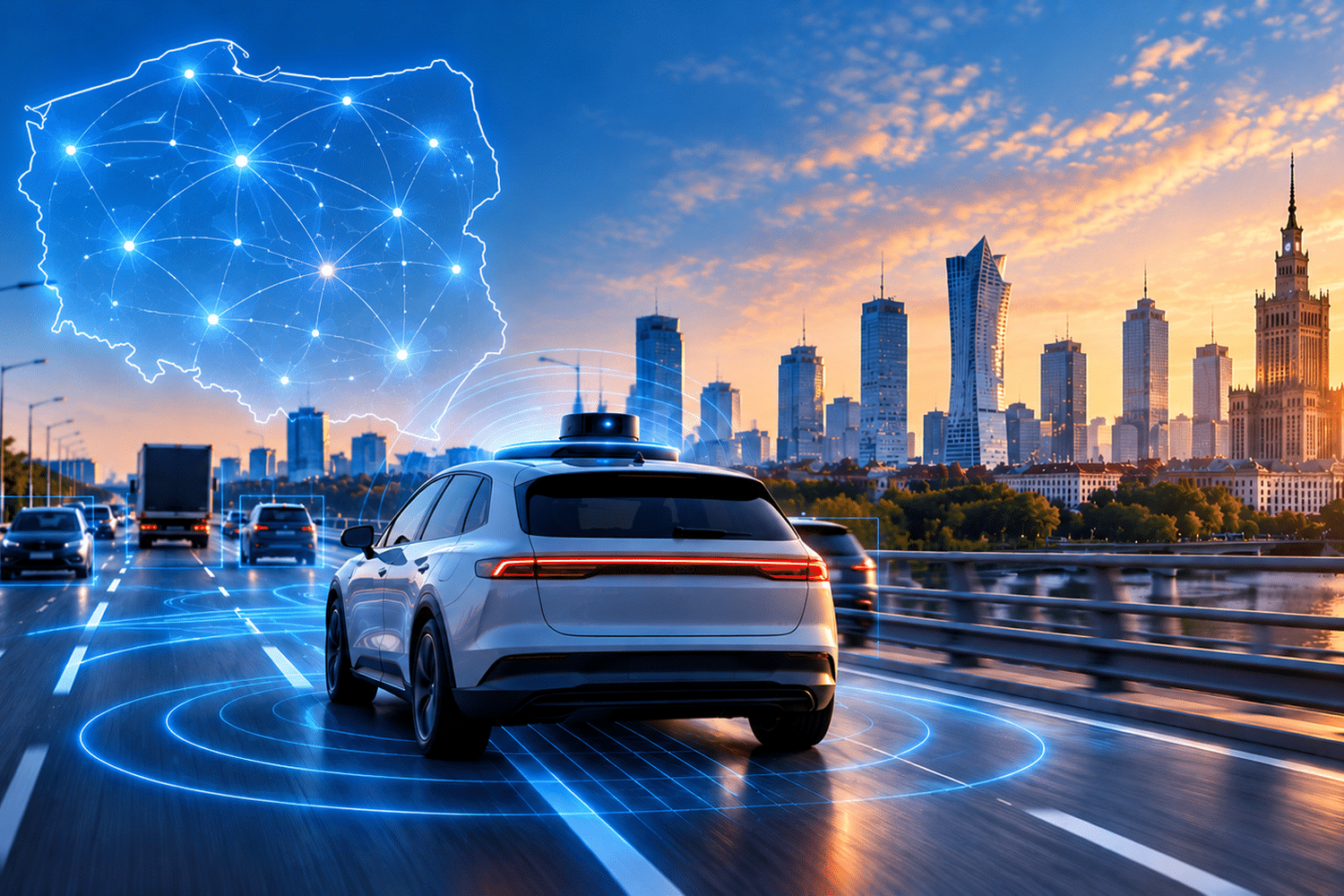
Autonomous vehicles can significantly reduce the number of road accidents, yet their implementation requires resolving issues of legal liability, algorithm ethics, and public trust. Although new regulations governing the testing of automated vehicles on public roads have been in effect in Poland since June 2026, regulatory, technological, and market challenges still raise questions about the country’s readiness for a transport revolution.
A car that does not fall asleep at the wheel, does not drive under the influence of alcohol, does not speed, and is not distracted by a phone sounds like the perfect recipe for safer roads. However, handing over control to a machine is more than just a technical novelty – it is a profound change in how we think about mobility and our own safety. The true revolution will not be decided solely in laboratories or on test tracks, but in regulations, social acceptance, and the ability of the Polish industry to seize this historic opportunity.
In the interest of safe roads
In 2025, there were 20,925 accidents on Polish roads, in which 1,660 people died and 24,590 were injured. Although the statistics of the National Police Headquarters indicate an improvement in safety compared to the previous year, the scale of the problem remains significant. Reducing the risk of accidents is one of the most important arguments in favor of developing automated and autonomous vehicles.
The premise is simple: eliminating or reducing the impact of human error should translate into improved safety. Automation systems do not get tired, do not lose concentration, and can analyze information from multiple sensors simultaneously. However, this does not mean they are infallible. Their effectiveness depends on the quality of software, data, components, road conditions, and proper environmental recognition.
Initial experiences with the commercial operation of autonomous vehicles are yielding promising results. According to a study published in July 2026 by the American Insurance Institute for Highway Safety, Waymo’s autonomous cars were involved in police-reportable road incidents 68 percent less often than human-driven vehicles (per mile traveled). The analysis covered 4 American cities where Waymo operates. The results indicate the technology’s potential for improving road safety, but researchers emphasize the need to continue monitoring its effectiveness as the scale of autonomous vehicle operation expands.
We should consider the development of autonomous transport primarily through the prism of its potential to improve road safety. It is not about replacing humans with technology, but about using solutions that will allow us to more effectively prevent accidents and protect road users – says Tomasz Bęben, President of the Association of Automotive Parts Distributors and Manufacturers (SDCM).
Technology is accelerating. What about trust?
One of the biggest challenges associated with the development of autonomous transport is convincing the public that the technology can be safely trusted. Handing over control of a vehicle to a computer system requires a change in the way we think about mobility and responsibility for our own safety.
Research published in 2026 in the scientific journal “Scientific Reports,” conducted on a representative sample of 1,057 Polish residents, shows the scale of the challenge facing the industry. Only 35 percent of respondents expressed a positive attitude toward autonomous vehicles, 34 percent rated them negatively, while as many as 31 percent had no defined opinion.
The authors of the study demonstrated that fear of new technologies does not necessarily translate directly into their rejection. What matters most are the perceived benefits, the opportunity to become practically acquainted with the solution, and concerns related to data privacy. Knowledge of the technology’s existence alone is not enough to build trust in it.
Similar conclusions come from the American J.D. Power 2026 U.S. Mobility Confidence Index report, prepared in cooperation with the Massachusetts Institute of Technology (MIT). Although more and more respondents understand what full driving automation is, the readiness index for using autonomous vehicles remains at just 39 points out of 100 possible. For 60 percent of respondents, the main source of concern is personal safety, 58 percent are worried about the vehicle’s behavior in emergency situations, and 51 percent about its operation in difficult road and weather conditions.
While an autonomous car delivering groceries may raise relatively few concerns, a vehicle transporting children poses completely different questions for users. According to the same study, 54 percent of respondents declared high trust in autonomous vehicles used for food delivery, but only 31 percent trusted them for transporting children.
This shows that the development of autonomous mobility requires more than just further technological demonstrations. Clear information about safety, the opportunity to learn about new solutions in practice, and education regarding the actual capabilities and limitations of automation are needed.
Can an algorithm make moral decisions?
The issue of trust takes on particular importance when an autonomous vehicle must react to a situation where it is impossible to completely eliminate danger. What should a car do when a pedestrian suddenly enters the road, and a sudden avoidance maneuver creates a risk for passengers? How should the system behave in a situation where every possible reaction involves a specific risk? Is it acceptable for an algorithm to differentiate its reaction depending on who the participant in the event is?
These are, on one hand, technological issues, but on the other, they raise questions in the fields of ethics, law, and liability. In practice, designing such systems does not consist of simply programming a choice of whose life is more important. The most important task is preventing critical situations, limiting risk, and developing rules for safe conduct when avoiding danger becomes impossible.
This does not change the fact that behind the way algorithms work are decisions made by people: designers, manufacturers, experts, and institutions setting safety requirements. They are the ones who must decide what rules should apply to systems that will be entrusted with performing tasks related to driving a vehicle.
No less important is legal liability. If an accident occurs during autonomous driving, it will be necessary to determine whether it was caused by a system defect, improper operation, operator error, or a combination of circumstances that the technology was unable to correctly recognize. Depending on the level of automation and the circumstances of the event, the liability of individual participants in this process may look different.
Added to this are issues of cybersecurity, privacy protection, and the processing of vast amounts of data collected by vehicles and their sensors.
Social acceptance of autonomous mobility will depend on the reliability of the vehicles themselves, but also on whether citizens receive clear answers to questions regarding the rules of their operation and liability for any irregularities.
Poland on the road to autonomy
Autonomous taxis are already transporting passengers in selected American and Chinese cities, but Poland is at a much earlier stage of this technology’s development. This does not mean, however, that the domestic market lacks the appropriate technological infrastructure or competence.
An important step was the changes in Polish law introduced in 2025, followed by implementing regulations that came into force in June 2026. The new solutions regulate research work on automated and fully automated vehicles, creating more detailed frameworks for testing new technologies on public roads. From the industry’s perspective, however, this is just the beginning. The Ministry of Infrastructure should take greater account of the practical needs of companies conducting research and development work. Therefore, it is necessary to further streamline administrative procedures, ensure an efficient process for obtaining and changing permits, and eliminate barriers related to the registration of vehicles used for research.
Regulations should allow companies to flexibly develop projects, including adjusting the scope of tests to subsequent stages of work on the technology, while maintaining appropriate safety requirements. In parallel, a discussion is needed about the conditions for future, regular operation of autonomous vehicles. Regulating research alone is not synonymous with creating comprehensive rules for their daily functioning on the roads.
Answers to these challenges require the cooperation of public administration, industry, the scientific community, and experts. One of the initiatives serving such cooperation is the Committee for Autonomous Transport, established at the initiative of SDCM, the Polish New Mobility Association (PSNM), and Łukasiewicz – PIMOT.
If we want autonomous vehicles to become a natural element of the Polish transport system in the future, we must work in parallel on technology, regulations, and social trust. We cannot expect citizens to entrust their safety to solutions whose operation they do not understand and for which they are not sure who bears responsibility. It is equally important to create regulatory conditions so that entrepreneurs can develop and test new technologies in Poland, instead of looking for a more predictable legal environment abroad. That is why, as SDCM, we have engaged in the establishment of the Committee for Autonomous Transport. We want representatives of business, administration, science, and experts to meet at one table to work together on the responsible implementation of autonomous mobility. Safety, as well as innovation, should not be treated as competing goals – emphasizes Nadia Rybczyńska, Government Relations & Communications Director at SDCM.
New mobility, new competencies, opportunities for the industry
The development of autonomous transport is a change in the way we move, but also a significant impulse for the development of the industry and the automotive market.
The growing importance of automation systems means an increase in demand for advanced sensors, radars, cameras, control systems, electronics, and software. This opens up new opportunities for parts and component manufacturers to develop their business, expand their product portfolios, and participate in increasingly technologically advanced supply chains.
At the same time, the transformation will generate demand for new competencies and specializations. Autonomous system engineers, specialists in artificial intelligence, cybersecurity, data analysis, ADAS system calibration, or the operation and supervision of autonomous fleets are just some of the areas where new jobs can be created.
Workshops, vehicle diagnostics, and the automotive services sector will also play an important role. Increasingly advanced cars will require appropriate technical infrastructure, access to information, and qualified specialists capable of properly servicing new systems.
For Poland, which has an extensive automotive parts production sector, this is an opportunity to develop new specializations and strengthen its position in the European industry. Utilizing this potential, however, will require investment in research and development, technical education, and cooperation between companies, scientific centers, and public administration.
We must remember that behind every autonomous vehicle is an entire industrial ecosystem: manufacturers of parts and components, suppliers of advanced electronic systems, software developers, and research and development facilities. For the Polish automotive industry, this is a huge space for developing new competencies, investments, and creating jobs. The condition for utilizing this potential is a regulatory environment that will support innovation, not limit the possibilities of its implementation – adds Tomasz Bęben, President of the Association of Automotive Parts Distributors and Manufacturers (SDCM).
The future of autonomous mobility will not be decided solely in laboratories, research centers, or on test tracks. It will also be decided on the roads, in regulations, and in social awareness. The technology must prove that it can function in a real, unpredictable environment, and that its development translates into tangible benefits for people. Will cars in Poland be able to move without a driver in the future? Will we be able to create conditions so that the public is ready to trust them, and the industry can fully utilize the opportunities they bring?
Source: Association of Automotive Parts Distributors and Manufacturers