









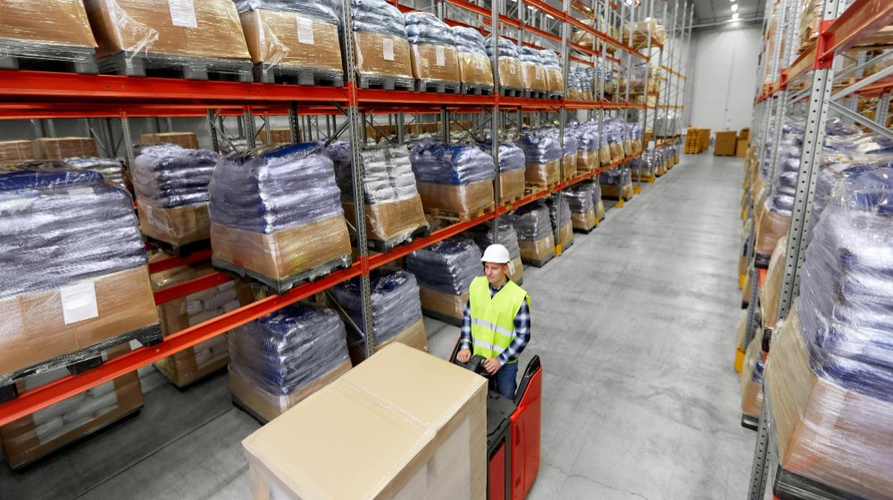
When choosing warehouse racks, it is easy to focus on two parameters: load capacity and price. In practice, however, this is not enough. The type of stored goods, the frequency of picking, the method of warehouse operation, and the conditions in the hall are also important. Therefore, warehouse racking systems should be selected for a specific way of working. A solution suitable for an e-commerce warehouse will not always work in a cold store, a production plant, or an auto parts wholesaler. The differences are best seen in specific examples.
E-commerce and fulfillment: fast access to a large number of products
In warehouses handling online sales, employees often pick orders consisting of individual items. At the same time, the number of different products can reach thousands. Therefore, the goods should be clearly visible, easily accessible, and arranged in a way that limits unnecessary movement around the warehouse.
In such conditions, warehouse shelving racks work well. The ability to change the height of the shelves makes it easier to adjust the layout to products of different dimensions. Where rotation is particularly high, they can be supplemented with flow racks, which speed up the picking of the most frequently ordered products.
Another solution is high-bay warehouse racks. They allow you to use the height of the hall to store stock, while the goods needed for current picking remain at easily accessible levels. Thanks to this, you do not have to allocate the entire working area to stock, and employees have the products they reach for most often at hand.
Production and automotive: from small parts to long and heavy elements
A warehouse at a production plant often has to accommodate very different types of materials. Next to small parts, there may be heavy components, crates, steel profiles, pipes, or elements several meters long.
It is difficult to handle such an assortment with one type of rack. Small parts can be stored on shelving racks or in drawers, palletized goods on pallet racks, and long elements on cantilever structures.
The most important thing here is to match the equipment to the actual dimensions and weight of the goods. Therefore, several different systems can operate in one warehouse, each handling a different group of products. Such a solution usually allows for better use of the available space than trying to fit the entire assortment to one type of structure.
FMCG and refrigeration: high rotation and correct order of release
In warehouses for fast-moving products, efficient flow of goods is of great importance. In the case of items with a specific expiration date, you also need to ensure that previously received batches are released first.
Flow racks help with this. The goods are placed on one side of the structure and picked from the other. Subsequent packages move towards the picking station, which makes it easier to maintain the FIFO principle and reduces the number of additional operations.
High-bay warehouse racks, in turn, can be used to store larger stock, which is used to replenish the picking zone on an ongoing basis.
A separate issue is cold stores and freezers. Low temperature and humidity affect the durability of the equipment, so you need to pay attention to proper protection of the structure against corrosion. A layout of racks that enables safe work and does not hinder the maintenance of the required storage conditions is also important.
Pharmacy and medicine: order, cleanliness, and controlled access
In pharmaceutical and medical warehouses, the storage method is strictly related to requirements regarding quality, product identification, and access control.
Warehouse shelving racks should be easy to keep clean and adapted to the method of marking goods. It is also important to clearly separate individual product groups, batches, or storage zones.
Some products require additional protection or access only for authorized persons. In such a warehouse, the racks are not just a place to put goods. Their arrangement helps to maintain order, reduce the risk of errors, and improve inventory control.
What is worth considering before choosing racks?
The industry is important, but the name of the sector alone is not enough to choose a specific solution. Two warehouses operating in the same industry may have completely different needs.
Before starting a project, it is worth checking primarily:
- dimensions and weight of stored goods,
- number of units stored on individual levels,
- frequency of receipts and releases,
- order picking method,
- height and layout of the hall,
- floor load capacity,
- type of trucks and other equipment used,
- possibility of future warehouse expansion.
Only by comparing this information can you assess which type of racks and which warehouse layout will be practical in daily work.
Why is it worth choosing a system for a specific warehouse?
Ready-made modules may be sufficient for simple applications. In more demanding facilities, however, a more precise adjustment of the structure to the available space, loads, and the method of handling goods is needed.
Direct cooperation with the manufacturer gives the opportunity to include these parameters at the design stage. You can then choose the dimensions of the structure, the spacing of levels, or the method of system expansion for a specific hall.
An example of a company offering such solutions is META, which designs warehouse racking systems taking into account the technical conditions of the facility and the way it is used.
Summary
There is no single racking system that will work equally well in every warehouse. E-commerce needs primarily fast access to a large number of products, production must deal with various dimensions, in FMCG efficient rotation counts, and in pharmacy, order and access control are of particular importance.
Therefore, before buying racks, it is worth starting with an analysis of the goods and the way the warehouse works. A well-chosen system not only allows you to store more products but also facilitates daily warehouse operation and gives more freedom for its later expansion.