









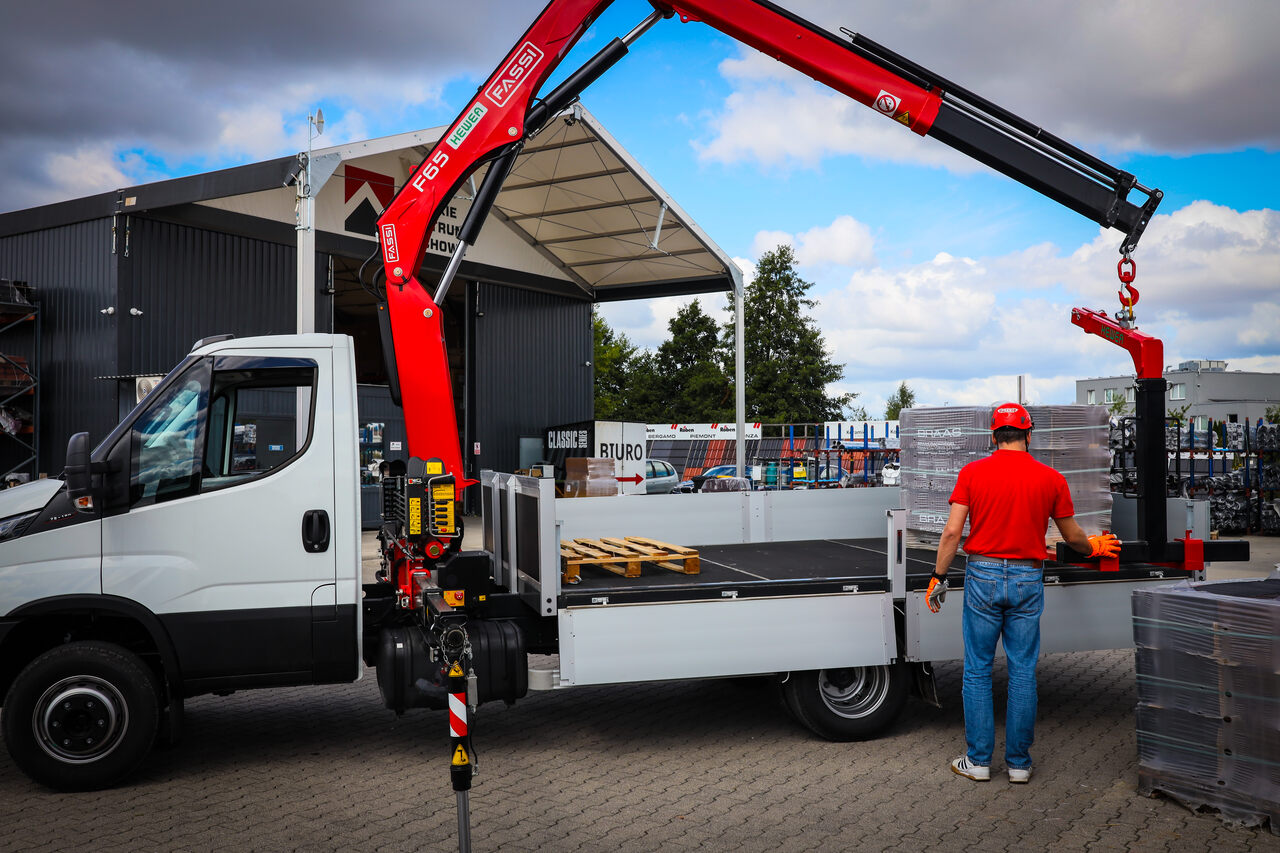
From September 21, 2026, the rules regarding e-TOLL charges for light vehicle combinations with trailers are changing. For entrepreneurs who use vehicles with a GVW of up to 3.5 t to transport equipment, this means a significant change in the organization of transport and its settlement. Among the devices whose transport may benefit from this are trailers with HDS cranes, mini cranes – compact machines used in assembly, construction work, and projects requiring precise lifting.
Based on the Act of May 29, 2026, amending the Public Roads Act and certain other acts, from September 21 of the same year, vehicles with a GVW of up to 3.5 t with an attached trailer are not subject to the obligation to pay the electronic toll in the e-TOLL system.
For companies using such combinations to transport mini cranes, this means a change in the current rules for settling transport. Previously, the obligation to use e-TOLL was determined by the GVW of the entire vehicle combination. If the car with the trailer exceeded 3.5 t GVW, travel on roads covered by the system required the payment of a toll. From September 21, the situation is different. If the towing vehicle has a GVW of up to 3.5 t, the travel of the combination with a trailer does not require settlement in the e-TOLL system, even if the total GVW of the car and trailer exceeds 3.5 t. However, the change only applies to the obligation to pay the electronic toll. It does not mean the abolition of other requirements related to operating such a combination.
– explains Remigiusz Zabolski, Director of Sales Support and Marketing at HEWEA.
Unused e-TOLL funds – until when can they be recovered?
The change in regulations also involves the need to organize settlements previously conducted in the e-TOLL system. Entrepreneurs who have accumulated unused funds in their billing account as a prepayment or cash security can apply for their refund to a bank account.
Six months from the date of entry into force of the new regulations have been provided for submitting the application. This means that the application for a refund must be submitted no later than March 21, 2027. After this deadline, unused funds will not be subject to a refund and will be transferred to the National Road Fund. It is therefore worth checking the status of settlements not only for a single vehicle but for the entire fleet used in the company. For companies that regularly used light transport combinations, this may be an opportunity to recover funds that remained in e-TOLL accounts.
– points out the Director of Sales Support and Marketing at HEWEA.
What remains unchanged?
The abolition of the e-TOLL obligation for vehicles with a GVW of up to 3.5 t with a trailer does not mean that the transport of a mini crane can take place without taking into account the parameters of the entire combination. It is still necessary to comply with regulations regarding permissible weights and axle loads, parameters of the towing vehicle and the trailer, as well as the proper securing of the transported device.
Before starting transport, it is also necessary to verify whether a specific vehicle can tow a given trailer and whether the combination meets the requirements specified for its category. Depending on the vehicle parameters and the nature of the transport, other regulations regarding road transport may also apply, including regulations related to driver working time or tachographs.
– adds the Director of Sales Support and Marketing at HEWEA.
Trailer instead of heavy transport
Transporting a mini crane on a properly selected trailer allows for simplifying the logistics related to servicing a construction project. Until now, HDS cranes were mounted on vehicles that had a 3.5 t GVW, which meant they no longer had payload capacity because the weight of the device was large enough to limit it. If the parameters of the device, trailer, and towing vehicle allow for creating a suitable combination, the crane can be transported directly to the place of work.
Such a solution gives the entrepreneur greater freedom in organizing work. After delivering the machine to the construction site, the car does not have to remain on site for the entire duration of the task. It can return to the base or be used to transport building materials, while the crane remains at the investment site and performs its tasks.
– says Remigiusz Zabolski, Director of Sales Support and Marketing at HEWEA.
This is particularly important for companies carrying out several orders simultaneously. The ability to leave equipment at one investment site and use the vehicle to handle subsequent tasks allows for better utilization of available transport resources. As a result, the method of transporting the machine becomes not only a logistical issue but also an element of organizing the entire investment implementation process.
Mini cranes and FASSI HDS cranes in the HEWEA offer
Mini cranes and FASSI HDS cranes are used, among other things, for the installation of windows and glass facades, construction work, and installations carried out inside industrial halls, commercial facilities, and public utility buildings.
Their compact dimensions allow them to be used also in places where the use of larger equipment is difficult or unjustified. Combined with a properly selected transport method, this gives the entrepreneur the ability to efficiently move the device between subsequent investments and adapt logistics to the actual needs of the task being carried out.
– says Remigiusz Zabolski, Director of Sales Support and Marketing at HEWEA.
For companies that work in different locations and must flexibly respond to the schedule of subsequent investments, equipment mobility becomes one of the important elements of effective work planning. The change in e-TOLL rules further simplifies the settlement of light combinations with a trailer, which makes it worth re-analyzing the current transport model for the machines used.
Source: HEWEA sp. z o.o.