









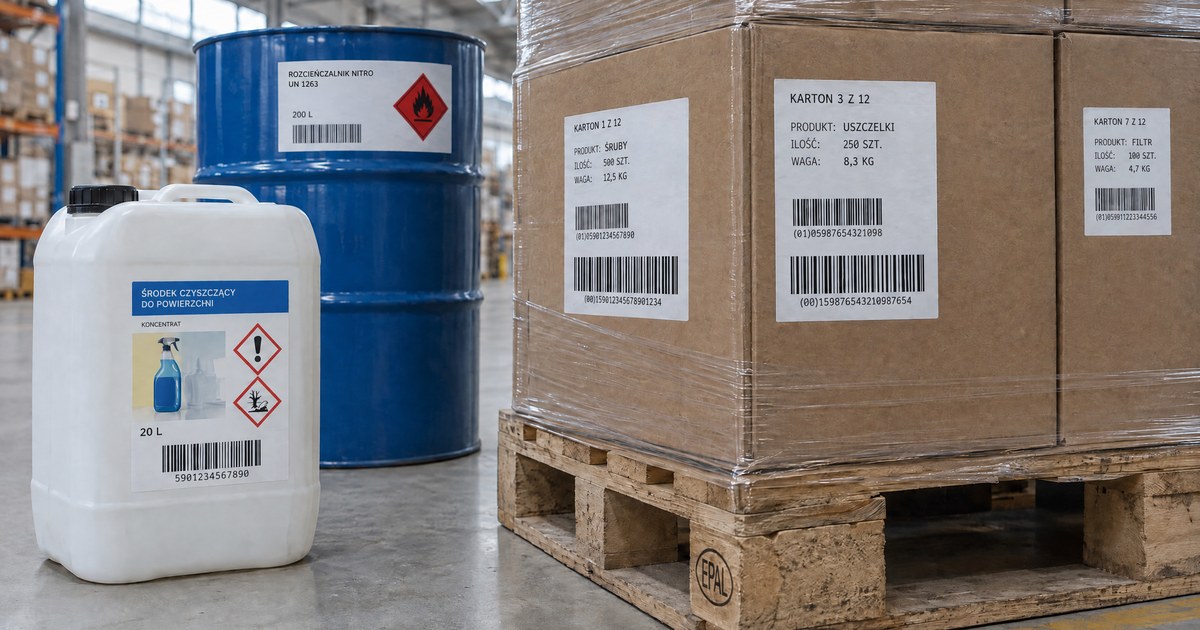
 Photo: TAKMA
Between the sender’s ramp and the recipient’s rack, a pallet is scanned several times: during loading, at the carrier’s terminal, upon receipt, and when put away. Each scan is a checkpoint. If the code cannot be read from the forklift, the pallet ends up in a staging area, and someone has to re-enter the number manually. I have seen recipients issue debit notes for such pallets.
The GS1 logistics label is intended to prevent this. The standard is public and well-documented, so I will not summarize it. I will focus on what actually determines whether a label works: a single number, several dimensions, and the choice of printer.
One mandatory number, the rest as needed
SSCC. The Serial Shipping Container Code is the only element without which a logistics label does not exist. Eighteen digits under the application identifier (00): extension digit, GS1 company prefix, serial number, and check digit. One pallet, one number. A repeated SSCC means two pallets with the same identity in the recipient’s system and a blocked receipt.
Three sections. The label has a supplier section (SSCC and content: GTIN under (02), quantity (37), batch (10), best-before date (15) or expiration date (17)), a customer section (order number, delivery location), and a carrier section (shipment number, route). Only the first one is mandatory. Barcodes go at the bottom, human-readable text above them, and the SSCC code always at the very bottom so the operator knows what to scan without reading.
Format. For the supplier section alone, a 105 × 148 mm (A6) label is sufficient. When customer and carrier data are added, an A5 (148 × 210 mm) label is required, which exceeds the 104 mm print width of a four-inch printer. Cramming three sections onto an A6 label results in a code reduced below the standard.
Dimensions that determine if the scanner will read the code
Module width. The narrowest bar in a GS1-128 code on a logistics label should be between 0.495 and 0.94 mm; GS1 recommends the lower value. A 203 dpi printer places a dot every 0.125 mm, so a 0.5 mm module is four dots and comes out clean. Higher resolution does not improve anything here.
Bar height. Minimum 31.75 mm, without text under the code. A tall code is forgiving of a scanner held at an angle and slight wrinkles in the film.
Print quality. GS1 requires at least class 1.5 (C) on the ISO/IEC 15416 scale. Large recipients check this with a verifier upon receipt. Contrast below the threshold means the print is too pale or the substrate is poor.
Placement. The bottom edge of the codes should be 400 to 800 mm above the pallet base, at least 50 mm from the vertical edge, preferably on two adjacent sides: right and back. A label on a corner or under strapping tape is the most common cause of rejection I see at ramps.
What to print with — determined by the pallet’s lifespan
A pallet that reaches the recipient in two days can have a thermal label. It does not need a ribbon, so the material cost is the lowest, and anyone can change the roll. For this application, thermal label printers for short-lifespan labels are sufficient.
A pallet that will sit in a warehouse for a quarter, in a hall with southern exposure, or in a cold store, needs thermal transfer. A thermal label turns gray after a few weeks in the heat, and the contrast drops below class C. For markings that need to last a season, thermal transfer printers for pallet and warehouse labels with a wax-resin ribbon are suitable; pure wax rubs off during handling. In the shipping department, logistics labels are printed on industrial six-inch printers because A5 does not fit on a four-inch one, and hundreds of pallets are processed daily. A ZT421 class printer costs about 10,600 PLN net, and at such volume, it is cheaper than two desktop printers replaced every season.
What breaks most often and how it looks to the recipient
- Pale print. The operator turns up the darkness instead of cleaning the printhead. The code reads well for a week, then starts skipping. Causes of pale print can be sorted out in fifteen minutes.
- Cut-off margin. The GS1-128 code needs a quiet zone on both sides, at least ten module widths. After changing the roll, the print shifts by a few millimeters, and the left margin disappears. Label sensor calibration after every media change helps.
- Text does not match the code. The template in the shipping system constructs the SSCC from fields but prints the value from a different field under the code. This is only detected by the recipient.
- Label on a film wrinkle. The bars break optically, and the class drops. The label should be applied to a flat cardboard surface or a straightened fragment of film.
Dangerous goods: here color is no longer just decoration
Next to the logistics label, a second marking appears on a pallet with chemicals. This is the only area in logistics where color is a legal requirement, not a marketing one.
ADR. The warning label is a diamond with a side of at least 100 mm with a line 5 mm from the edge, at least 2 mm thick. The background color depends on the class: red for flammable liquids, white with black for corrosive materials, stripes for class 9. On containers and vehicles, the labels grow to 250 × 250 mm.
CLP. The pictogram is a black symbol on a white background in a red frame. It must occupy at least one-fifteenth of the minimum label area and no less than 1 cm². For packaging from 50 to 500 liters, the label is at least 105 × 148 mm, so each pictogram comes out to about 10 cm², i.e., a square with a side of over 30 mm. A black pictogram without a red frame is non-compliant, regardless of how well it is printed.
There are two paths. First: labels with red frames pre-printed at a print shop and black thermal transfer printing in-house. This works when the assortment is constant. Second: full color on-demand, when each substance has a different set of pictograms, and the wholesaler bottles chemicals into smaller containers. In that case, the label is assembled entirely by a color label printer with pigment ink, and on a polypropylene substrate, the print meets the BS5609 standard required in maritime transport. A printer of this class costs about 7,500 PLN net, so it makes sense where it replaces regular orders at a print shop, not for two substances in the offer.
Before the pallet leaves
- Is the SSCC new and does it match the shipping advice?
- Is the lowest code on the label the SSCC, and is the module at least 0.495 mm?
- Is the label 400–800 mm above the base, 50 mm from the edge, and not on a corner?
- Will the printing technology last as long as the pallet will be stored?
- For chemicals, do the pictograms have a red frame and the correct size?
The recipient does not judge the label; they scan it. If the code reads on the first try, no one will notice the label was there at all.
Jakub Tiuchty — an automatic identification specialist with 25 years of industry experience. He advises on the selection of mobile terminals, label printers, and barcode scanners for logistics, manufacturing, and trading companies.