









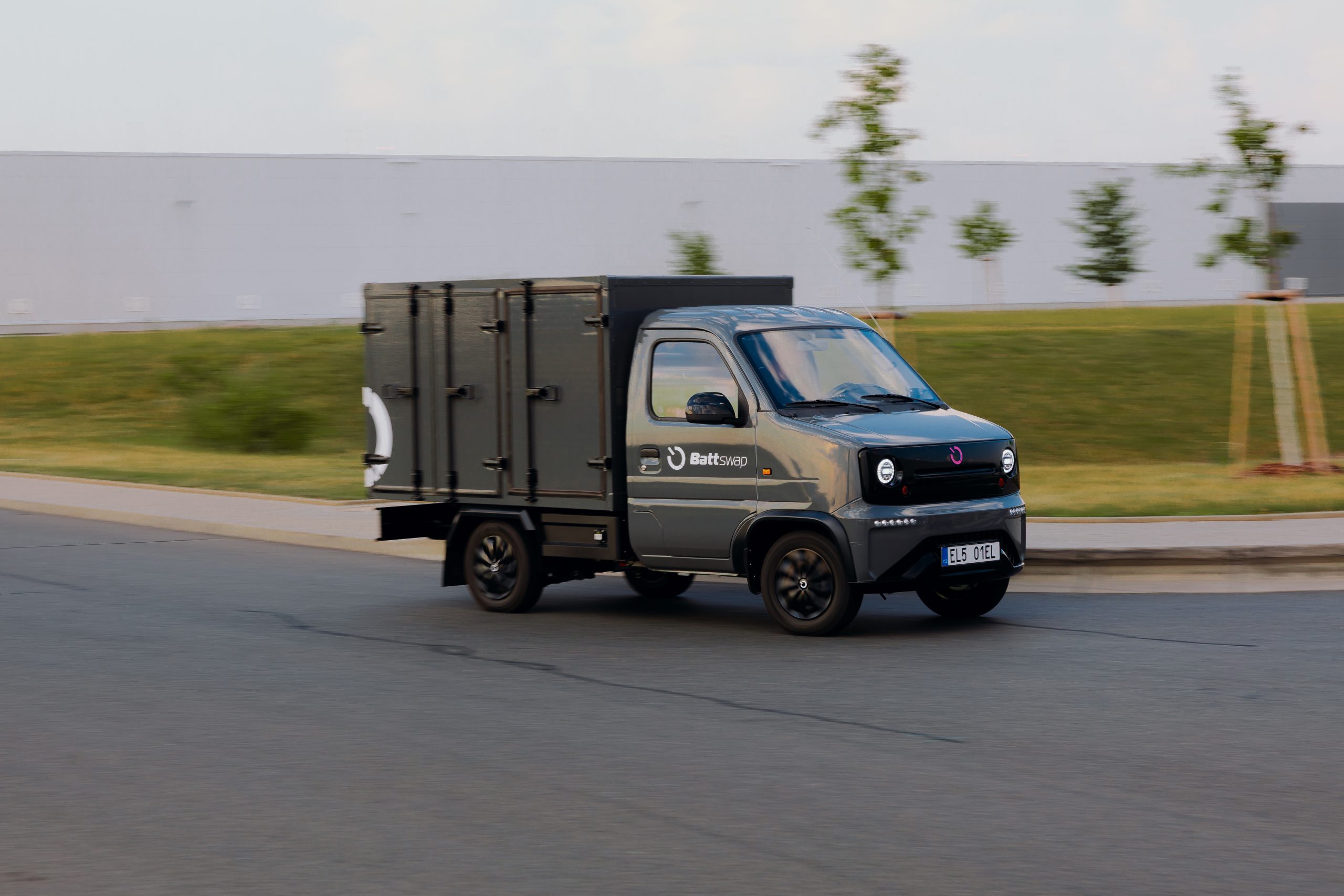
BattSwap is entering the Polish market with an automated battery swapping system for electric delivery vehicles. The Czech company, which has created the only commercially operating automated network of this type in Europe, allows a depleted battery to be replaced with a fully charged one in less than three minutes. The solution reduces the load on the power grid and eliminates the need to charge each vehicle at a separate charger. BattSwap is preparing pilot implementations in Poland with partners including Lisek.app, Kuchnia Vikinga, and other last-mile delivery operators. VeloHub, which specializes in solutions for urban logistics and last-mile delivery, is responsible for the company’s development in the Polish market.
Instead of charging – swap the battery
Electric delivery vans typically require downtime for charging. BattSwap eliminates this downtime: instead of waiting for the vehicle to charge, the system automatically replaces the depleted battery with a fully charged one. The entire process takes less than three minutes.
The swap takes place in an automated station the size of a shipping container. One such station draws a maximum of 130 kW from the grid and can serve a fleet of about 30 vehicles per day. Batteries are charged gradually inside the station, primarily outside of peak energy demand hours. During this time, vehicles can continue to make deliveries. For fleet operators, this solves two significant problems associated with transitioning to an electric fleet: limited grid power availability and the time vehicles are out of service due to charging.
Thanks to BattSwap, companies whose bases cannot obtain a high-power connection can also use an electric fleet. The solution is also suitable for rented facilities where building permanent charging infrastructure may be impossible or unprofitable. A BattSwap station does not require the construction of a permanent facility and can be moved along with the fleet if the base location changes.
Over 65,000 battery swaps already – BattSwap in practice
The BattSwap network in the Czech Republic currently serves 78 electric delivery vehicles using four stations in Prague and Brno. To date, the system has performed over 65,000 battery swaps. Vehicles using the solution have covered a total of over 2.5 million kilometers, completing electric deliveries without the need to use public charging stations.
One of BattSwap’s clients is the Rohlík Group, a leader in the Czech online grocery market. In the first five months of 2026, the company’s vehicles covered 790,000 km using the BattSwap solution.
In 2025, BattSwap achieved 2.6 million euros in revenue, representing a 370 percent year-on-year growth. The company’s operations are profitable and are being developed without government subsidies.
Why Poland?
Poland is the largest last-mile delivery market in Central and Eastern Europe, and the fast online grocery delivery sector is among the fastest-growing in the region. At the same time, infrastructure for charging large fleets of electric vehicles is still in its early stages.
According to the requirements of the EU’s AFIR regulation, by 2030, Poland will need charging infrastructure for heavy-duty electric transport in 166 locations. Currently, there are seven such locations.
Before we started talking about BattSwap more broadly, we spent several years developing and testing our system in the daily operation of delivery fleets. That is why we are entering Poland with a solution that has already proven itself. The Polish fleet market is developing very dynamically, but one of the challenges remains access to sufficient power from the grid. We want to show that transitioning to an electric fleet does not have to mean waiting for energy infrastructure expansion – says Radek Janků, founder and CEO of BattSwap.
BattSwap at the New Mobility Congress, September 23–25 in Katowice
BattSwap’s entry into the Polish market coincides with the company joining the Polish Alternative Fuels Association (PSNM). One of the first places where BattSwap technology can be seen in Poland will be the New Mobility Congress in Katowice, for which the company has become a partner.
From September 23-25, a fully operational automated battery swapping station will be presented at booths 20 and 21. Congress participants will be able to see the entire process live: from the vehicle entering the station to the battery swap.
During the event, Radek Janků, founder and CEO of BattSwap, and Ondřej Koči, CSO of BattSwap, will also meet with the media to talk about the technology, experiences from the Czech market, and the company’s development plans in Poland.
The last-mile delivery market is currently one of the most dynamic areas of the Polish economy – the value of e-commerce has exceeded 165 billion PLN, and this year more than 1.5 billion parcels will be delivered across Polish roads. Behind this volume are thousands of delivery vehicles entering city centers every day, and it is this segment that is electrifying more and more strongly – in the first quarter of 2026, registrations of electric delivery vans increased by 54 percent year-on-year, and the total fleet of electric delivery and heavy-duty vehicles exceeded 12,600 units. Increasingly, the barrier is no longer the vehicles themselves, but access to power: an operator who wants to electrify a base of several dozen cars overnight faces grid connection limitations. That is why, from the perspective of PSNM, it is so important that the market develops various energy replenishment models in parallel – from fast charging and intelligent power management to automated battery swapping. The more solutions proven in practice, the faster the transition of a fleet to electric drive will become a purely business decision in Poland, rather than a derivative of available infrastructure. We are pleased that BattSwap is joining our association and will showcase its technology during the New Mobility Congress in Katowice.
– comments Aleksander Rajch, Board Member of the Polish Alternative Fuels Association.
Source: BattSwap