









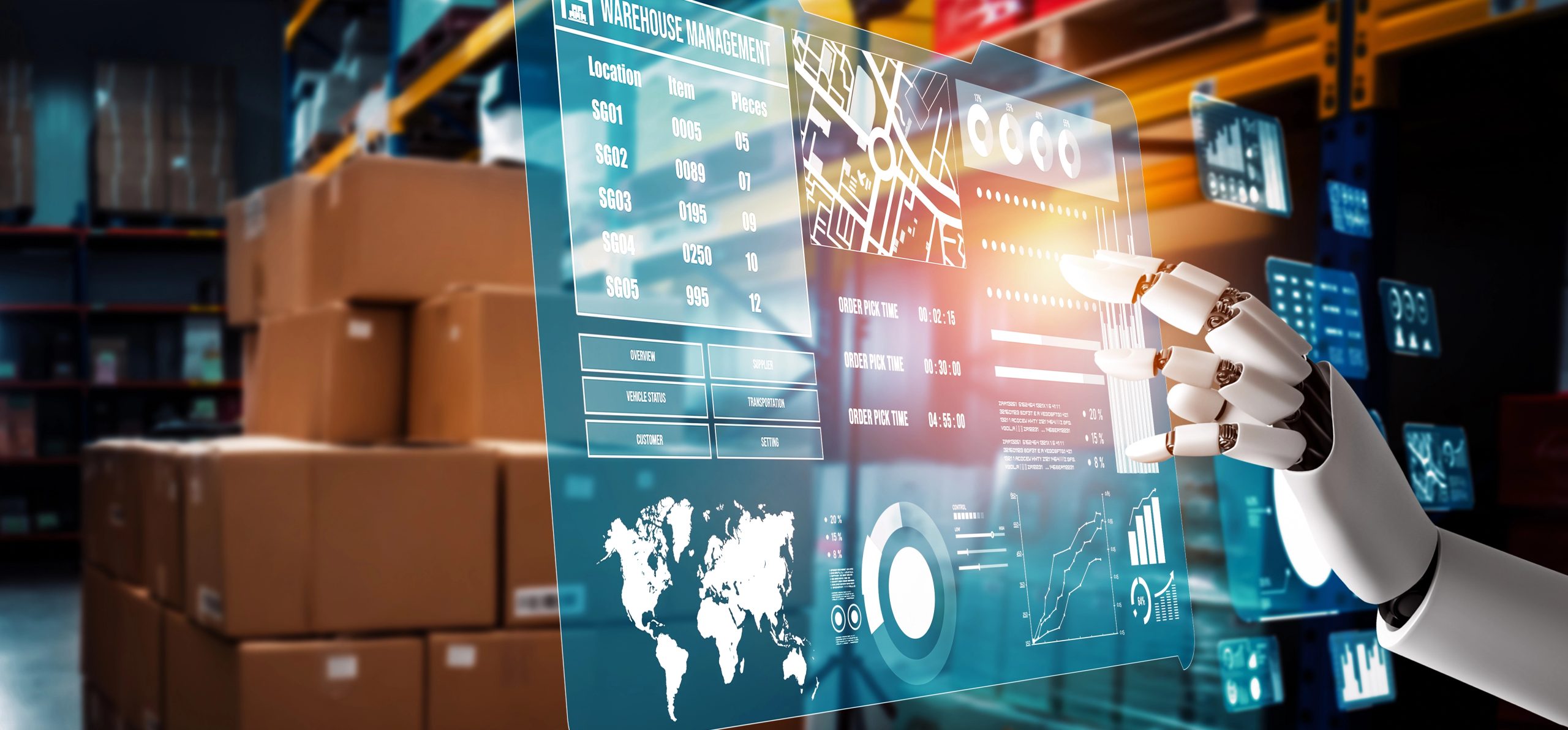
What are AI agents capable of today, what opportunities do they open up for logistics, and what risks are associated with their use? Few technological trends are currently attracting as much interest. Seven observations from DACHSER, presented in a Q&A format, highlight the most important opportunities and challenges related to the development of AI agents in logistics.
The logistics industry sees enormous potential in these digital assistants. As is often the case with highly publicized topics, many people talk about them without knowing exactly what they are. The definition of agentic AI varies slightly depending on the case. AI agents are essentially software applications. Unlike conventional programs, however, they combine generative artificial intelligence with rule-based processing. This combination creates digital units that, within a defined scope of tasks, can understand queries and input data, develop action strategies based on defined goals, and then trigger and monitor appropriate actions.
For example, in the shipment tracking process, an AI agent can analyze information from status systems and even unstructured chat messages, draw conclusions based on defined goals, and trigger appropriate actions. Once a shipment reaches a certain status, the agent can either notify the customer directly or escalate the case to a customer service representative for review and further processing.
What is the difference between an AI agent and an AI assistant?
No, but the line between them is becoming increasingly blurred. In an ideal scenario, an AI agent acts as a fully autonomous system that decides for itself whether and how to involve a human. In practice, however, it often acts more like an assistant: it performs almost no action without human approval.
Depending on the quality of the results generated by the AI and the process specifications, hybrid forms are emerging that combine the features of AI agents and AI assistants. The formal boundaries between the two definitions are increasingly blurring, and both solutions are gradually merging.
Where are AI agents already changing logistics processes?
Primarily in processes that connect different participants in the supply chain. This is where the first agent-based systems are being tested. One example is entering necessary shipment data into logistics platforms.
This data can include unstructured texts and documents, as well as voice messages—coming from both humans and other AI agents. The Model Context Protocol (MCP) is opening up new possibilities. Thanks to it, large language models are communicating more effectively with external systems and databases. This creates a new form of data exchange interface that has the potential to complement the EDI and API-based solutions used today.
The second area is procurement and sales. Here, AI agents gather preliminary information about the properties and availability of products and services, analyze contract terms, and negotiate their provisions. This is already happening today in the first pilot projects.
How often do AI agents make mistakes?
As DACHSER points out, the estimated accuracy of even the best AI agents currently does not exceed 90–95%. In other words: in 5–10 cases out of 100, the agent may draw an incorrect conclusion and, consequently, fail to trigger the expected action. In many operational scenarios, this is a fundamental challenge.
Another important factor is the agent system’s ability to recognize how accurate its own decision is, what process is currently taking place, and which decision-making rules apply. This ability further influences the quality of the actions taken by the agent.
Practical conclusion: due to the inherent level of error, risk must always be assessed. What is the impact of occasional errors? How does the business model handle them? Currently, there are many processes that, precisely because of this risk, cannot yet be entrusted to AI agents.
How to work with AI agents in a team?
Like with new team members—with a clear task, context, and supervision. AI agents have strengths and weaknesses that sometimes surprisingly resemble the traits of real people in everyday professional life. Together, they make agents more than just computer programs—they resemble team members.
They are prepared and trained to perform various tasks and can collaborate with humans. In the future, humans will assign tasks to AI agents and work with them iteratively until the desired result is achieved. This is not about including one, but several agents acting in parallel—a single agent needs time to “think,” so working with several at once speeds up the process.
Agents perform tasks effectively only when they repeatedly receive the appropriate context for their actions: high-quality data and instructions (prompts). In other words, they require professional management and good integration with human teams—so that they are accepted as “colleagues.”
These are new competencies that leaders and managers at all levels will need to learn very quickly and implement in practice.
Who can create AI agents?
Increasingly, the users themselves, not just programmers. Alongside managing and using agents, creating one’s own agents will become increasingly important in the daily work of logistics professionals.
Under the banner of “citizen development,” environments are emerging that enable many users to create and deploy simple AI agents: it is enough to formulate prompts appropriately and connect data sources and workflow systems. An example from everyday office work is Microsoft’s Copilot agents.
Are investments in AI agents already paying off?
Generally, not yet. Despite the enormous potential of agent-based systems and the first concrete efficiency gains in some processes, AI agents usually do not yet provide a return on investment (ROI). Many of them are still at the MVP (Minimum Viable Product) stage, tests are underway in pilot projects, and the solutions remain far from full integration with business models.
Costs include development work, AI system licenses, and token consumption for queries to large language models such as ChatGPT, Claude, or Mistral. These grow especially in the case of excessive dependence on a single provider or a single LLM. In addition, there is employee training and the time needed to gain experience in working with AI agents. Every innovation process naturally involves a certain level of investment in learning how to properly use new technologies.
However, step by step, concrete KPIs and ROI analyses must also become tools for setting the direction for the development of AI agents—so as to create a solid economic foundation for the use of artificial intelligence in the medium term.
How will AI agents change the supply chain?
They will gradually enter almost every process—despite weaknesses, risks, and costs. Everyone should be aware of this. In some cases, AI agents will change the nature of collaboration only slightly; in others, in a very significant way. In most cases, however, they will make collaboration more efficient.
This is not just about individual AI agents, but also about multi-agent systems, where agents will interact both with each other and with humans. The future of logistics and supply chain management will therefore be shaped not only by people, but also by AI agents.
This also means that working with AI agents will become part of leadership responsibility. Stefan Hohm, Chief Development Officer (CDO) at DACHSER, summarizes it as follows:
AI will not replace leaders. But leaders who use AI will replace those who do not.
Source: Dachser