









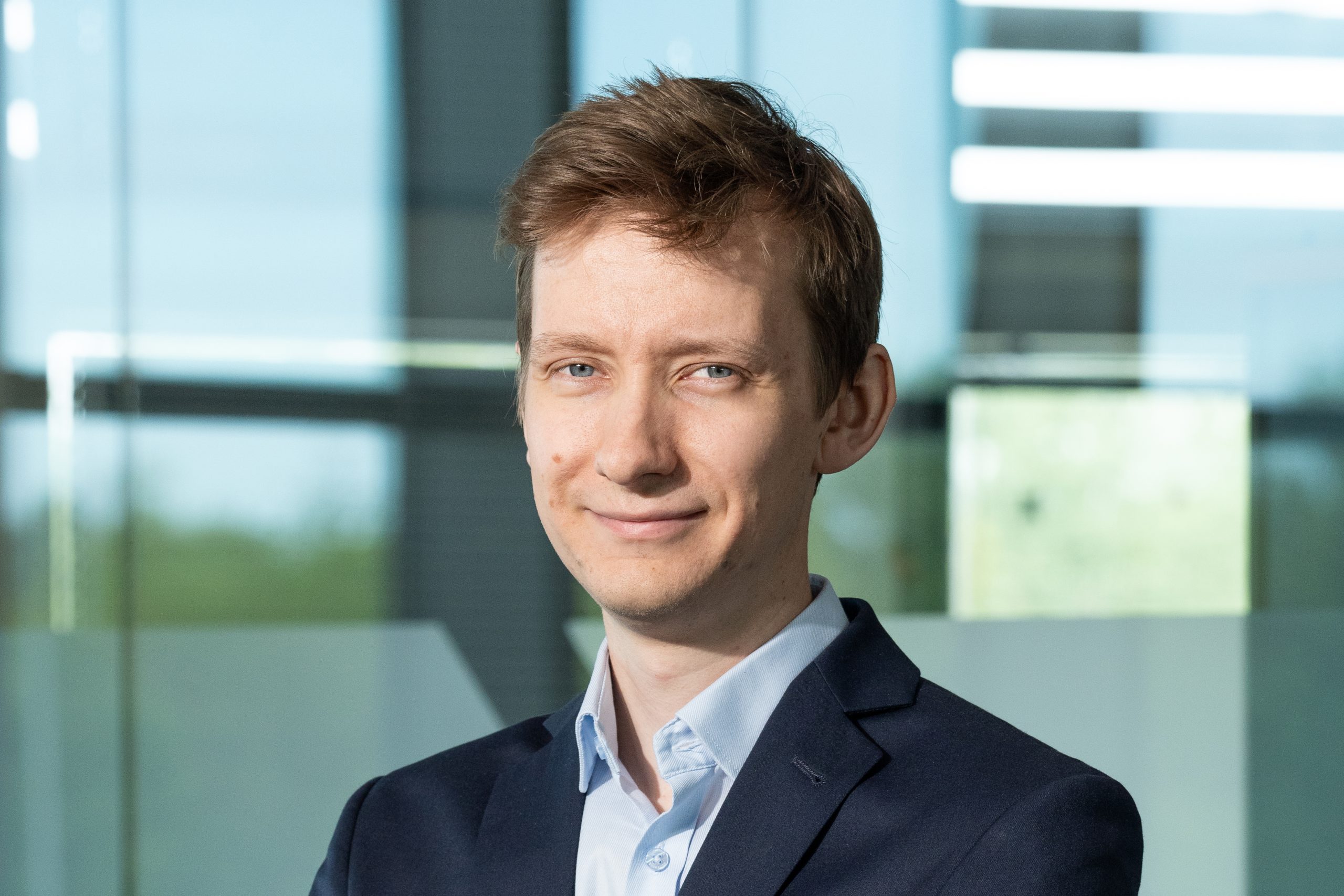
An interview with Mateusz Klimowicz, Robotic Process Automation Manager at FM Logistic.
Tomasz Janiak: First of all, I would like to congratulate you on your participation in the prestigious Google Cloud Next conference in Las Vegas, which took place on April 22–24. You spoke in the session “Accelerate R&D with Gemini-based agents Co-Scientist and AlphaEvolve.” What was the background of the entire event, and your presentation in particular?
Mateusz Klimowicz: Thank you. The fact that we were invited to present such an innovative solution at the largest annual Google Cloud conference is something exceptional. It was the culmination of a very interesting project. Google Cloud provided us with early access to their latest tool – AlphaEvolve – created for optimizing algorithms, including those used in logistics. We can safely say that we are the first logistics company in the world to have successfully used this solution in practice.
T.J.: The joint venture between a global logistics operator (FM Logistic) and a technology leader (Google) is also interesting from the perspective of project work – in terms of logistics and IT project management, i.e., the selection of experts, competencies, etc. Could you shed some light on the behind-the-scenes of this interdisciplinary, international team’s collaboration?
M.K.: Working with the Google team was a pure pleasure. We received support from their engineers in Poland, Germany, the UK, and the USA, while on the FM Logistic side, the project was carried out by a Polish-French team. Interestingly, with such an advanced topic, there were no competency barriers between us. The biggest – and actually the only – organizational difficulty was simply finding the right time slot for joint meetings due to the time zone difference with the USA. We closed the project in just two months, achieving very good results immediately. This was possible because we were not starting from scratch. We already had solid prior experience using machine learning models in warehouse operations, implementing language models, and evaluating algorithms. This allowed us to speak the same language as the Google engineers from day one.
T.J.: We have been talking about digital twins in the warehouse and their potential for several years now. Today, we have more experience, as well as successful implementations and pilots. From your perspective, how do you assess the possibilities for the further evolution of digital twins, especially in intralogistics?
M.K.: This is a very important topic and definitely a future-oriented direction, but the devil is in the details. In warehouse logistics, I would distinguish three types of digital twins, depending on the goal they are to achieve. First, we have large system simulations. At FM Logistic, we have been using software like Flexsim for some time to design and study the throughput of processes and automated lines, including in e-commerce operations. Second, for the purpose of creating and optimizing algorithms, I program smaller, dedicated simulations. Thanks to their “lightness,” they are able to analyze thousands of operation variants in a very short time – as was the case in the AlphaEvolve project. They also allow for simulating months of warehouse work in a reasonable amount of time. Such a simulation allows you to quickly check how, for example, the implementation of a given strategy will affect a specific activity in the long term. Third – and this is the direction of further evolution – platforms like Nvidia Omniverse will become increasingly important. They are already being used for the advanced training of artificial intelligence models that control autonomous robots moving and working in the intralogistics space. The market will head in this direction.

T.J.: From what I know, AlphaEvolve, developed by Google as a tool for independently creating and optimizing algorithms for managing various processes, has a very universal application, so it also fits into the “logic” of the warehouse, solving the traveling salesman problem and replacing (or perhaps developing) the “classical” lean spaghetti diagram.
M.K.: That is true – the application of AlphaEvolve is extremely broad: from classical mathematics, through medicine and banking, to logistics. This tool can improve almost any algorithm, provided it can be written in programming code and subjected to assessment (evaluation). In the case of the implementation we are talking about, we used AlphaEvolve to optimize the process of grouping orders into larger sets that form a so-called picking mission for a single employee. In warehouse realities, even a single order with just two items can stretch the picking route across a large part of the facility. When we combine a group of a dozen or so such orders, the employee’s paths begin to form a very complicated, almost textbook spaghetti diagram. When we have hundreds of orders to fulfill simultaneously, the number of possible combinations and routes can be counted in the millions. The classical lean approach allows you to draw and manually shorten such a spaghetti diagram, but at this scale of the problem, a human is unable to find the optimal solution. And this is where AlphaEvolve comes in. We fed it our initial solution, which had already given us a significant improvement over the initial state, the aforementioned “light” simulation to evaluate the results, and the appropriate business context. Based on these elements, the tool began to independently create, evaluate, and mutate thousands of algorithms, looking for the best way to group orders. As a result, we received a new version of the algorithm that allowed us to shorten the distance covered by employees by over 10% compared to the initial solution.
T.J.: Why did you choose the facility in Poland for the pilot of the solution?
M.K.: The choice fell on Poland for several key reasons. The warehouse where we conducted the pilot is one of the largest e-commerce operations we run in the entire global FM Logistic network. It is an ideal testing ground – at such a huge scale, even a small percentage optimization brings very large, real savings and operational benefits. Additionally, the staff of this facility is extremely organizationally efficient and open to innovation. We have already carried out similar projects with them in the past. On one hand, this facilitated cooperation, but on the other – it set the bar very high. The process of picking and creating missions had already been optimized many times there using various methods and, in our opinion, was close to the optimum, with minimal room for further improvement. We therefore wanted to test AlphaEvolve in the most difficult conditions possible. The last, but extremely important argument is the fact that it is in Poland – which is a shared services hub for FM Logistic operations in Central Europe – that we have built a very good team and know-how on how to work with technologies such as machine learning, language models, and finally AlphaEvolve.
T.J.: AlphaEvolve brought a more than 10-percent improvement to a process that was already very highly optimized. Was the greater value of this project the specific operational savings, or rather the acquisition of a new method for solving optimization problems that can be used in subsequent processes?
M.K.: Both of these values are crucial for us. From a strictly operational perspective, we achieved a massive success – we managed to significantly increase the throughput of the entire e-commerce operation, without any additional investments in warehouse infrastructure, a fleet of trucks, or time-consuming staff training. We simply made better use of available resources thanks to a more advanced algorithm. On the other hand, the acquired know-how and the new method of problem-solving are invaluable. We have already started using these experiences to scale the solution to other warehouses in the FM Logistic group and to optimize completely different processes. As I mentioned earlier: with the help of AlphaEvolve, we can improve any process whose logic can be described by an algorithm written in programming code, and whose result can be subjected to an unambiguous assessment. Modern logistics and its repeatable, measurable operations are an almost ideal environment for the widespread implementation of this methodology and technology.
T.J.: Will it be possible to transpose the project results to road transport as well (also in the sense of synchronization with warehouse work)?
M.K.: Definitely yes. In road transport, we see huge potential for using this technology. Here – just like in the warehouse – one operates on specific algorithms for route planning, time windows, or loading, so mathematically it is a very similar environment. Looking at the process purely pragmatically: even if we only managed to achieve half the success in transport that we achieved in the warehouse, and our actions translated into shortening truck routes by just 5%, then at the scale of operations of an operator like FM Logistic, we are talking about potential savings reaching tens of thousands of kilometers and hundreds of hours. This shows how much potential lies in this, both in terms of finance and the environment.
The interview originally appeared in the magazine Logistyka No. 4/2026.