









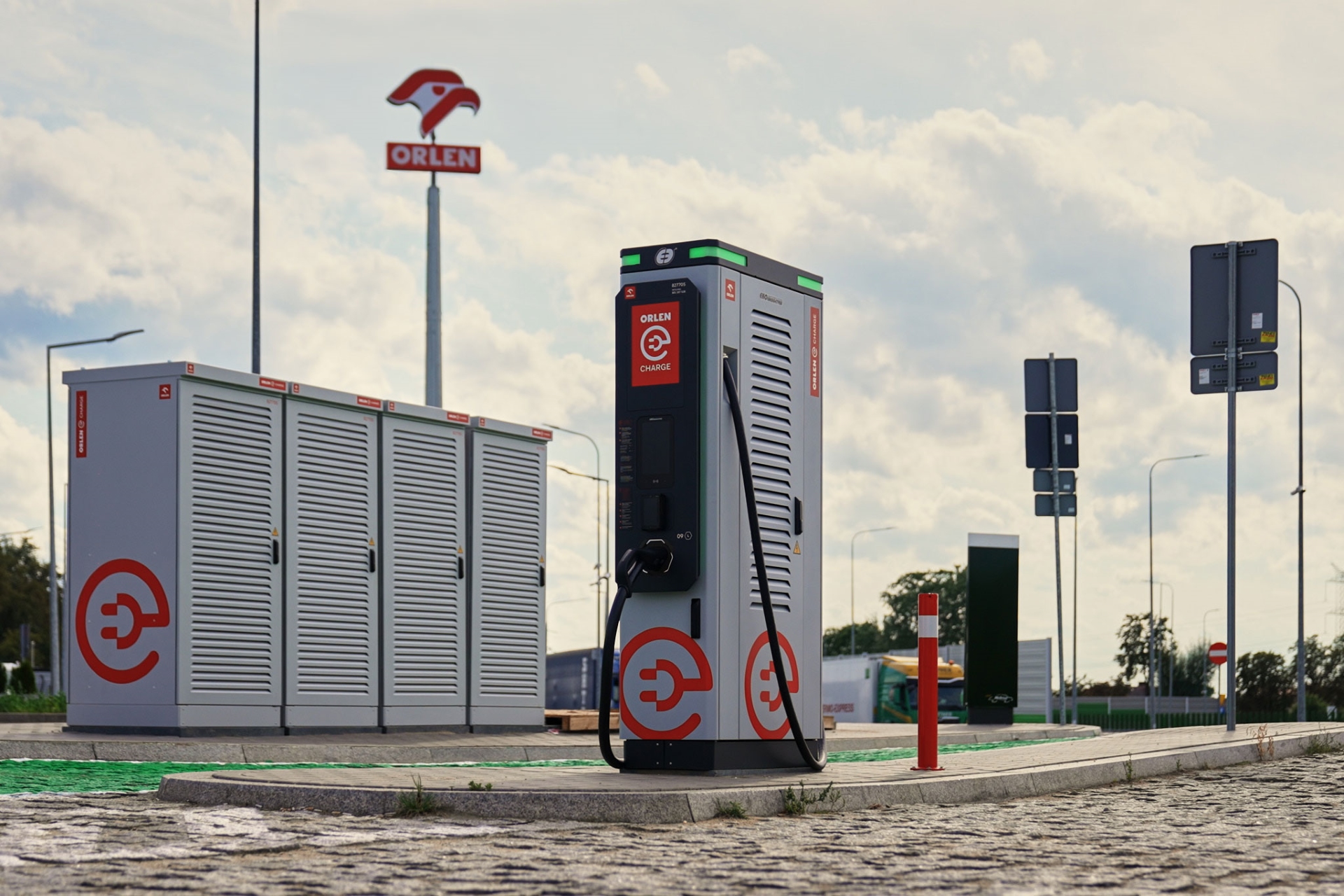
ORLEN is opening a new chapter in electromobility in Poland. The country’s first public MCS charging infrastructure for heavy-duty vehicles, enabling charging at power levels of up to 1.5 MW, has been established along the A1 motorway at the Stobiecko Szlacheckie East and West Service Areas (Łódź Voivodeship). The infrastructure has been launched on both sides of the motorway, increasing its accessibility for carriers traveling in both directions. This investment aligns with market trends, allows transport companies to better plan future fleet electrification investments, and provides an impetus for the development of modern electromobility in Poland.
The launch of Poland’s first public MCS charging infrastructure along the A1 motorway is an important step in the development of electromobility in heavy-duty transport. This pilot solution aligns with upcoming charging standards and will help reduce downtime for heavy-duty vehicles. Furthermore, thanks to high-power infrastructure and the expansion of connector types, transport companies will be able to better plan future investments and adapt fleet electrification to long-haul routes, delivery schedules, and mandatory driver breaks. This solution helps prepare the market for the next stage of sustainable logistics development in Poland.
– says Krzysztof Kaczyński, Executive Director for Electromobility at ORLEN.
For carriers, this means access to infrastructure designed for long-haul routes, where downtime and charging predictability are crucial. The Megawatt Charging System (MCS) is a high-power charging technology designed for heavy-duty vehicles that require significantly more energy than passenger cars. The development of MCS aligns with upcoming heavy-duty transport charging standards in Europe and prepares the infrastructure for the needs of long-haul logistics electrification. Manufacturers are already developing heavy-duty vehicles adapted for MCS standard charging, and the first such solutions are being implemented on the European market.
The first public ORLEN Charge MCS stations have been launched at the Stobiecko Szlacheckie East and Stobiecko Szlacheckie West Service Areas along the A1 motorway, one of the most important transit routes in Poland. The location of the investment was chosen with the development of charging infrastructure along key transport corridors in mind, where the demand for servicing electric heavy-duty vehicles will first emerge. At each of the two locations, on both sides of the A1 motorway, drivers have access to four charging points for passenger cars with a power of up to 400 kW each, and two designated bays prepared for heavy-duty transport: one MCS bay (up to 1.5 MW) with the option to choose a CCS connector (up to 600 kW), and a second, separate CCS bay for heavy-duty vehicles. As a result, the infrastructure can serve both currently available electric heavy-duty vehicles using the CCS standard and models prepared for charging in the MCS standard. This totals eight charging points for passenger cars and four designated bays for heavy-duty vehicles. The chargers are also equipped with an intelligent power management system that monitors and adjusts the amount of energy delivered to individual vehicles, ensuring efficient use of available power even when several vehicles are charging simultaneously.
The investment supports the implementation of the EU’s AFIR regulation. These regulations oblige member states to provide publicly accessible high-power charging infrastructure for heavy-duty vehicles along the most important TEN-T network corridors. This creates the necessary conditions for electric trucks to realistically serve long-haul routes and participate in the daily operations of the logistics sector.
From daily travel to the logistics of the future
ORLEN Charge currently includes nearly 1,400 charging points across Poland. The network operates in cities and along major routes, including at Service Areas.
An important direction for the development of ORLEN Charge is the construction of charging hubs – locations with a larger number of bays, higher power, and greater throughput. Such a solution reduces waiting times, facilitates trip planning, and works better along routes and in high-traffic areas. ORLEN Charge hubs are already operating in, among others, Nowy Dwór Gdański, Gorzów Wielkopolski, Stare Miasto, and Szczecin, as well as along expressways – at the Olsztynek South, Gruczno West, and Barnisław North and South Service Areas.
In parallel, standalone fast-charging stations are being developed, which are appearing in more cities and complementing the network of hubs. According to plans, by the end of 2027, the ORLEN Charge network is set to grow by several dozen new hubs and over a hundred additional standalone stations.
Source: ORLEN