









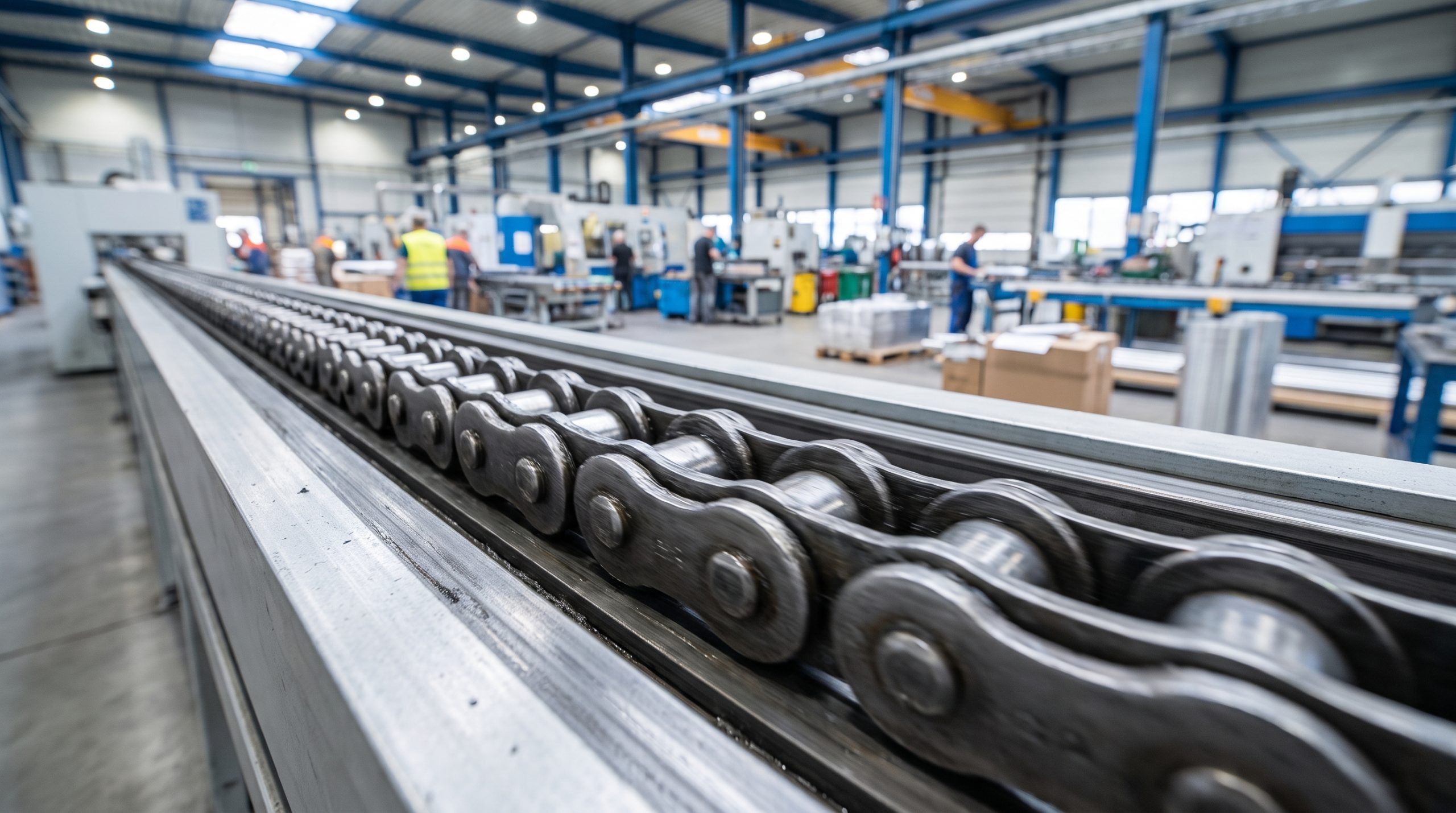
The efficient operation of an industrial plant is the result of dozens of elements – machines, processes, and people. However, it is often the conveyor chain that acts as the link upon which the continuity of the entire production depends. It is therefore worth knowing exactly what it is, how to select it, and how to maintain it to avoid costly breakdowns.
What is a conveyor chain and where is it used?
A conveyor chain is a mechanical element used for power transmission or for moving loads in a continuous or sequential manner. Unlike drive chains, whose main task is to transmit torque between sprockets, conveyor chains are designed to move materials, products, or components along production lines, conveyors, and feeders.
Their application is extremely broad. They can be found in almost all branches of industry:
– Food industry – conveyors for bottles, packaging, product trays – Automotive industry – assembly lines, body and component feeders – Wood and furniture industry – transport of lumber, boards, and finished elements – Logistics and warehousing – sorter systems, pallet conveyors – Ceramic and construction industry – transport of bricks, blocks, tiles – Chemical and pharmaceutical industry – packaging feeders, packaging lines
Each of these industries has its own requirements regarding resistance to temperature, moisture, chemicals, or dynamic loads. This is precisely why there are dozens of types of conveyor chains available on the market – from steel constructions to stainless steel, and even those made of plastics.
Key technical parameters of conveyor chains
Selecting the right chain is not random – it is based on specific technical parameters that determine the durability and reliability of the entire system. Here are the most important ones:
- Chain pitch This is the distance between the centers of two adjacent pins. The pitch must be matched to the sprockets – an error in this regard leads to accelerated wear and vibration.
- Tensile strength Defines the maximum force that the chain can withstand without the risk of breaking. In practice, safety factors are used, usually ranging from 5 to 10 depending on the nature of the loads.
- Material of construction Carbon steel works well in standard conditions. Stainless steel is essential when in contact with water, chemicals, or in the food industry. Plastics offer low weight and corrosion resistance, but at the cost of lower load capacity.
- Type of connections and accessories Conveyor chains can be equipped with various types of attachments, bumpers, guides, or special links that allow for the mounting of equipment. This is a key issue when designing conveyor systems for specific products.
- Resistance to operating conditions Temperature, humidity, the presence of chemical substances, or dust – each of these factors influences the choice of the appropriate material and protective coating.
- Operating speed and dynamic load Chains operating at high speeds require precise balancing and high-quality workmanship to reduce vibration and noise.
How to choose a conveyor chain tailored to your needs?
Choosing the right conveyor chain is a decision that has a direct impact on production efficiency and maintenance costs. It is not worth being guided solely by price – the cheapest product often turns out to be the most expensive solution in the long run.
Before you make a purchasing decision, answer a few key questions:
– What loads will be transported and what is their mass? – In what environmental conditions does the system operate (temperature, humidity, chemicals)? – What is the required transport speed? – Does the system operate in continuous mode or with frequent starts and stops? – What are the overall dimensions of the conveyor and the sprocket?
Answers to these and many other questions must be found before placing an order. A detailed guide on how to choose a conveyor chain? can be found in the dedicated material, which walks you through the entire selection process step by step.
It is also worth remembering that the chain should be treated as part of the entire drive system – sprockets, guides, tensioners, and lubrication are elements just as important as the chain itself. An improperly selected sprocket can destroy even the best chain in a short time.
If you have doubts at any stage, it is worth consulting with an experienced technical office that will analyze your case and propose an optimal solution – not just on paper, but with the real operating conditions of your plant in mind.
Maintenance and replacement of the chain – how to avoid costly downtime
Even the highest quality conveyor chain requires regular maintenance. Neglect in this area leads to accelerated wear, failure, and consequently – unplanned production downtime, which generates real financial losses.
Regular lubrication This is the foundation. A suitable lubricant reduces friction between the links and the pin, protecting the chain from wear and corrosion. The frequency of lubrication depends on the intensity of work and environmental conditions. In the food industry, lubricants approved for food contact (e.g., H1) are used.
Checking chain elongation The chain elongates over time due to wear of the pin-bushing connections. If the elongation exceeds 2–3% of the nominal length (depending on the standard), the chain must be replaced. A chain that is too long begins to work incorrectly with the sprocket, which accelerates the wear of both elements.
Visual inspection and technical audit Regular inspections allow for the detection of link cracks, deformations, jams, or signs of uneven wear. It is best to implement an inspection schedule as a permanent part of the maintenance plan.
Correct chain tension A chain that is too loose vibrates, jumps, and can slip off the sprocket. One that is too tight generates excessive bearing loads and accelerates wear. Proper tension is often an underestimated but very important parameter.
Replacing the entire system Replacing only the chain when the sprockets are very worn is a mistake. Worn sprockets immediately destroy a new chain. Therefore, it is recommended to replace the chain and sprockets at the same time or at least carefully inspect the sprockets before installing a new chain.
Where to find a reliable supplier of conveyor chains?
The quality of a conveyor chain is one thing – product availability, speed of order fulfillment, and technical support are equally important. In industry, every hour counts, and production downtime often costs more than the entire ordered goods.
A good supplier is not just a warehouse with a product catalog. It is a technical partner who:
– understands the specifics of your industry and knows how to advise, not just sell, – offers a wide assortment – various types of chains, sprockets, accessories, and drive system components, – ensures fast fulfillment – because time is of key importance in maintenance, – cares about quality – cooperates with renowned manufacturers and offers products that meet industry standards, – approaches you individually – because every plant is different and requires different solutions.
The Schipolska technical office operates in exactly this way. As an expert in the field of mechanical power transmission elements, the company offers comprehensive service – from technical consulting and the selection of appropriate components to efficient delivery logistics. Schipolska cooperates with renowned manufacturers and provides conveyor chains technically matched to every branch of industry – both for the domestic and foreign markets.
Summary
A conveyor chain is a seemingly simple element, but its correct selection, installation, and maintenance are of fundamental importance for production continuity. Improper parameter selection, neglected maintenance, or delayed replacement are the easiest paths to costly downtime. It is worth investing not only in a good product but also in knowledge and an experienced technical partner – one who will help not only to deliver the chain but also to ensure that it will work exactly as it should.