









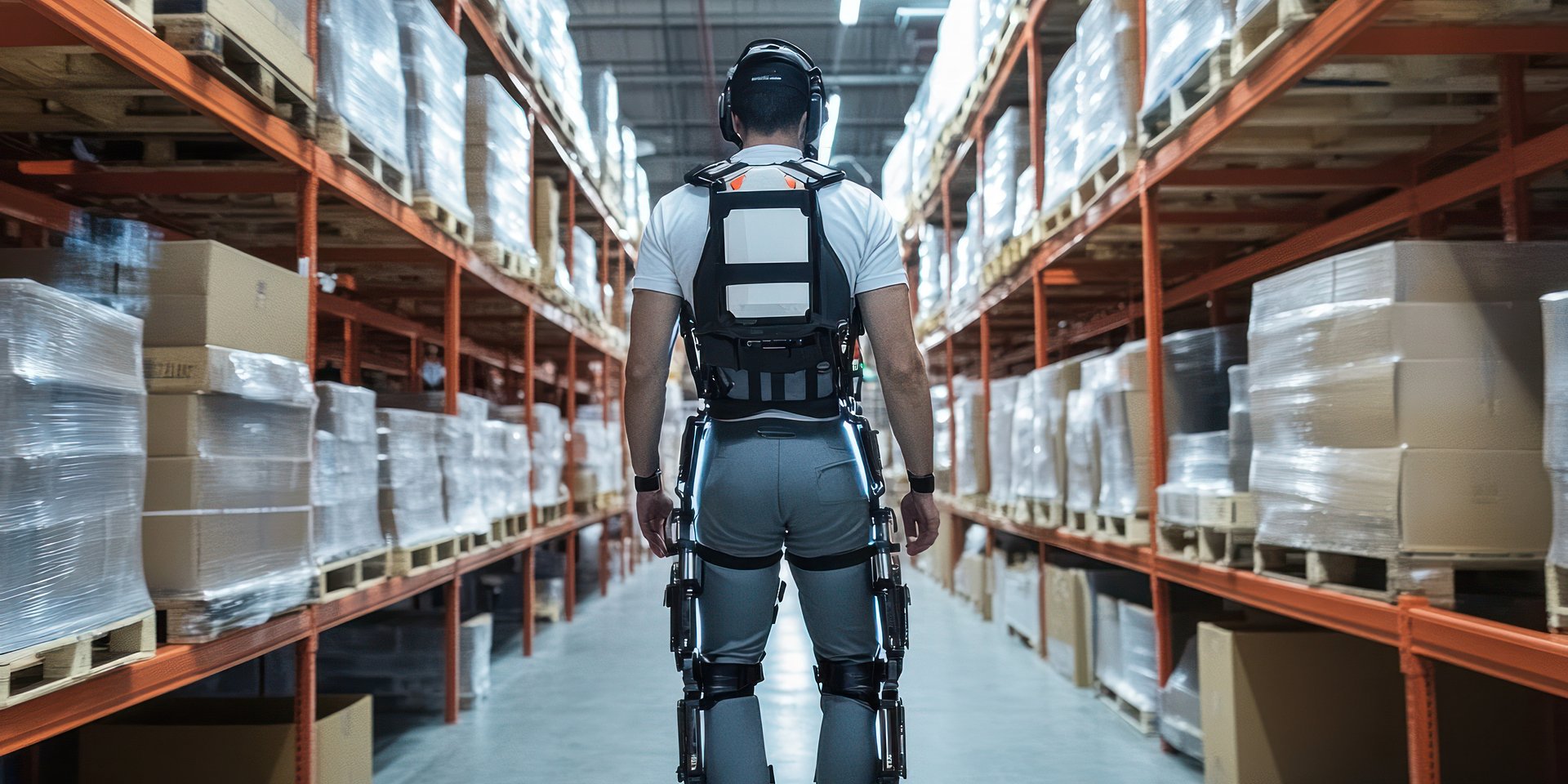
Exoskeletons are increasingly being used in industry, construction, logistics, and other sectors that require intensive physical labor. It is already clear that the development of such support systems can play a significant role in the future of the labor market.
Paradoxically, advancing automation puts people at the center of attention, highlighting the importance of their health and efficiency. The shortage of qualified workers, demographic changes, and the growing number of musculoskeletal disorders are increasing the demand for solutions that support physical work. In response to these challenges, exoskeletons help reduce strain on the spine and muscles, supporting both the prevention of injuries and occupational diseases, as well as maintaining the ability to work for people with existing conditions.
Modern industry is currently struggling with many challenges – a shortage of workers or high turnover, and musculoskeletal disorders that generate huge costs related to sick leave. The construction, logistics, and mechanical industries require personnel to repeatedly lift heavy loads, work in forced positions, or stand for long periods. This is why employers are increasingly looking for solutions that support employees in performing their daily duties, reducing the risk of strain, injury, and long-term health problems.
External exoskeletons, known as “wearable robots,” are gaining popularity as a viable support tool. An example of the dynamic development of this segment in the Polish market is the cooperation between leaders in tool technology and medicine. The Ottobock IX Back Air model we have introduced shows that technology, which until recently was associated with science-fiction films, is becoming a daily work tool for engineers, warehouse workers, and assemblers.
– explains Ewa Paprocka, Product Manager at Würth Polska.
One system, many industries – a new standard for physical work
The application of modern exoskeletons goes far beyond a single, narrow specialization, finding recognition wherever full automation using stationary robots is impossible or economically unjustified. In the construction and interior finishing sector, these devices prove useful during demanding assembly work, moving heavy plasterboard, installing ceiling systems, or long-term work with cumbersome tools such as jackhammers. In logistics and warehousing, where an employee performs hundreds of repetitive bends during a single shift, this technology supports continuous sorting, lifting packages directly from the ground, and efficient loading and unloading of shipments.
Exoskeletons have an equally strong impact on ergonomics in the field of mechanics and the automotive industry. There, they facilitate long-term work on the assembly of heavy engine components or eliminate the discomfort associated with constantly lifting arms. The range of applications is rounded off by heavy industry and advanced manufacturing, where these devices provide invaluable support in operating assembly lines where individual components still require precise manual positioning before final fastening.
When introducing the Ottobock IX Back Air model to our offer, we were guided primarily by market pragmatism and the real needs of companies. Physical workers in Poland lift thousands of tons of goods in total every day, which generates huge health costs. The exoskeleton from the Ottobock line weighs less than three kilograms, does not require an external power supply, and can be put on in a few seconds, and the benefit to the spine is immediate. For a modern manager, investing in such a solution is not an expense, but a hard business calculation – fewer sick leaves, higher productivity, and a strong argument in recruiting new employees.
– emphasizes Ewa Paprocka, Product Manager at Würth Polska.
The economics of ergonomics, or why industry is investing in exoskeletons
Passive support systems, unlike their active, battery-powered counterparts, are characterized by a simple design, reliability, and no need for regular charging.
In our offer, there are two main types of exoskeletons – those supporting the upper limbs and those relieving the back and spine. An example of the first group is the IX Shoulder Air Ottobock model, designed for work performed at shoulder height and overhead, such as installation, service work, or production tasks. The system supports lifting and holding the arms, reducing strain on the shoulder and neck muscles. The IX Back Air model, on the other hand, was designed for employees who frequently lift and carry heavy loads. The exoskeleton relieves the lumbar spine when bending and lifting loads, while maintaining great freedom of movement.
– explains Ewa Paprocka, Product Manager at Würth Polska.
In the face of many market challenges and shrinking human resources, ensuring a safe working environment is becoming one of the main pillars of building a competitive advantage. Companies that are the first to adapt mechanical support technology on their production lines and construction sites will not only minimize the risk of downtime but also gain the status of an employer of choice, for whom employee health is a real value, not just a slogan in a CSR declaration.
Source: Würth Polska